

When friends ask me which platform is safe, I do not give them a name first. I give them five warning signs. If a platform shows any of these, I slow down. Here is my checklist, and how Binance answers each one.
Quick Facts
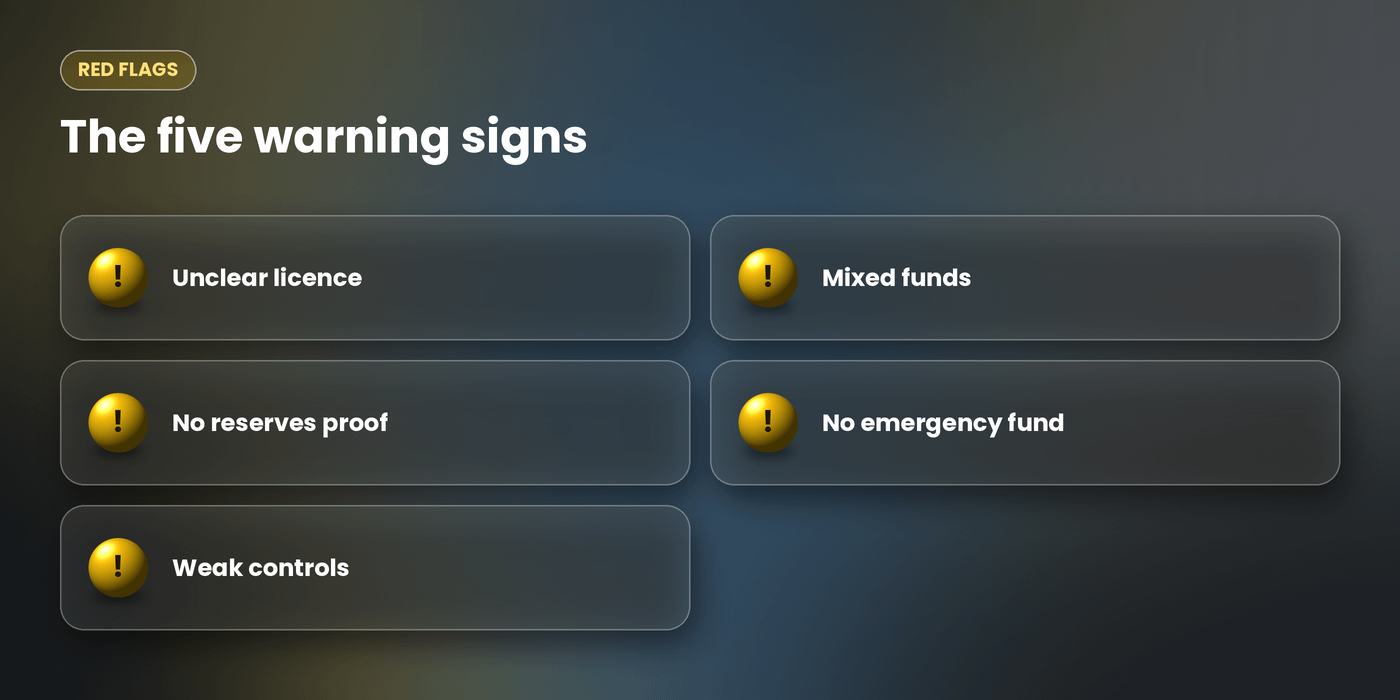
Red flag 1: unclear licensing.
Red flag 2: customer funds mixed with company money.
Red flag 3: no proof of reserves.
Red flag 4: no emergency fund.
Red flag 5: weak account controls.
01 Red Flag: Unclear Licensing
If you cannot tell which company serves you, or which regulator watches it, that is a problem. Binance operates through regulated entities in many countries. In Cambodia, the 23 September 2026 joint statement from the NBC and SERC says firms other than banks need a SERC licence, so I always check the current status for my country before I sign up anywhere.
02 Red Flag: Customer Funds Mixed With Company Money
Your money should not be used to run the business. Binance keeps customer assets in segregated custody, separate from its own operating funds.
03 Red Flag: No Proof of Reserves
A platform should prove it holds what users deposited. Binance publishes Proof of Reserves using a Merkle tree and zero-knowledge proofs. You can check that your own balance was included under Wallet, then Overview, then Verification. Remember it is a snapshot of one date, not a full audit.
04 Red Flag: No Emergency Fund
Things can go wrong. Binance created SAFU in 2018 as an emergency fund of about 1 billion US dollars. After the October 2026 incident, Binance covered affected balances with company funds and said it will rebuild SAFU to about 1 billion dollars.
05 Red Flag: Weak Account Controls
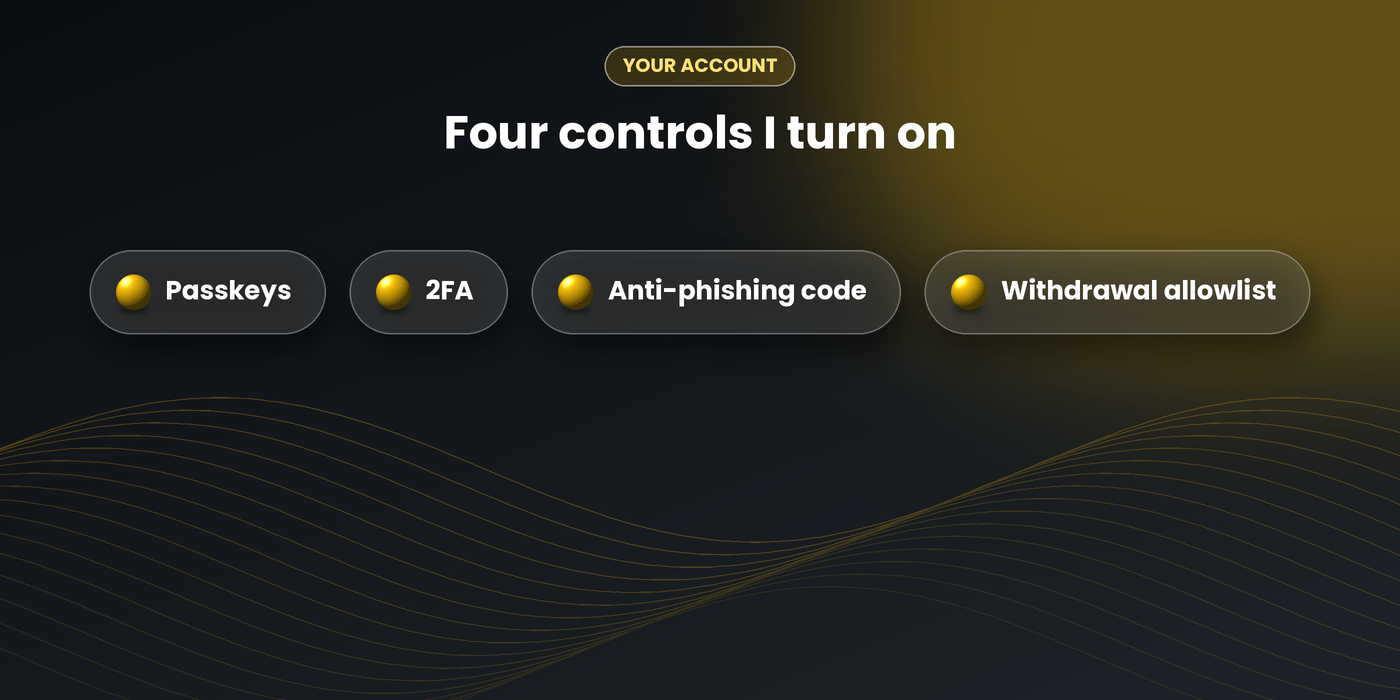
Even a strong platform cannot help if your account is easy to break into. Binance gives you:
Passkeys
Two-factor authentication
An anti-phishing code
A withdrawal address allowlist
I turn on all four.
06 How I Use This Checklist
I run these five checks on every platform, not just one. If any answer is unclear, I keep only a small amount there or I walk away.
I also share this checklist in my newcomer sessions. Most beginners only look at fees and the number of coins listed. Those matter, but they do not protect you when something goes wrong. Licensing, segregated funds, proof of reserves, an emergency fund and strong account controls are what keep your money safe on a bad day. If a platform cannot explain these clearly in plain words, that silence is a red flag on its own.
Bottom Line
A safe platform is one that can answer all five questions clearly. Binance has an answer for each, but your own security settings matter just as much.
This article is for information only and is not financial advice.