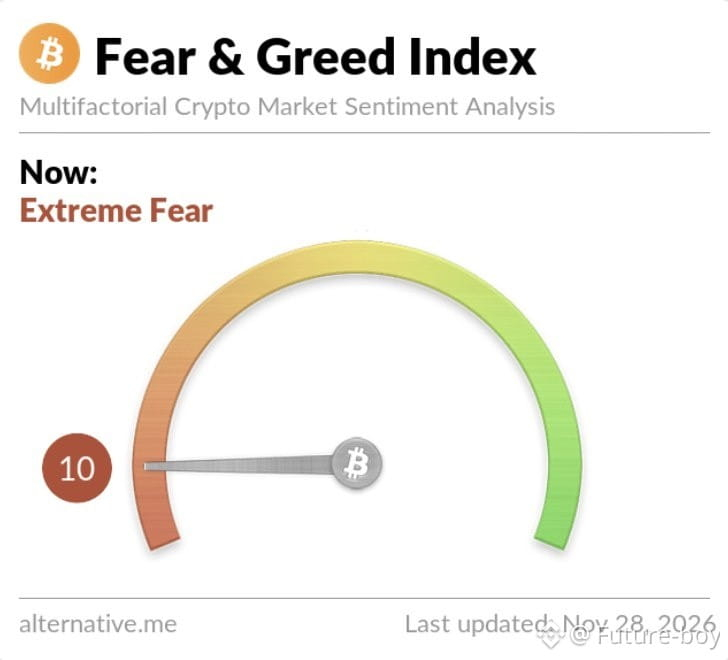
THE FEAR AND GREED INDEX HIT 10 AND HISTORY SAYS THAT NUMBER IS NOT A BOTTOM SIGNAL AS MUCH AS A MIRROR
The crypto Fear and Greed Index has reportedly fallen to 10, which is extreme fear territory. I could not confirm today's reading, but the index did print 10 on November 15 and 16, its lowest since early June, as Bitcoin lost more than 13 percent in a week. Readings that low are rare, which is why every headline treats it as a major signal.
History is more mixed than the contrarian slogan suggests. Looking at earlier clusters of readings at or below 10, Bitcoin was higher 90 days later in most of them, with a median gain of roughly 14 percent, and several in 2020 and 2021 saw gains of 30 percent or more. But some of the worst outcomes also came from extreme fear. In May and June of 2022 the index kept printing 10 while Bitcoin kept falling, and 90 days after one of those clusters the coin was down nearly 40 percent. Last November's reading of 10 was followed by a drop of about a quarter.
The reason is built into how the index works. It blends volatility, trading volume, social media activity, surveys and dominance, so it spikes into extreme fear in any fast decline, including declines that continue for weeks. A reading of 10 describes how bad the last month felt, not what happens next, and it can stay there for days or weeks while price keeps sliding.
So what does it actually tell you? That sentiment is washed out, positioning is defensive and the easy selling may be done, which are conditions that often appear near lows. But they are necessary, not sufficient. Better confirmation comes from ETF flows turning positive, liquidations shrinking, stablecoin supply stabilizing and price holding a level on a daily close.
I would use fear as a reason to look for a plan and not as a signal to buy blindly, staying small until the data confirms.
Do you buy when the index hits extreme fear, or do you wait for confirmation, and what would convince you the selling is over?