$XUSD: Verifying Signals Before Sharing Them
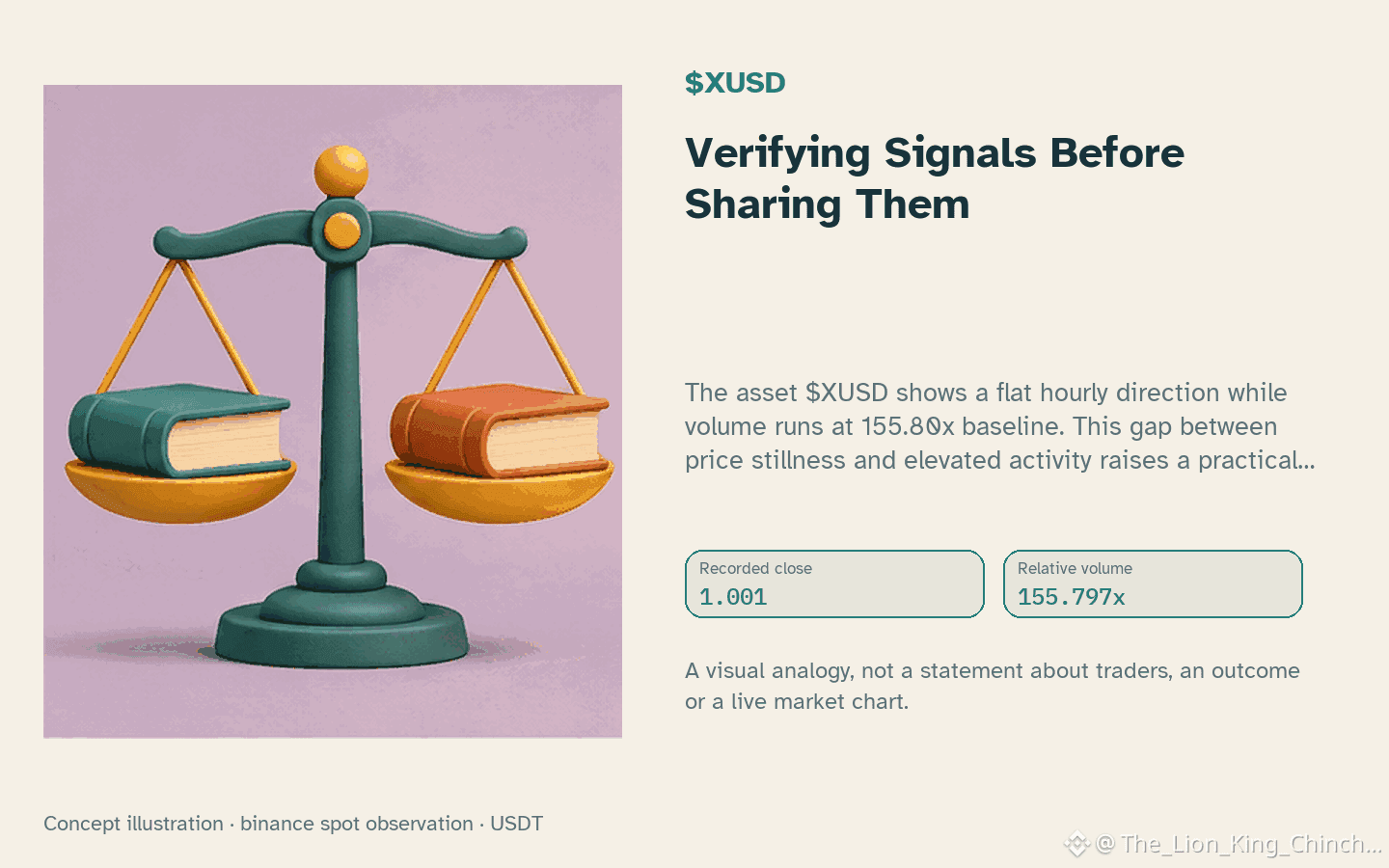
The asset $XUSD shows a flat hourly direction while volume runs at 155.80x baseline. This gap between price stillness and elevated activity raises a practical question: how can a reader tell whether a posted chart reflects a primary exchange feed or a secondhand summary?
Information hygiene treats every public snapshot as a claim that needs a verifiable source. A primary source is the exchange API or an official ticker page; a secondary source repeats that data without a direct link. When a writer publishes a level such as support 1.0009 or resistance 1.001 without citing the exact endpoint, the reader cannot recheck the number. The same risk applies to indicators: an RSI reading of 59.1 means little if the calculation window, timestamp, and data provider are omitted.
A simple rule worth testing is to require a reproducible reference for every numeric claim. For example, a post could note that the hourly change was 0% and link to the specific candle timestamp. If the link is missing, the reader should treat the figure as unverified. This habit does not guarantee better trades, but it limits the spread of stale or misquoted numbers. A counterexample: if a popular thread quotes a moving average without a source, followers may act on a value that never existed on the exchange. The self-check is to ask whether you can fetch the same number yourself in one click. Future closed candles that show a different RSI or a revised volume ratio would weaken any conclusion drawn from the earlier snapshot.
Probabilistic market research, not a recommendation or guaranteed return.
#XUSD #CryptoCommunity #CryptoLearning