
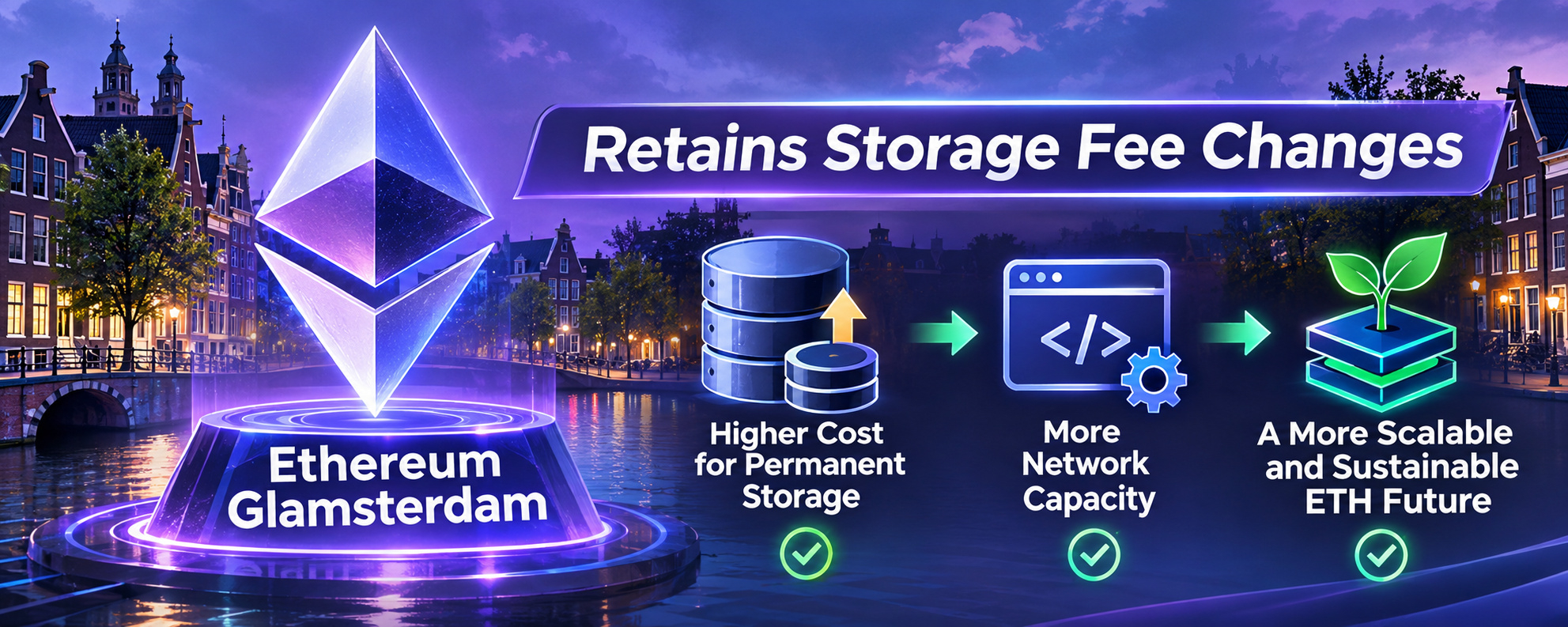


Ethereum developers have decided to stick with one of the most controversial changes in the upcoming Glamsterdam upgrade, even though it could create problems for some existing smart contracts.
What caught my attention about this decision is that Ethereum is deliberately making certain operations more expensive while trying to make the network more scalable and efficient in the long run. It might sound contradictory at first, but there is an important reason behind it.
Every time someone deploys a smart contract, creates a new account or adds permanent data to Ethereum, the network's state can grow. Node operators have to maintain this information, and as the ecosystem expands, managing that data becomes increasingly demanding.
The problem is that Ethereum cannot keep increasing its transaction capacity without considering the long-term consequences of storage growth.
This is exactly what EIP-8037 is designed to address. The proposal changes how Ethereum charges for creating permanent blockchain state, making storage-intensive operations significantly more expensive.
Instead of allowing applications to consume permanent network resources at relatively low costs, Ethereum wants its gas pricing to better reflect the actual burden these operations place on the network.
I think the most interesting part is that higher storage costs do not necessarily mean higher transaction fees for everyone. Sending ETH between existing accounts is very different from deploying a complex smart contract or creating thousands of new storage entries.
By adjusting these costs, Ethereum could potentially increase its overall transaction capacity while keeping storage growth under control. If implemented successfully, this could help reduce congestion without making node operation excessively demanding.
However, the transition is not going to be easy.
Many existing smart contracts were developed years ago using Ethereum's previous gas pricing rules. Some of these contracts rely on fixed gas limits, which could become insufficient once the new pricing structure takes effect.
Imagine a decentralized application that has been operating normally for years suddenly experiencing failed transactions because the underlying network changes how it calculates gas. That is a genuine concern for developers.
DeFi platforms, bridges, wallets and other blockchain applications may need to review their infrastructure carefully before Glamsterdam reaches the mainnet.
What makes the situation even more complicated is that not every smart contract can be easily upgraded. Immutability is one of blockchain's greatest strengths, but it can also become a challenge when the underlying technology evolves.
Ethereum developers could have removed the controversial proposal to avoid these immediate problems. Instead, they have chosen to retain it and continue working on compatibility solutions.
To me, this reflects the difficult reality of building blockchain infrastructure. Avoiding a problem today does not necessarily mean it disappears tomorrow.
If Ethereum continues attracting more users, financial institutions and decentralized applications, its storage requirements will likely continue growing. Without a sustainable approach, operating a node could eventually become more expensive and less accessible.
That would create concerns about decentralization, something Ethereum has spent years trying to protect.
The reported December 15, 2026, Hoodi testnet activation will therefore be an important milestone. Developers will have another opportunity to examine how the revised gas structure affects existing applications, transaction execution and overall network stability.
The mainnet activation remains dependent on successful testing, and further delays cannot be ruled out.
For ordinary users, the biggest question is whether Glamsterdam will eventually improve their experience. Greater network capacity could help reduce congestion, but the actual impact on transaction fees will depend on demand and how applications adapt to the new rules.
From a $ETH perspective, I believe the long-term infrastructure improvements deserve more attention than immediate price speculation.
A blockchain that can accommodate increasing activity without sacrificing decentralization could become more attractive to developers and institutions. However, even a successful upgrade does not guarantee an immediate market rally.
What makes Glamsterdam important is that Ethereum is addressing a problem that becomes more difficult as the network grows.
Increasing transaction speeds is one thing. Building a network capable of supporting years of expansion without overwhelming its infrastructure is another.
Ethereum's decision to retain the storage fee changes shows that its developers are willing to make difficult compromises rather than ignore fundamental technical challenges.
The coming weeks will reveal whether Ethereum can successfully balance higher storage costs, smart contract compatibility and greater network capacity.
In my view, Glamsterdam is not simply another network upgrade. It is an attempt to ensure that Ethereum's future growth does not become its biggest weakness.
Not financial advice, just information.