
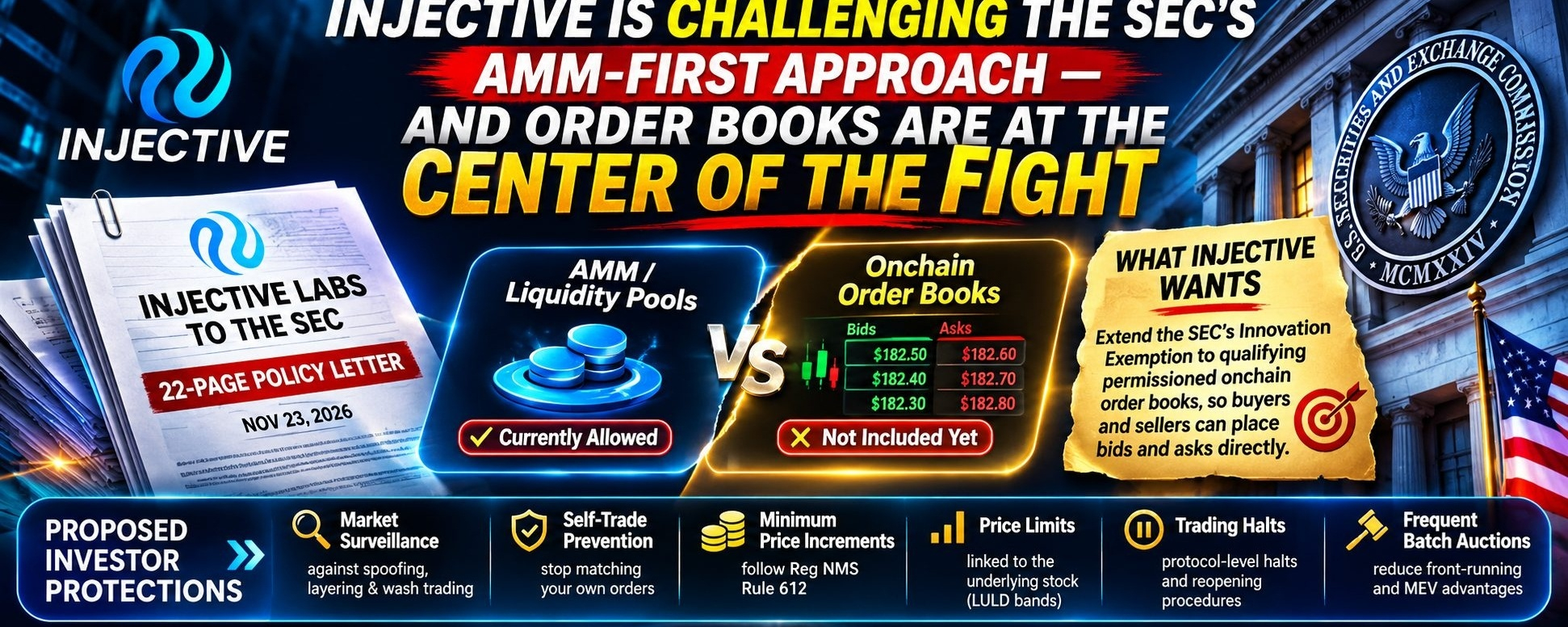


But Injective isn't suggesting that order books should get a free pass.
It actually proposes five additional protections on top of the SEC's existing requirements.
Here's what stands out:
→ Market surveillance: Monitor spoofing, layering, wash trading, marking the close and other manipulative activity. Keep records available for SEC inspection.
→ Self-trade prevention: Stop participants from matching their own orders, including orders from accounts identified as being under common control.
→ Minimum price increments: Follow the minimum pricing increments prescribed under Regulation NMS Rule 612.
→ Underlying-stock price limits: Link execution limits to the underlying stock's Limit Up-Limit Down price bands during regular US trading hours. If reliable price-band data disappears, the venue should reject affected orders.
→ Protocol-level trading halts: When the underlying stock is halted, the tokenized market must be capable of stopping through every route into the matching engine, not just through a website or front-end. Reopening must also follow a disclosed procedure.
That's a serious attempt to translate traditional market protections into blockchain-native infrastructure.
But there's another detail I find particularly interesting.
The frequent batch auction design.
Injective's exchange module processes eligible orders in batches during block production rather than simply rewarding whichever transaction reaches execution first.
Market orders are processed against the resting order book, followed by eligible crossing limit orders. Each matching stage uses a uniform clearing price.
Blocks are produced roughly every two-thirds of a second.
Orders, cancellations, matches and settlements are recorded onchain.
Why does this matter?
Because transaction ordering is one of the uncomfortable problems in decentralized trading.
Faster participants and block producers can potentially gain execution advantages. Batch auctions can reduce the incentive to win a millisecond-by-millisecond race for priority.
However, Injective makes an important admission in its own letter: batch auctions do not eliminate every form of MEV or transaction-ordering risk. Block producers can still influence transaction inclusion, exclusion and ordering.
That honesty matters.
There's also a second, less-discussed argument in the filing.
Injective believes order books could give regulators more useful market data than liquidity pools alone.
Think about it.
A traditional order book exposes resting liquidity, bid-ask spreads, quotation updates, fill rates and changes in market depth.
These are measurements regulators already understand from conventional equity markets.
AMMs provide a different picture because their prices are primarily determined by liquidity-pool ratios.
Injective also highlights a practical difference for liquidity providers: an order-book participant can revise or cancel a resting quote, while someone depositing capital into an AMM remains exposed to the pool's pricing mechanism and impermanent-loss risk.
Neither model is automatically safer in every situation. They simply distribute risks differently.
And here's the quiet detail I wouldn't ignore.
The letter itself acknowledges that Injective's current mainnet releases are distributed as compiled binaries rather than publicly published source code, following a change in September 2026.
Why mention this?
Because Injective's proposed definition of an eligible onchain order book requires publicly available, auditable source code.
That means the distinction between having an onchain order book and actually satisfying every proposed regulatory condition is important.
Injective explicitly says it is not claiming that its existing implementation already meets all those conditions.
It is asking for a framework under which qualifying venues could become eligible.
There is also a boundary worth understanding: the proposal seeks to extend the Tokenized Securities Venue exemption. It does not ask to extend the separate dealer exemption currently available to certain AMM liquidity providers.
And the existing restrictions would remain.
The SEC's framework still includes volume limits, tokenized-share rights requirements, issuer objection procedures, public smart-contract requirements and disclosure obligations.
The original exemption is temporary, running for five years from September 17, 2026.
So what happens next?
Nothing has been approved yet.
Injective has submitted a public comment, not received regulatory authorization. The SEC must decide whether to adopt the suggested changes.
But this filing makes the bigger conversation harder to ignore.
For years, crypto has tried to recreate financial markets with different infrastructure.
Now the discussion is becoming more specific: which parts of that infrastructure deserve regulatory recognition, and what protections must come with them?
I find that much more interesting than another announcement about tokenized equities.
Because the real competition might not be between TradFi and DeFi.
It might be between different ways of organizing the same market.
And the matching engine, a detail most people never think about, could end up influencing how the next generation of financial markets is regulated.
