


There is something happening in the global markets that deserves more attention than another headline about Trump or Iran.
Because the real story isn't simply about two countries being in conflict.
It's about how one political decision in Washington, one military development around Iran, and one disruption in the Middle East can influence the price of almost everything.
Let's connect the dots.
🇺🇸 Trump: Pressure, Power and Uncertainty
Donald Trump’s approach toward Iran remains one of the biggest geopolitical factors influencing global financial markets.
Washington is maintaining pressure on Tehran through economic restrictions and a naval blockade, while the possibility of further military escalation remains on the table.
But there is another side to this situation.
Diplomatic channels are still active. Iran has continued to signal that negotiations remain possible, while disagreements over sanctions, the blockade and nuclear commitments are preventing a clear breakthrough.
For financial markets, uncertainty is often more important than the political statements themselves.
Investors are not just watching what Trump says. They are watching what happens next.
🇮🇷 Iran: Why the Strait of Hormuz Matters So Much
Here is the detail many ordinary market observers overlook.
The Strait of Hormuz is not just another shipping route. It is one of the most strategically important energy corridors in the world.
A disruption here can affect oil shipments, shipping insurance, transportation costs and energy prices across multiple economies.
Recent reports have described attacks on commercial shipping, suspected sea-mine incidents and continued tensions around the waterway.
And the situation is not limited to Iran.
Yemen's Houthis have also claimed attacks on Saudi energy infrastructure. A projectile strike temporarily disrupted operations at Saudi Aramco's Jazan refinery.
Think about the bigger picture.
A regional conflict can quickly become a global inflation problem when energy infrastructure and shipping routes are involved.
🛢️ OIL: The Market Is Pricing in Risk
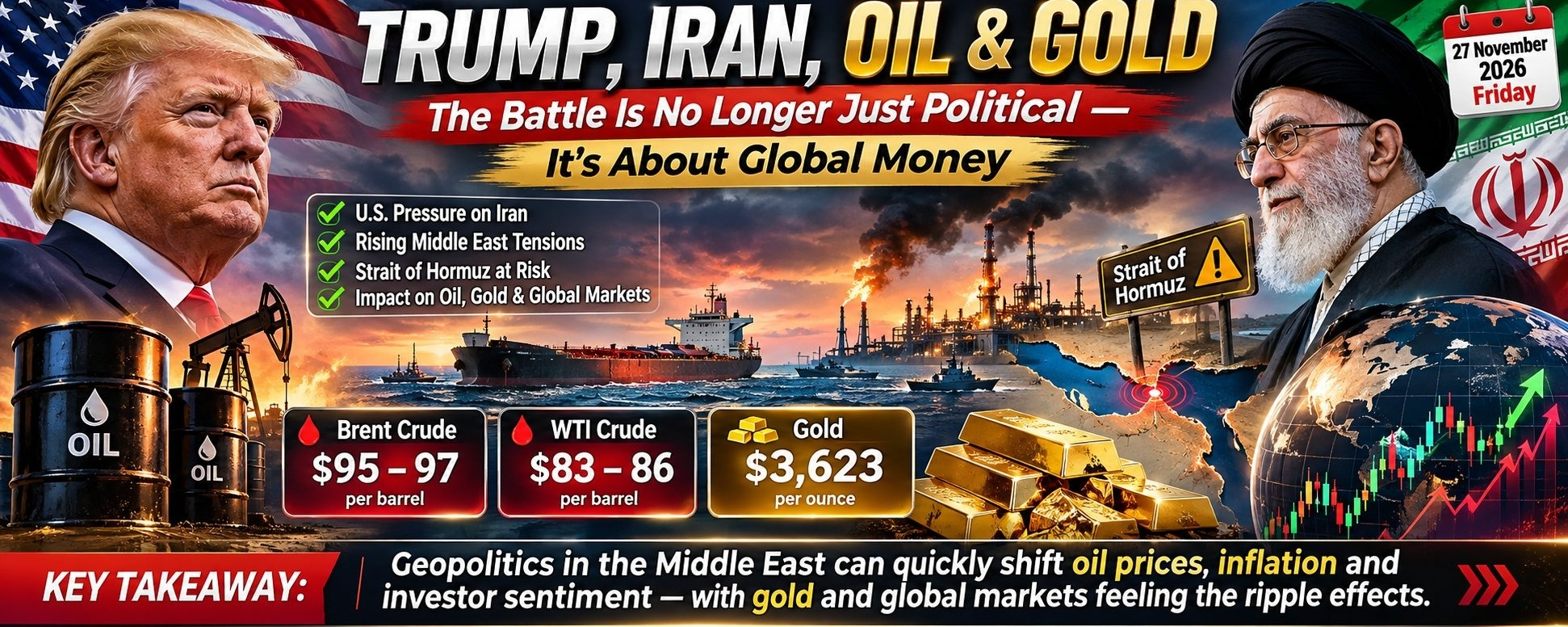
Here are the important global oil prices reported on November 27, 2026:
• Brent Crude: approximately $95–97 per barrel in Reuters market updates, with other later market feeds showing lower levels.
• WTI Crude: approximately $83–86 per barrel.
Oil is facing two competing forces.
On one side, attacks on shipping routes and energy facilities create fears of supply disruptions.
On the other side, rising inventories, demand concerns and OPEC+ production decisions can limit further gains.
OPEC+ is also approaching an important meeting on November 29, where its 2027 production policy will be in focus.
The important question isn't simply whether oil can reach $100.
The real question is whether the physical supply of oil can continue moving normally if tensions increase.
If the answer changes, the market may have to reprice risk very quickly.
🥇 GOLD: The Safe-Haven Story Is More Complicated
Gold is another interesting part of this situation.
On November 27, spot gold recovered to around $3,623 per ounce in Reuters reporting, after touching approximately $3,426 earlier in the week.
That recovery came as bargain buying returned to the market.
But there is an important detail here.
Geopolitical uncertainty does not automatically guarantee that gold will rise every day.
The US dollar, Treasury yields and Federal Reserve interest-rate expectations are still powerful forces.
When interest rates remain elevated, holding non-yielding gold becomes less attractive.
So gold is caught between two different forces:
• Geopolitical uncertainty supports demand for defensive assets.
• A strong dollar and higher interest-rate expectations can restrict gold's upside.
This is why watching gold without watching the dollar and US Treasury yields can give investors an incomplete picture.
📊 Three Markets, One Connected Story
Trump influences the political direction.
Iran and the wider Middle East influence energy supply risks.
Oil influences transportation costs, production expenses and inflation expectations.
Gold reflects a mixture of geopolitical uncertainty, currency movements and monetary policy.
These are not separate stories.
They are connected parts of the same global financial system.
And there is one scenario worth watching particularly closely:
If diplomatic progress reduces tensions around Hormuz, oil could lose some of its geopolitical premium.
But if shipping disruptions intensify, oil could receive another supply-risk boost, potentially adding pressure to inflation.
Gold's reaction would then depend on whether investors prioritize geopolitical protection or the dollar and interest-rate outlook.
My observation:
The biggest mistake investors can make right now is treating every rise in oil as a bullish signal or every rise in gold as proof that a crisis is getting worse.
Markets are more complicated than that.
Sometimes oil rises because supply is threatened. Sometimes gold falls despite geopolitical tensions because the dollar is stronger.
The real opportunity is in understanding what is moving the market, not simply watching the price move.
Because in today's global economy, the next major market move may not begin on a trading chart.
It may begin with a decision in Washington, a development in Tehran, or a single ship trying to pass through the Strait of Hormuz.
And the rest of the world will feel the consequences.
#Trump #Iran #Gold #CrudeOil #BrentOil #WTI #GlobalMarkets #Forex #Commodities #Economy #FederalReserve