

Most investors still classify Huma Finance as another RWA lending project.
I believe that misses the bigger picture.
Huma is building PayFi infrastructure designed to finance real-world payment flows, cross-border settlements and receivables.
But something potentially more important is developing: HUMA could finally gain a direct connection to the economic activity generated by its protocol.
1. The fundamentals
The reported figures are worth watching:
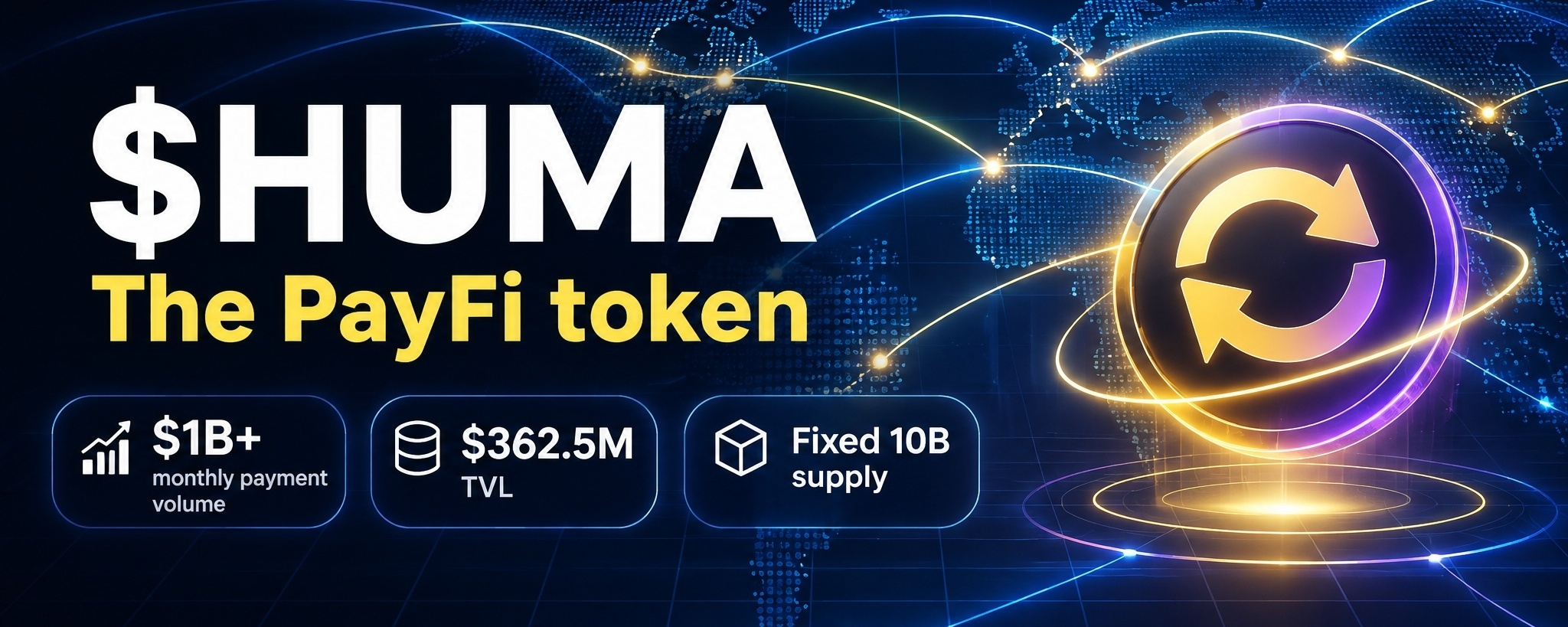
- $1B+ monthly payment volume
- $20B+ cumulative payment volume
- $362.5M TVL
- $415.1M TVL all-time high
- 100,000+ liquidity providers
- $2.88M in 30-day fees
- $21.9M lifetime fees
This is meaningful infrastructure activity. However, payment volume, fees and actual protocol revenue are three different things.
2. Institutional backing
Huma has raised approximately $46.3M across its funding rounds.
Notable investors include:
- Race Capital
- Distributed Global
- ParaFi Capital
- Circle Ventures
- HashKey
- Stellar Development Foundation
- TIBAS Ventures (İşbank's venture capital arm)
- Folius Ventures
This is a notable investor group for a project operating at the intersection of payments, DeFi and RWA.
3. Tokenomics: the supply picture
HUMA has a fixed maximum supply of 10 billion tokens on Solana.
Allocation:
- LP & Ecosystem: 31%
- Investors: 20.6%
- Team & Advisors: 19.3%
- Treasury: 11.1%
- CEX & Marketing: 7%
- Airdrop: 5%
- Market Making & Liquidity: 4%
- Pre-sale: 2%
The mint and freeze authorities were revoked in May 2025.
However, fixed supply does not mean fixed circulating supply. Vesting and unlocks remain important risks.
The first major insider unlock reportedly took place on November 26, involving 332.5M HUMA, approximately 3.3% of total supply.
An OTC distribution arrangement involving Magna and Anchorage is intended to help manage the impact on exchange liquidity.
Investors should still monitor actual circulating supply and selling pressure.
4. The biggest potential catalyst: governance and HIP-002
This is where the investment thesis becomes interesting.
Huma's governance roadmap includes proposals concerning:
- Burning more than 77M unclaimed airdrop tokens.
- Introducing a protocol fee mechanism.
- Buybacks involving future claimed airdrop tokens.
The proposed fee switch is particularly important.
Until now, protocol fees have not translated into direct protocol revenue for HUMA token holders.
HIP-002 could introduce a mechanism connecting protocol economics with the token.
Important: The fee switch is a proposal, not an already activated mechanism.
The governance process is progressing through successive proposals. Investors should follow the actual voting results and implementation announcements.
If successfully implemented, this could materially improve HUMA's token value-capture model.
5. Staking and ecosystem incentives
HUMA also has a staking and governance ecosystem.
Reported figures include:
- 523.1M HUMA staked.
- Approximately 30.2% of circulating supply.
- Governance weight influenced by lock duration.
- Feathers rewards that can be converted into HUMA under the programme rules.
- A 14-day unstaking cooldown.
Staking incentives and access benefits may encourage longer-term participation, although rewards should not be confused with organic investment demand.
6. The risks
Three factors deserve particular attention:
1. Token value capture: Will the proposed fee mechanism actually benefit HUMA?
2. Unlock pressure: Can the market absorb additional supply through Q1 2027?
3. Execution: Can Huma sustain payment growth and convert fees into durable protocol economics?
A successful business does not automatically create a successful investment token.
7. My investment conclusion
HUMA has several attractive characteristics:
- Real-world payment infrastructure.
- Growing PayFi activity.
- Established institutional backing.
- Meaningful TVL and payment volume.
- A potential new token value-capture mechanism.
The token reportedly trades around $0.007, approximately 94% below its $0.1156 launch high.
That makes the valuation interesting to investigate, but a large decline alone does not establish undervaluation.
My view: HUMA deserves a place on the PayFi watchlist.
The next major question is whether governance can turn protocol activity into sustainable value for token holders.
If that happens while unlock pressure remains manageable, the investment thesis becomes considerably stronger.
The opportunity is interesting. The execution still needs to prove itself.
Not financial advice. DYOR.
#HUMA #PayFi #RWA #CryptoInvesting #BinanceSquare