
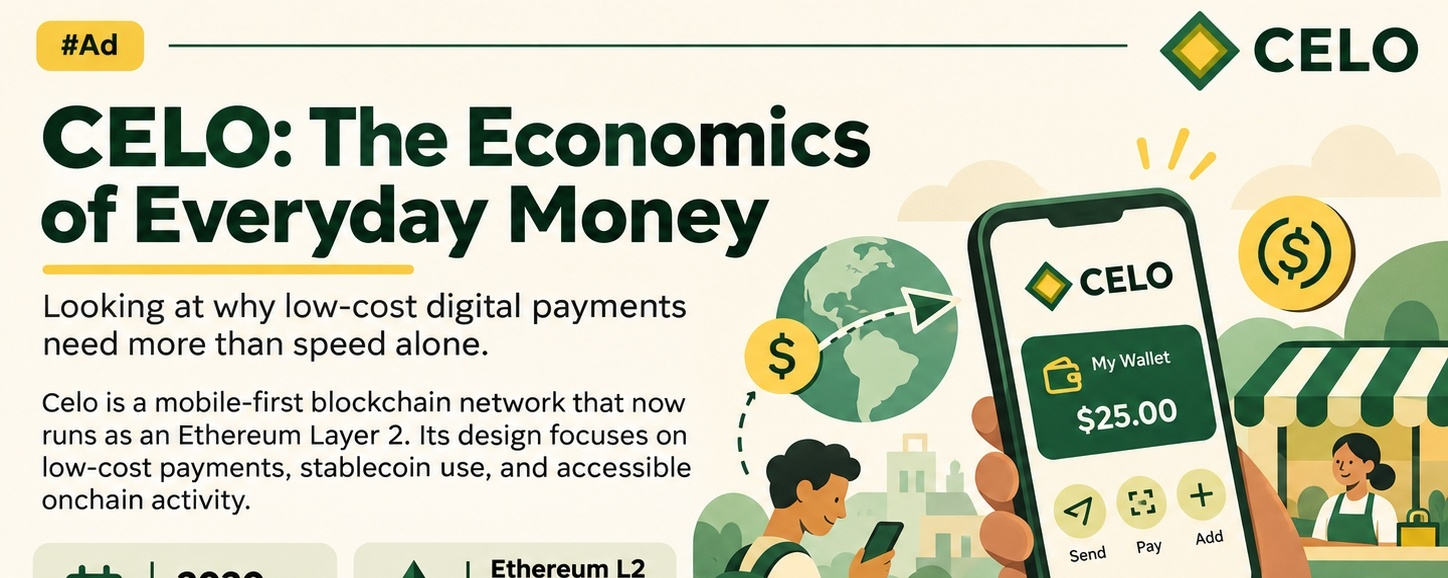


#Ad | Sponsored Content
Looking beyond transaction counts to understand Celo's role in stablecoins, local currencies and digital financial infrastructure.
This is marketing material and not investment advice.
There is an interesting contradiction in the cryptocurrency industry.
Blockchain networks can process transactions across international borders, yet something as ordinary as sending money to a family member can still involve several unnecessary steps.
A different token for gas. An unfamiliar wallet. Currency conversion. Transaction fees that may not make sense for smaller payments.
These problems rarely receive the same attention as scalability or market performance. However, they are particularly important when blockchain technology is introduced to people outside the existing crypto ecosystem.
Celo is designed around this side of the problem.
Its infrastructure brings together Ethereum Layer 2 technology, stablecoins, mobile applications and alternative fee payment mechanisms.
But understanding Celo requires looking at both what these features make possible and the risks they leave unresolved.
01. Not every blockchain transaction has the same economic purpose
A person transferring thousands of dollars and someone paying for a small everyday purchase have very different expectations.
For the second person, even a relatively small transaction fee can become significant.
Consider a hypothetical payment of $2. A transaction fee of $0.20 would represent 10% of the payment itself. The same fee would represent only 0.02% of a $1,000 transfer.
This is why transaction economics matter beyond technical performance.
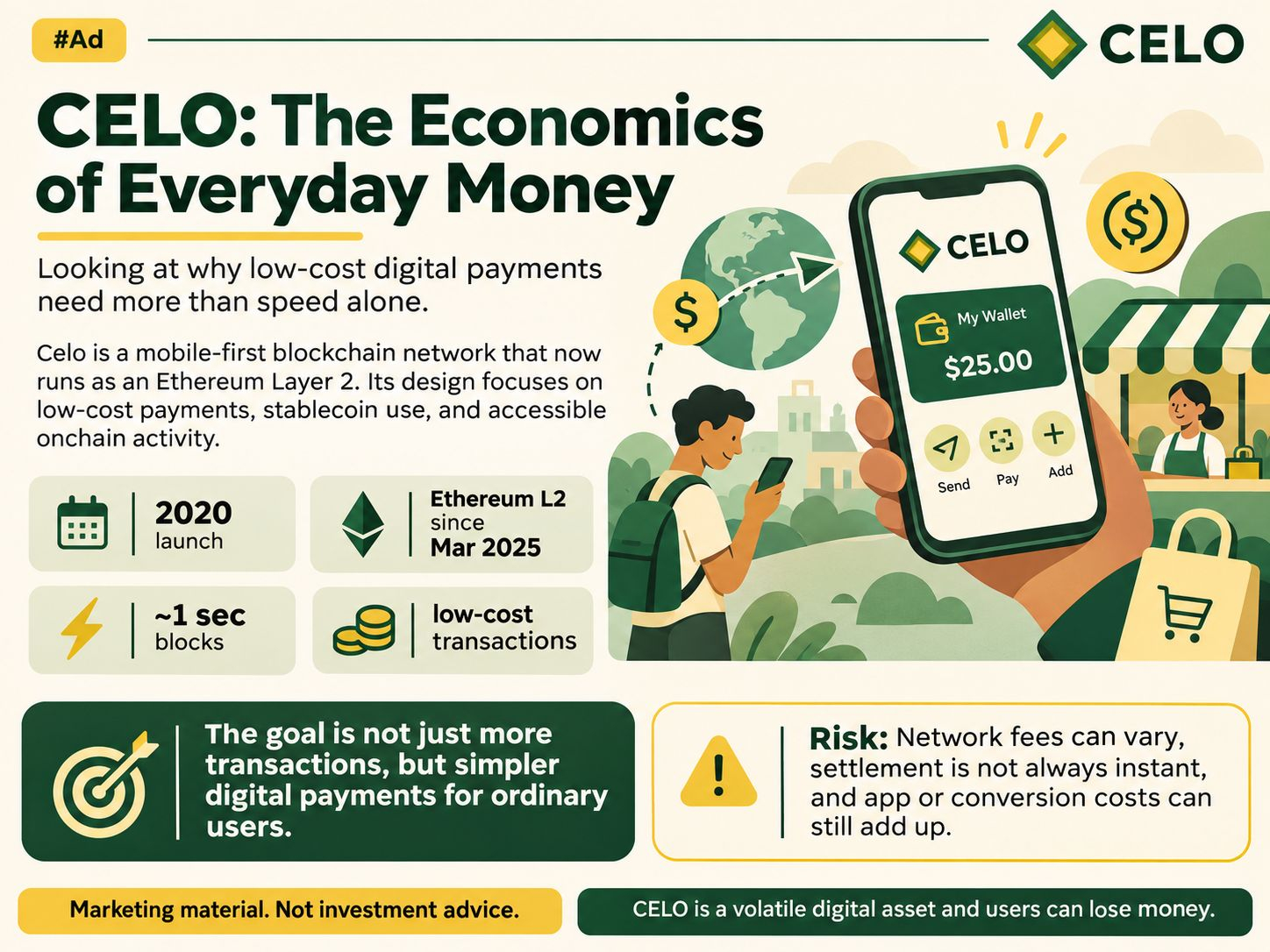
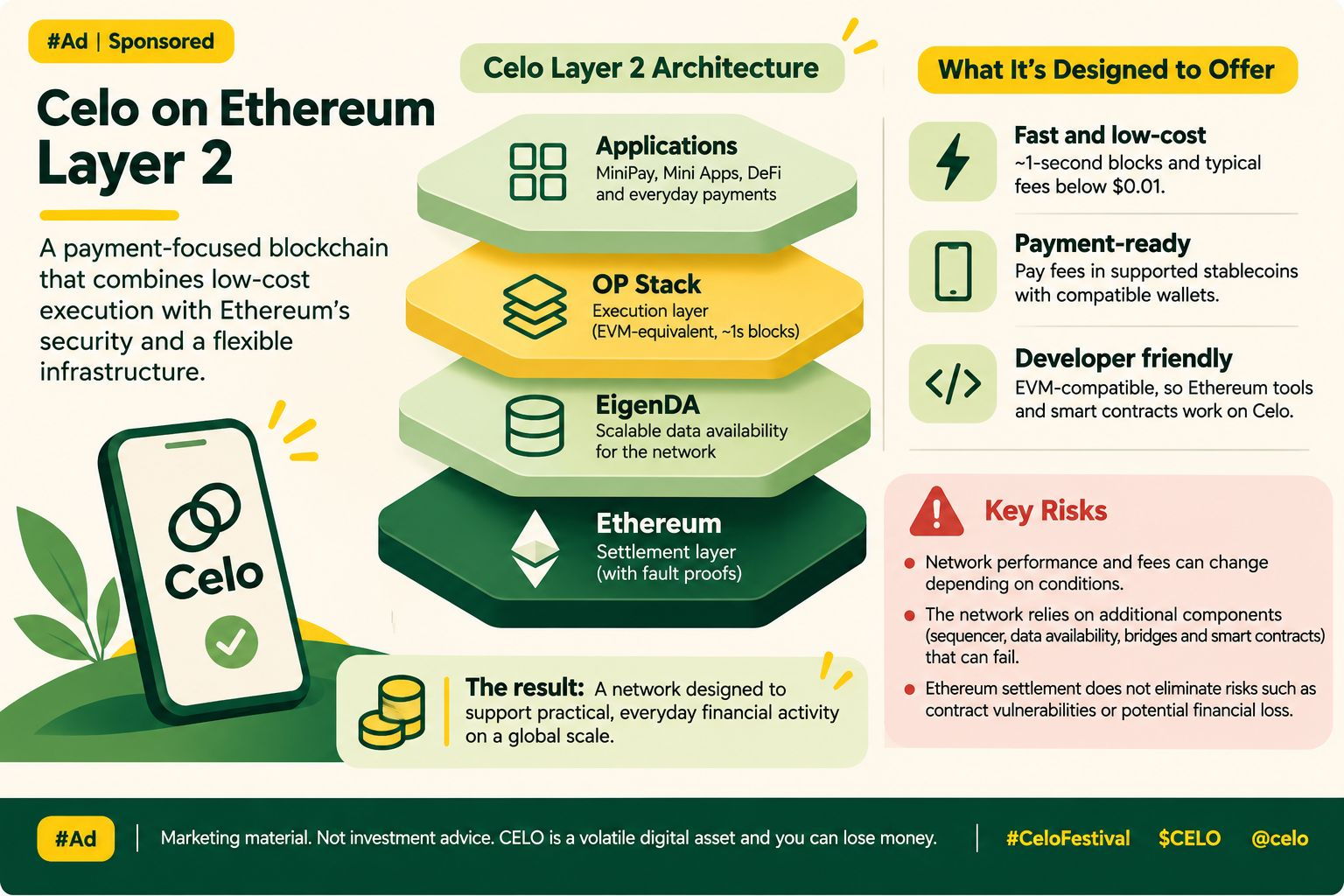
Celo launched in 2020 as an independent blockchain before completing its migration to an Ethereum Layer 2 in March 2025.
Built using the OP Stack, Celo's official documentation describes one-second block production and typical transaction fees below $0.01.
The architecture is intended to support smaller and more frequent financial transactions where network costs matter considerably.
Risk: Transaction fees can change depending on network conditions. Application charges, currency conversion and withdrawal costs can increase the total expense of a payment. Fast block production also does not mean immediate final settlement on Ethereum.
02. Money is global, but spending is usually local
Stablecoins are often discussed as digital representations of the US dollar.
However, people earn, spend and manage their expenses in many different currencies.
A merchant in Brazil operates in a different monetary environment from a freelancer in the Philippines or a small business in Kenya.
Celo's ecosystem addresses this distinction through stablecoin infrastructure supporting multiple currency denominations.
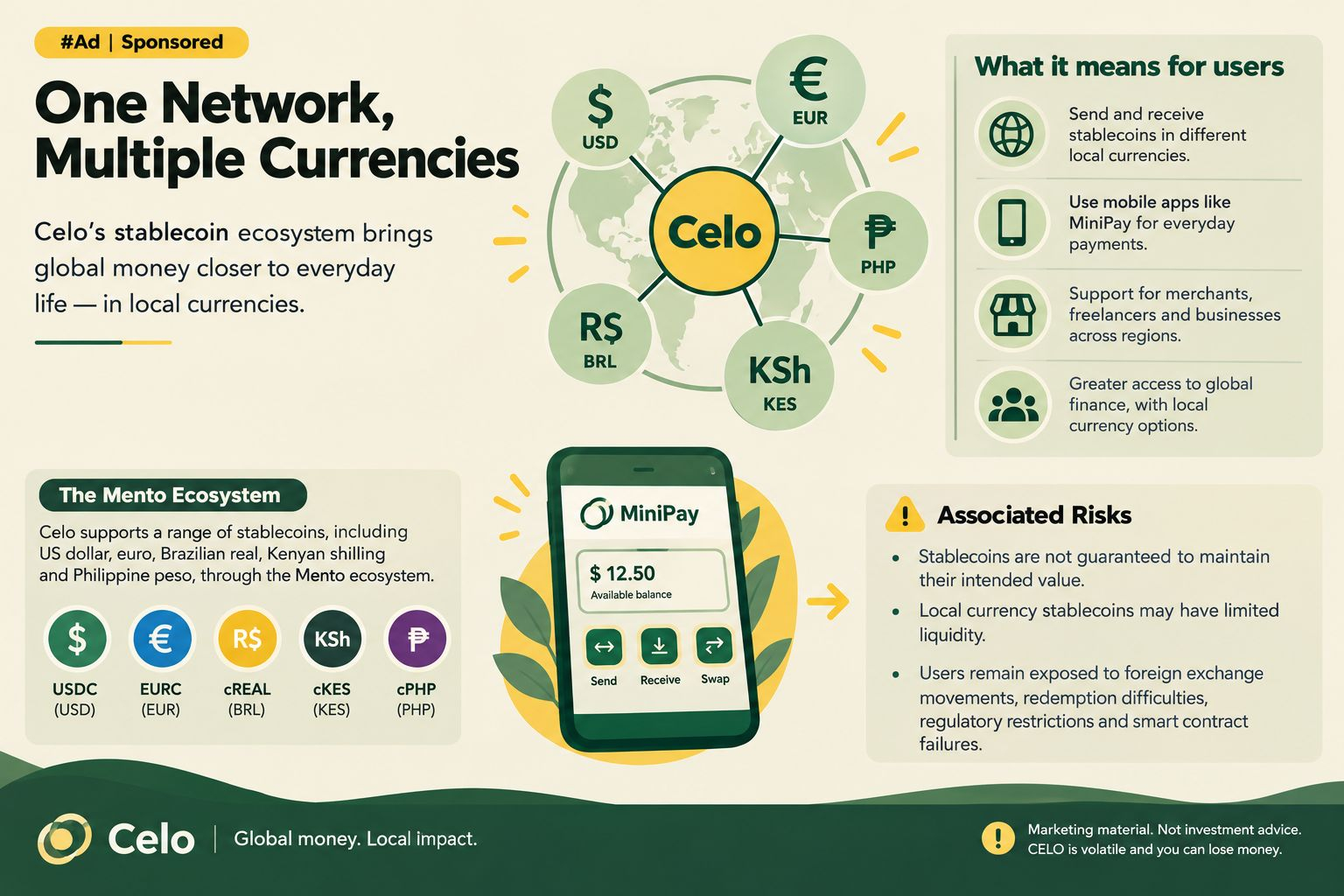
Through the Mento ecosystem, Celo supports assets representing currencies including the US dollar, euro, Brazilian real, Kenyan shilling and Philippine peso.
The intended usefulness extends beyond transferring digital dollars. Applications can potentially connect international payments with local monetary needs.
This makes currency accessibility another dimension of Celo's infrastructure.
Risk: Stablecoins are not guaranteed to maintain their intended value. Local currency stablecoins may have limited liquidity, and users remain exposed to foreign exchange movements, redemption difficulties, regulatory restrictions and smart contract failures.
03. Removing the requirement to own a separate gas token
One of Celo's more distinctive protocol features is fee abstraction.
On many blockchain networks, users need a particular native cryptocurrency before they can perform a transaction.
This creates an unusual situation where someone may have sufficient digital money to make a payment but cannot complete it because they lack the asset required for network fees.
Celo allows compatible wallets to pay transaction fees using supported tokens, including certain stablecoins.
Instead of requiring every user to manage a separate gas token, applications can provide greater flexibility over how transaction costs are covered.
The technology does not eliminate transaction fees. It changes the assets that can be used to pay them.
That distinction is important.
Risk: Fee abstraction depends on compatible wallets, approved tokens and functioning infrastructure. Supported stablecoins may lose their peg, and paying fees in alternative assets can involve additional execution costs.
04. Where CELO fits into a stablecoin-focused network
If users can interact with Celo through stablecoins, what purpose does its native token serve?
The answer lies in separating the payment experience from protocol participation.
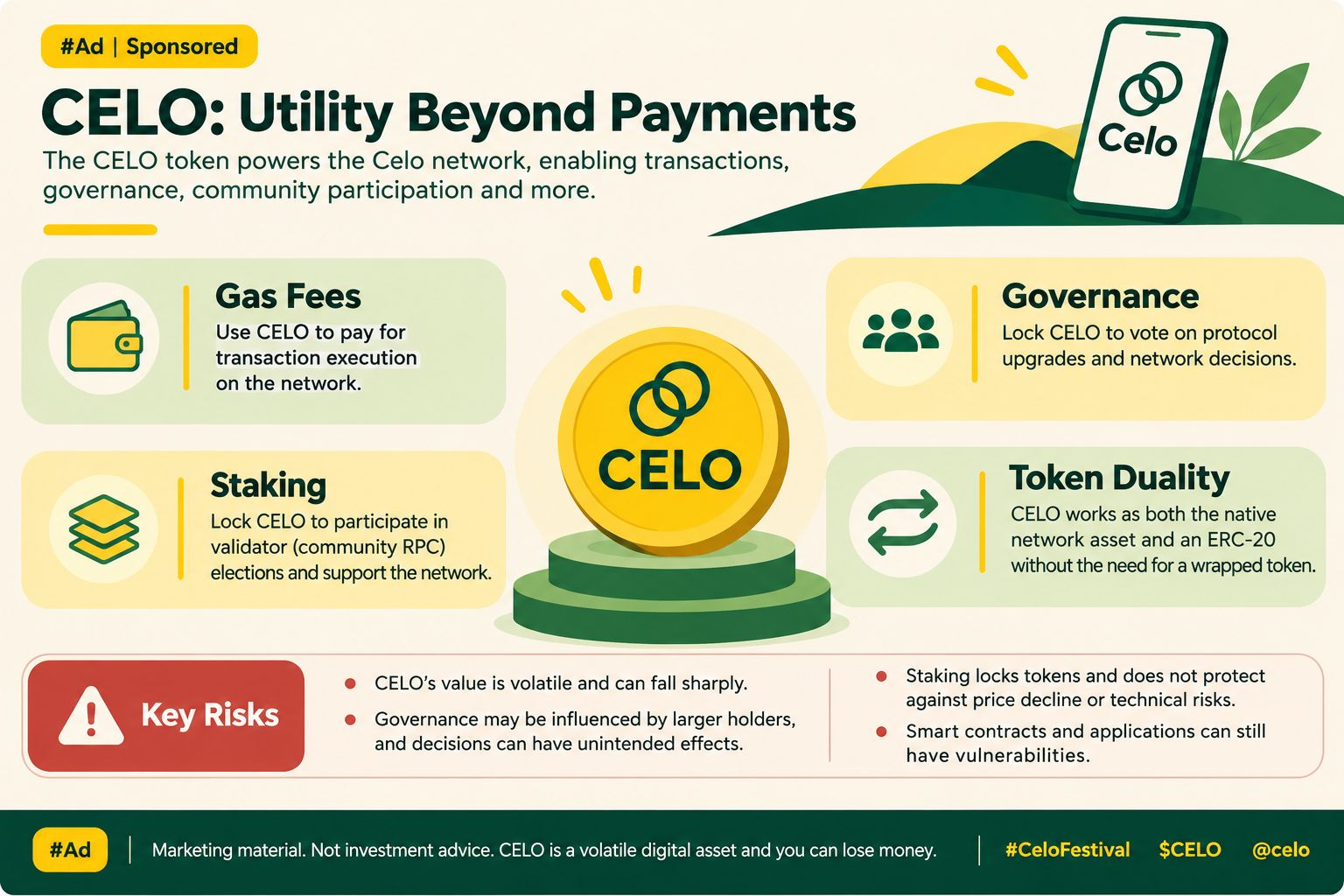
CELO has several functions within the network.
Native gas asset
CELO can cover transaction execution costs across the network.
Risk: Its market value fluctuates, affecting the monetary cost of fees paid in CELO.
Governance participation
Locked CELO provides voting power in decisions concerning protocol changes and governance proposals.
Risk: Voting influence may be concentrated among larger participants, and governance decisions can have unintended consequences.
Staking and community infrastructure
CELO can be locked to participate in elections involving community RPC providers, historically described as validators in Celo's protocol documentation.
Risk: Locked assets have reduced liquidity. Protocol rewards are not guaranteed, and token depreciation can result in financial losses.
Token duality
CELO operates as both the native network asset and an ERC-20-compatible token. Both interfaces access the same underlying balance without requiring a separate wrapped token.
Risk: Applications can still contain implementation errors, security vulnerabilities or incompatible token-handling mechanisms.
These functions explain why CELO exists within the network. They should not be interpreted as guarantees of token demand, appreciation or investment returns.
05. Ethereum settlement changes the infrastructure, not the responsibility
Celo's transition from an independent Layer 1 to an Ethereum Layer 2 changed how its network operates.
Transaction execution takes place through Celo's OP Stack-based infrastructure. Ethereum provides the settlement environment, while EigenDA supports data availability.
Developers can also work with familiar Ethereum-compatible tools and smart contract standards.
The architectural objective is to combine relatively inexpensive execution with access to Ethereum's broader technological ecosystem.
However, a network becoming an Ethereum Layer 2 does not automatically make every application secure.
Different infrastructure components introduce different dependencies.
A payment may depend on a functioning sequencer, available transaction data, properly implemented smart contracts and secure wallet software.
Risk: Infrastructure interruptions, bridge exploits, settlement delays, software vulnerabilities and failures involving external dependencies may prevent transactions or result in financial losses.
06. Adoption is not simply a transaction counter
Imagine two blockchain networks processing an identical number of transactions.
On one network, most activity comes from speculative trading.
On the other, activity includes payments between individuals, merchant transactions and transfers involving different currencies.
The transaction count alone would not explain the economic differences between them.
Celo's mobile-oriented ecosystem, including applications such as MiniPay, represents an attempt to connect blockchain infrastructure with practical financial activities.
Evaluating such an ecosystem requires considering more than wallet registrations or transaction numbers.
Are users returning because the applications serve a genuine purpose?
Can recipients convert digital assets into money they can actually spend?
Are the costs competitive after accounting for conversion and withdrawal fees?
These questions are useful when examining Celo's design and its potential real-world applications.
Risk: Application adoption is uncertain. Wallet activations do not necessarily represent active users, transaction counts do not establish economic value, and network growth does not guarantee an increase in CELO's market price.
07. Understanding the CELO Trading Festival
Binance has announced the CELO Trading Festival, an affiliate-focused promotional campaign running from November 20, 2026, at 10:00 UTC until December 20, 2026, at 10:00 UTC.
The announced campaign includes three categories:
Spot trading promotion: up to 75 BNB.
New-user welcome promotion: 70 BNB.
Affiliate creator challenge: 25 BNB.
The combined announced promotional allocation is up to 170 BNB.
Eligibility, reward distribution and regional availability are subject to the official campaign terms.
The festival is a promotional initiative. It does not establish the technological success of Celo or indicate future CELO market performance.
Trading involves financial risk, and promotional rewards do not eliminate the possibility of losses.
Official campaign rules:
https://www.binance.com/en/activity/trading-competition/ExCELOTradingFestival2026
08. What Celo's design ultimately tells us about blockchain adoption
The development of financial infrastructure is not always about introducing more features.
Sometimes it involves removing unnecessary requirements.
Celo's support for alternative fee currencies addresses one such requirement. Its mobile-oriented applications address another. Its Ethereum Layer 2 architecture attempts to provide an execution environment suitable for frequent financial activity.
The challenge is connecting these components to actual economic needs without overlooking the risks.
Affordable transactions alone cannot guarantee adoption. Stablecoins cannot eliminate every form of monetary risk. Ethereum settlement cannot prevent every application failure.
And a useful network does not necessarily make its native token a successful investment.
Perhaps the most interesting aspect of Celo is the distinction between making blockchain technology available and making it practically usable.
Those are two very different objectives, and the distance between them remains an important subject for the entire digital asset industry.
Official technical references
Celo documentation: https://docs.celo.org/
Network overview: https://docs.celo.org/learn
Token duality: https://docs.celo.org/learn/protocol/celo-token
Staking and governance: https://docs.celo.org/learn/protocol/staking
Affiliate disclosure: The author may receive affiliate-related compensation from Binance.
CELO ownership disclosure: [Insert whether you currently hold CELO.]
Regulatory disclosure: Binance's ADGM entities are regulated by the Financial Services Regulatory Authority (FSRA). These entities include Nest Exchange Limited, Nest Clearing and Custody Limited, and Nest Trading Limited, operating under their respective regulatory permissions.
Risk warning: Digital asset prices can fluctuate substantially. Investors may lose some or all of their invested capital. Investment decisions remain the responsibility of the individual.
CELO is a volatile digital asset and users can lose money.
This is marketing material and not investment advice.