
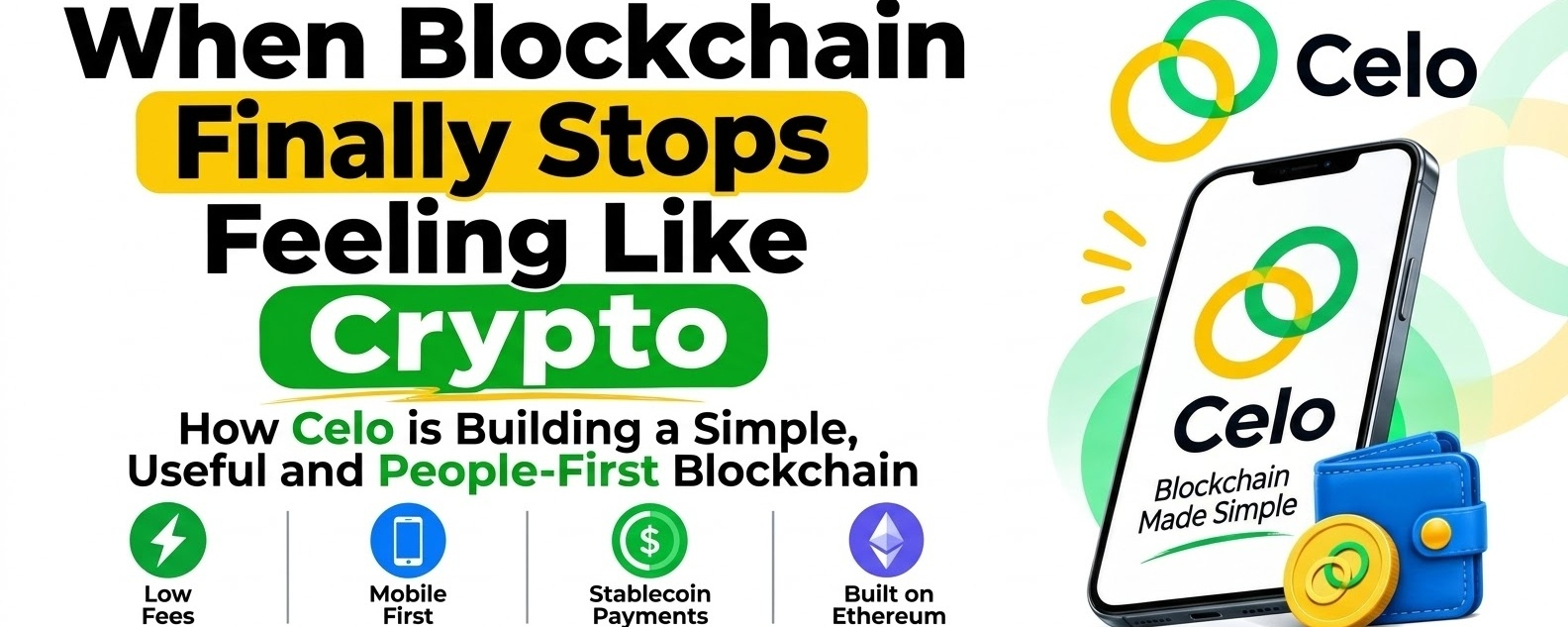


There is a quiet frustration that sits underneath most conversations about blockchain. For all the talk of permissionless systems and borderless value, the average person still experiences it as a series of small irritations. You need a special token just to move money. You have to understand networks and bridges and gas prices that bounce around like weather. You open an app and immediately feel like you walked into a room where everyone already knows the language and you do not. The technology keeps promising to become invisible, yet it rarely does.
@celo has been one of the few projects that seems to treat that frustration as the actual problem rather than a temporary inconvenience. Instead of starting with the assumption that users will learn the machinery, it has spent years trying to hide the machinery. The goal is not another faster chain for people who already live inside crypto. The goal is something closer to ordinary money that happens to run on a blockchain.
That difference in starting point changes almost everything that follows. When the primary user is imagined as someone who simply wants to send or hold digital dollars on a phone, the design decisions begin to look different. Fees should feel small enough to ignore. The asset used for those fees should preferably be the same one the person already holds. The wallet should feel like an app rather than a gateway into a new financial system. None of these ideas are revolutionary on their own. What is unusual is how consistently the project has returned to them even as the broader industry chased other narratives.
The decision to move onto Ethereum as a Layer 2 fits the same pattern. Remaining a separate chain offered independence, but it also created another island. Sitting on top of Ethereum keeps the existing community and state while borrowing a settlement layer that already carries institutional weight. The technical details of that shift matter less than the signal it sends. Celo is not trying to win the race for the most pure or most isolated blockchain. It is trying to become useful enough that people stop thinking about the blockchain part at all.
Stablecoins sit at the center of this approach for an obvious reason. Most people do not want exposure to volatile assets when they are simply trying to pay someone or hold value across borders. They want something that behaves like money. Building the network around that preference creates a different kind of demand. Activity can grow without every user first becoming a token holder. That is both a strength and a complication. When the majority of transactions can happen without ever touching the native asset, the economic relationship between network use and the token itself becomes thinner. Linking the two again requires deliberate design rather than automatic market forces.
There is something almost unfashionable about this focus. Much of the industry still measures success in the language of total value locked, peak throughput, or the latest narrative that can be packaged for attention. Celo’s quieter metric is whether someone who has never cared about blockchains can complete a useful financial action without friction. That standard is harder to celebrate in real time and easier to dismiss as incremental. Yet the long-term value of any financial infrastructure is usually decided by how ordinary it becomes, not by how exciting it looked in the early years.
The mobile emphasis is part of the same logic. Large parts of the world already live on phones in ways that desktop-first crypto never fully accounted for. Designing for that reality means accepting constraints that pure infrastructure projects sometimes ignore. The experience has to survive imperfect internet, limited storage, and users who will not tolerate complexity. It also means distribution becomes as important as the chain itself. A well-designed network that never reaches the people it was meant for remains a theoretical exercise.
None of this removes the harder questions. Making gas payable in stablecoins lowers one barrier while raising another about how value accrues back to the network’s own token. Building for payments invites competition from both other blockchains and traditional financial rails that already work. Relying on mobile wallets and familiar interfaces still leaves users responsible for security in ways that banks have traditionally absorbed. And any system that processes real economic activity inherits the full range of risks that come with digital money, from technical failures to regulatory pressure.
What makes the project interesting is not that it has solved these tensions. It is that it continues to treat them as central rather than secondary. Most chains still feel designed first for people who already understand the culture. Celo keeps trying to design for people who do not. Whether that approach can scale into something durable remains open. The more useful question may be whether the rest of the industry is willing to measure progress by the same standard: not how much crypto activity a network can attract, but how little the people using it have to think about crypto at all.
