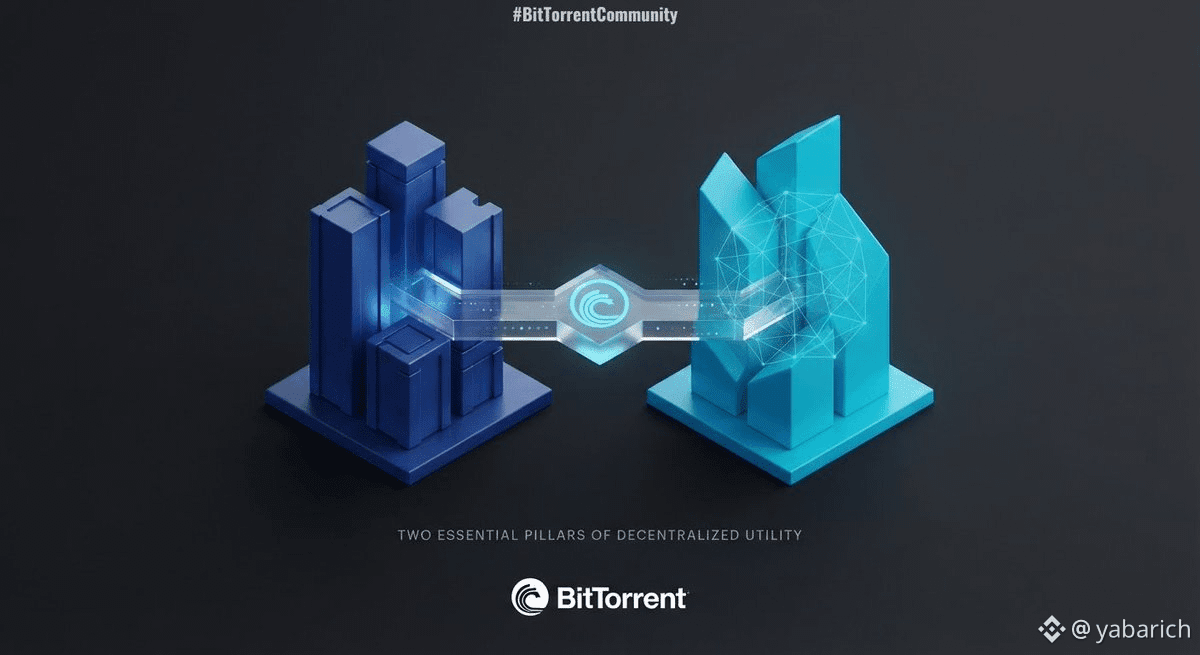
𝗕𝗜𝗧𝗧𝗢𝗥𝗥𝗘𝗡𝗧'𝗦 𝗠𝗢𝗗𝗨𝗟𝗔𝗥 𝗔𝗥𝗖𝗛𝗜𝗧𝗘𝗖𝗧𝗨𝗥𝗘:
The growing demand for artificial intelligence infrastructure is exposing a fundamental challenge in decentralized computing: data storage and computational execution require fundamentally different resource allocation strategies.
Storage infrastructure must prioritize durability, availability and long-term data integrity. AI inference infrastructure must prioritize computational performance, response latency and efficient resource scheduling.
Attempting to optimize both workloads through a single infrastructure design could introduce unnecessary operational complexity.
BitTorrent addresses this challenge through a modular architecture that separates decentralized storage from on-demand AI computation while connecting both services through BTT.
This architectural separation could become an important competitive advantage as decentralized infrastructure evolves toward commercial AI applications.
𝗧𝗪𝗢 𝗦𝗣𝗘𝗖𝗜𝗔𝗟𝗜𝗭𝗘𝗗 𝗜𝗡𝗙𝗥𝗔𝗦𝗧𝗥𝗨𝗖𝗧𝗨𝗥𝗘 𝗟𝗔𝗬𝗘𝗥𝗦, 𝗢𝗡𝗘 𝗧𝗢𝗞𝗘𝗡 𝗘𝗖𝗢𝗡𝗢𝗠𝗬
According to BitTorrent's latest architectural overview, the unified ecosystem incorporates two specialized infrastructure pillars:
• BTFS — Decentralized Storage
Designed to provide durable, decentralized file storage, addressing the need for persistent data availability without exclusive dependence on centralized storage providers.
Its relevant performance indicators include storage capacity, data retrieval reliability, storage costs and long-term availability.
• BTTInferGrid — Decentralized AI Compute
Designed to provide on-demand computational resources for AI inference workloads.
Its relevant performance indicators include inference latency, computational throughput, resource utilization, task completion rates and cost per successful inference.
• BTT — Shared Economic Infrastructure
BTT connects these two distinct infrastructure directions through a common token economy.
The strategic advantage of modularity is that storage and computational infrastructure can be optimized according to their respective technical requirements.
However, the announcement does not disclose current storage pricing, inference costs, service revenue, utilization rates or detailed technical integration mechanisms between BTFS and BTTInferGrid.
Source: BitTorrent's official modular architecture announcement.
Public research resources:
https://www.bittorrent.com
https://www.btfs.io
https://bt.io
https://x.com/BitTorrent
𝗠𝗬 𝗣𝗘𝗥𝗦𝗢𝗡𝗔𝗟 𝗩𝗜𝗘𝗪: 𝗠𝗢𝗗𝗨𝗟𝗔𝗥𝗜𝗧𝗬 𝗖𝗢𝗨𝗟𝗗 𝗜𝗠𝗣𝗥𝗢𝗩𝗘 𝗧𝗛𝗘 𝗨𝗡𝗜𝗧 𝗘𝗖𝗢𝗡𝗢𝗠𝗜𝗖𝗦 𝗢𝗙 𝗗𝗘𝗖𝗘𝗡𝗧𝗥𝗔𝗟𝗜𝗭𝗘𝗗 𝗔𝗜
I believe the strongest economic argument for BitTorrent's modular architecture is the ability to optimize storage and computational expenditure independently.
Consider a hypothetical AI application that requires persistent data storage and recurring inference services.
Monthly operational requirements:
• Data storage: 100 TB.
• AI inference requests: 10 million.
• Assumed storage cost: $8 per TB per month.
• Assumed inference cost: $0.002 per request.
Estimated monthly expenditure:
• Storage: $800.
• AI inference: $20,000.
• Combined expenditure: $20,800.
Under this scenario, inference accounts for approximately 96.15% of the combined infrastructure expenditure.
Now assume specialized infrastructure optimization reduces storage costs by 25% and inference costs by 15%.
The resulting expenditure would be:
• Optimized storage cost: $600.
• Optimized inference cost: $17,000.
• Combined monthly expenditure: $17,600.
• Monthly savings: $3,200.
• Annual savings: $38,400.
• Overall infrastructure cost reduction: approximately 15.38%.
These figures are hypothetical calculations, not actual BTFS or BTTInferGrid pricing, measured performance improvements or guaranteed customer savings.
The example illustrates why separating infrastructure workloads can be economically meaningful.
A storage network should not need to adopt the same resource scheduling mechanisms as an AI inference network. Similarly, computational providers should not necessarily be responsible for maintaining long-term data persistence.
Specialization allows each infrastructure layer to address its own technical bottlenecks.
Nevertheless, modularity also introduces potential coordination costs, including data transfer latency, service compatibility, authentication and cross-layer reliability.
The real economic advantage exists only when the benefits of specialization exceed the additional costs of coordinating independent infrastructure components.
𝗙𝗥𝗢𝗠 𝗠𝗢𝗗𝗨𝗟𝗔𝗥 𝗜𝗡𝗙𝗥𝗔𝗦𝗧𝗥𝗨𝗖𝗧𝗨𝗥𝗘 𝗧𝗢 𝗦𝗨𝗦𝗧𝗔𝗜𝗡𝗔𝗕𝗟𝗘 𝗕𝗧𝗧 𝗧𝗢𝗞𝗘𝗡 𝗘𝗖𝗢𝗡𝗢𝗠𝗜𝗖𝗦
The use of BTT across decentralized storage and AI computation creates an opportunity to diversify the sources of economic demand supporting the BitTorrent ecosystem.
Storage services can generate demand through recurring data retention requirements.
AI inference services can generate demand through computational workloads and application usage.
These demand profiles are structurally different, potentially reducing dependence on a single infrastructure market.
BitTorrent's previously announced first quarterly BTT buyback and burn provides additional context for evaluating this economic direction:
• BTT burned: approximately 21.62 trillion.
• Reported value: approximately $7.6 million.
• Share of total token supply: approximately 2.18%.
• Funding source: 100% of reported Q3 2026 decentralized service revenue.
These historical figures are attributed to BitTorrent's October 16, 2026 announcement and have not been independently reverified here.
The important distinction is that infrastructure expansion alone does not guarantee sustainable token demand. Actual value accrual depends on paying customers, service utilization, token payment mechanisms, operating costs and transparent revenue allocation.
The indicators I would prioritize include:
• BTFS paid storage capacity and utilization.
• Data availability and retrieval reliability.
• BTTInferGrid completed inference workloads.
• Cost per successfully completed AI task.
• Computational resource utilization.
• Recurring decentralized service revenue.
• Actual BTT consumption across infrastructure services.
• Revenue-funded buybacks and independently verifiable token burns.
In my assessment, BitTorrent's modular strategy represents a potentially more sustainable approach to decentralized infrastructure than attempting to serve every workload through a single technical architecture.
BTFS addresses data persistence.
BTTInferGrid addresses computational execution.
BTT provides a shared economic connection.
The ultimate measure of success will be whether these specialized infrastructure layers can deliver commercially competitive services while generating recurring, verifiable economic demand.
A unified ecosystem does not require every component to perform the same function.
It requires specialized components to create complementary value.
That is where BitTorrent's modular architecture could establish its strongest long-term advantage within the decentralized AI economy.
@BitTorrent_Official @TRON DAO