Two bridges got drained in two days last week, and neither one was broken by a clever smart-contract bug. They were broken by keys.
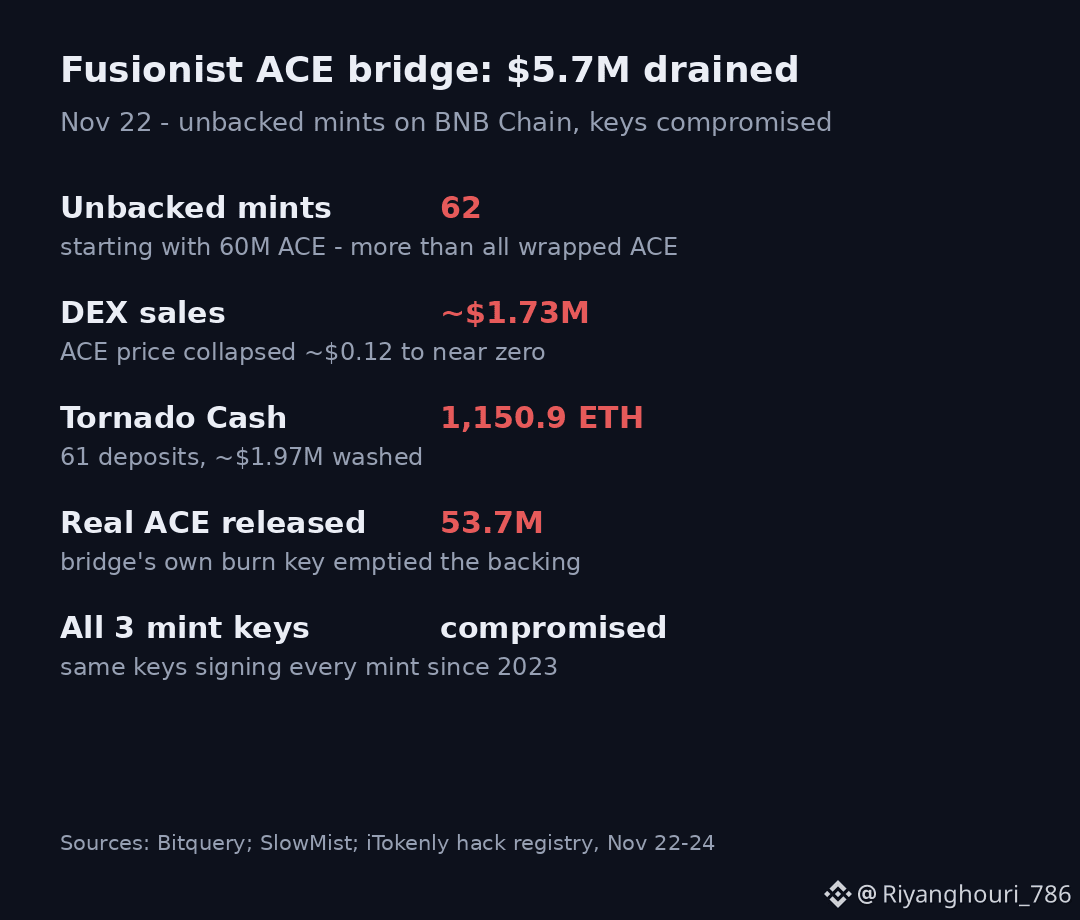
On Nov 22, Fusionist's ACE bridge started minting ACE on BNB Chain that nobody had deposited - 62 unbacked mints, starting with 60 million ACE, more than all the wrapped ACE that existed at the time. The price collapsed from about 12 cents to almost nothing while the thieves sold into it. SlowMist puts the total loss at $5.7 million: about $1.73M in DEX sales, plus the proceeds washed through Tornado Cash in 61 deposits worth roughly 1,150 ETH.
Here's the part that should actually scare you. All three keys that request, approve and execute mints on that bridge signed the fake mints - the same three keys that had signed every genuine mint since 2023. Then the bridge's own burn key released 53.7 million real ACE to back the fake tokens, emptying the backing completely. The bridge didn't just fail to stop the theft, it helped finish it.
Fusionist said on Nov 24 it knows how the attacker got in, but it hasn't said how. Nothing recovered, no cause published. And a day earlier, the Cyber bridge lost $1.1M the same way - a single verifier signing key pulled from a cloud system.
My take: we keep auditing code and ignoring the keys. A bridge whose three 'independent' keys all live in the same place is a single point of failure wearing a multisig costume. Before you bridge anything, ask one question: who holds the keys, and how many of them have to fail before your money is gone? If the project can't answer that clearly, don't bridge there. $ACE