

I'll be honest, I almost skipped Celo at first.
Most blockchains compete on speed and fees. Celo started from a different question: why would an ordinary person bother using crypto at all?
The original Celo whitepaper named two problems. Paying with crypto was hard to use, and prices swung too much to trust. Their answer was to let people pay to a phone number and to build around stable-value money. That was 2020. Six years on, I think the question still matters more than another speed benchmark.
Maybe that's the question we should be asking more often.
The small steps are what stop people
Picture a first-time user who just wants to send a few dollars. They need a wallet, some stablecoins, and a separate token to cover gas. If you already know crypto, that feels normal. If you don't, it feels like homework.
Celo moved from its own Layer 1 to an Ethereum Layer 2 on March 26, 2025, built on the OP Stack with one-second blocks. It also lets users pay gas in supported stablecoins. That removes one step from every payment. It sounds minor, but this kind of detail often decides whether people keep using something.
Small things like this are easy to ignore, but I don't think they're small to a new user.
MiniPay is where the idea meets real users
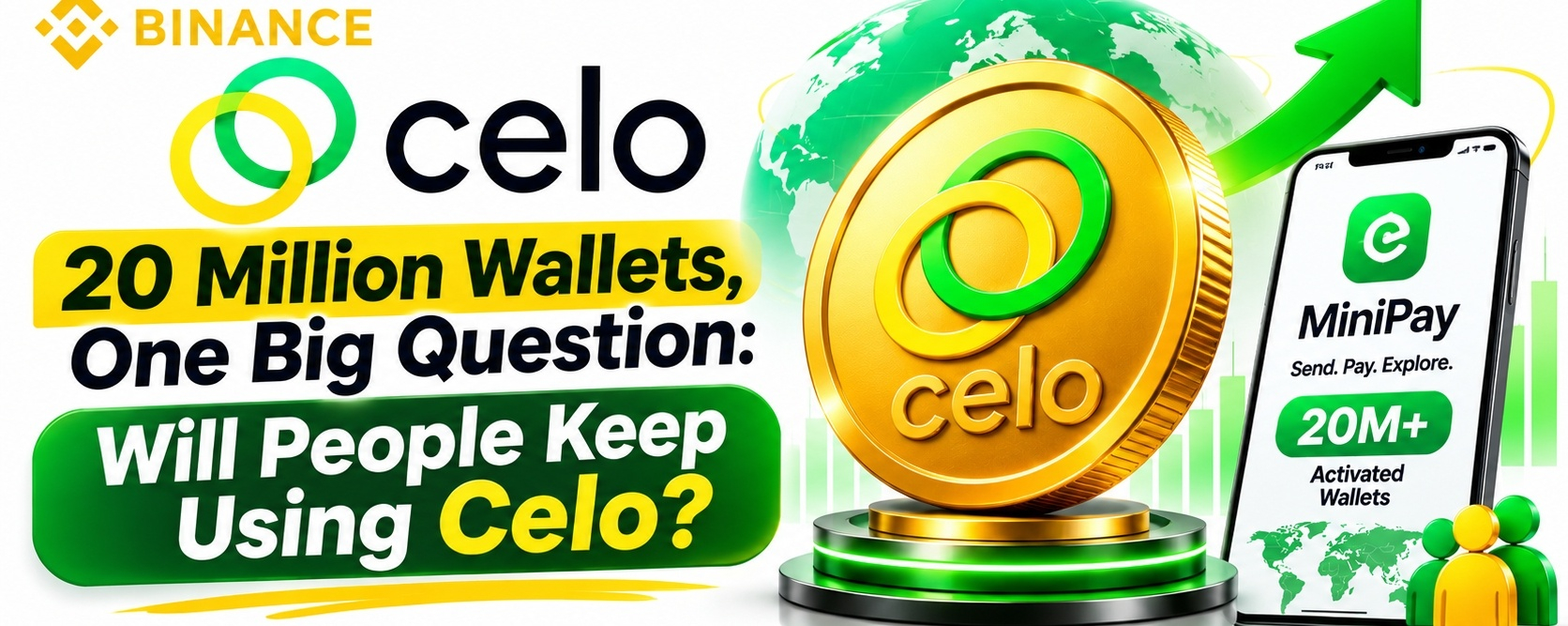
MiniPay launched in 2023 inside the Opera Mini browser and started in Africa. It now reports more than 20 million activated wallets, over 600 million transactions, and 77 Mini Apps across 70+ countries. On November 19, 2026, it announced a move to Privy, the wallet infrastructure company Stripe owns. Users can sign in with an email, a social account or a passkey, with no seed phrase to write down, and the wallet stays self-custodial.
Honestly, I didn't expect it to be this big.
One thing I'd keep in mind, though. An activated wallet is not a person paying every day. Celo itself pointed to more than 450,000 daily active users as of September, which is a healthy number but a much smaller one than 20 million. Repeat usage will tell us more than wallet counts.
Big numbers look great on paper, but I'd rather see people coming back every day.
Software that pays for things
Celo is also betting on AI agents. On October 13, 2026, Celo Core Co. launched "buy", a marketplace where an agent can pay for more than 700 services (compute, data, APIs) using USDC, USD₮ or USA₮. No account sign-up, no API key juggling, no subscription.
Sounds a bit strange at first, but it makes sense.
I like the idea. I also think trust is the hard part. Spending limits, wallet security and identity checks need to work before anyone lets an agent handle real money. Buy does include Self, a proof-of-human system, for services that need verification, so at least that question is on the table.
It's early, so I'm watching this one with curiosity, not blind excitement.
Does any of this reach CELO holders?
This is the part that matters if you hold the token. A network can be busy and still send very little value to its native token, especially when users can pay fees in stablecoins.
Celo tried to answer this with CELOccelerate, a tokenomics proposal that passed in April 2026 with over 97% support. Net sequencer revenue now goes to the Community Fund, and stablecoin fees are converted into CELO first. CELO holders then decide whether to hold, spend or burn it. About 1.749M CELO was returned to the fund and later burned through a governance vote. Celo says roughly 9.1M CELO has been bought back so far and that chain revenue is up more than 6x since April. Those figures come from Celo's own posts, so I treat them as claims to keep checking, not settled fact.
I'll wait to see more data before I get too excited.
Both sides
The bull case is easy to see: stablecoin payments already exist here, MiniPay gives real distribution, agent payments could add a new source of activity, and the Ethereum link makes life easier for builders.
The risks are just as real. Layer 2 and stablecoin payments are crowded markets. Wallet growth doesn't guarantee habit. Higher fees could clash with Celo's low-cost payments pitch. And buybacks only help if revenue keeps growing.
What I'm watching
Do people keep coming back to MiniPay? Do stablecoin payments become part of normal life in the markets Celo targets? Do agents make real, repeat payments? And does revenue keep growing enough to make the buybacks meaningful?
Celo knows what it wants to build. The next job is proving people need it, and that the token benefits when they do. That's why I'm still following $CELO .
I'll keep watching and update if things change.
