
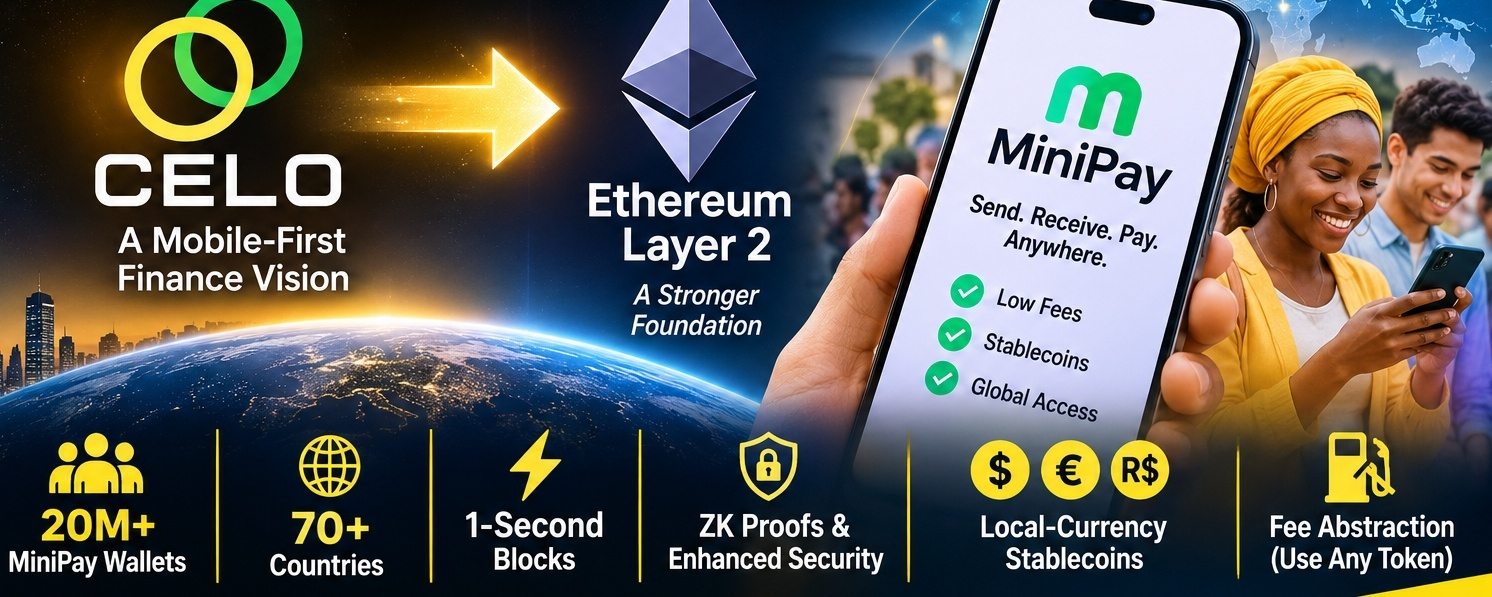


I keep coming back to one question when I follow Celo: what does a blockchain need to do before ordinary people have a reason to use it?
It’s easy to describe a network through its technical features. We can talk about block times, transaction costs, consensus, bridges, data availability and developer tools. Those details matter, especially when a network is responsible for moving people's money. But they aren't usually what makes someone open a wallet for the first time.
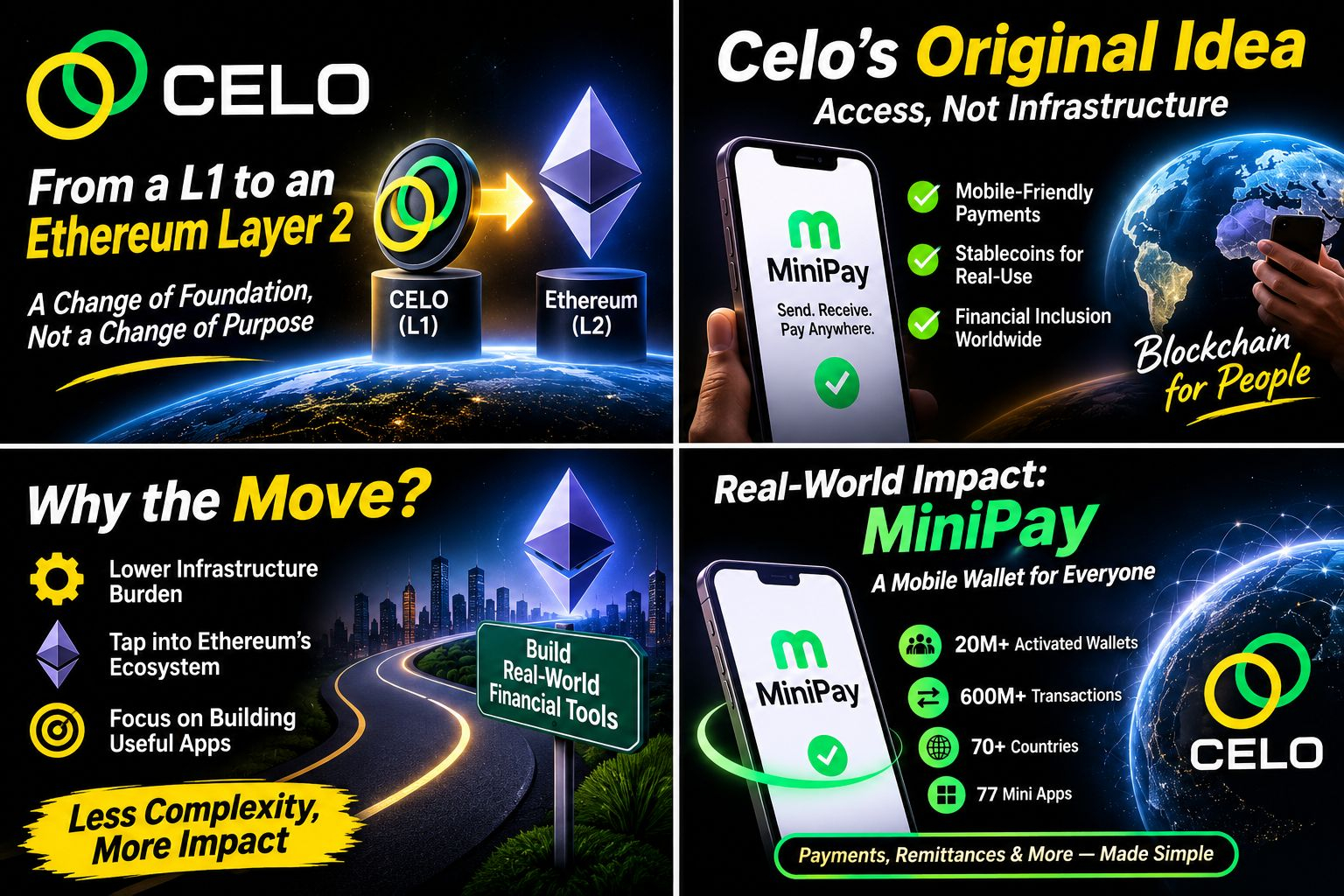
A person sending money to family doesn't particularly care whether the transaction happens on a Layer 1 or a Layer 2. They care whether the money arrives, whether the fee is reasonable, whether the person receiving it can use it, and whether the process feels reliable enough to repeat next week.
That practical question has been at the center of Celo since its early days. The project has spent years trying to make blockchain-based financial services easier to access, particularly through mobile devices and stablecoins. Its move to Ethereum in March 2025 changed the technical foundation behind that work, but it didn't erase the original purpose.
In fact, I think that distinction is the most interesting part of Celo's development. The project didn't move to Ethereum simply to become another network in a growing collection of Layer 2 chains. It made a decision about where it wanted to spend its energy: less on maintaining an entirely independent blockchain infrastructure, and more on building financial applications that people might actually use.
Whether that decision will prove successful depends on more than the migration itself. It depends on the quality of the technology, the reliability of its services, the strength of its ecosystem, and, most importantly, whether people continue finding a genuine reason to use it.
Celo's original idea began with access, not infrastructure
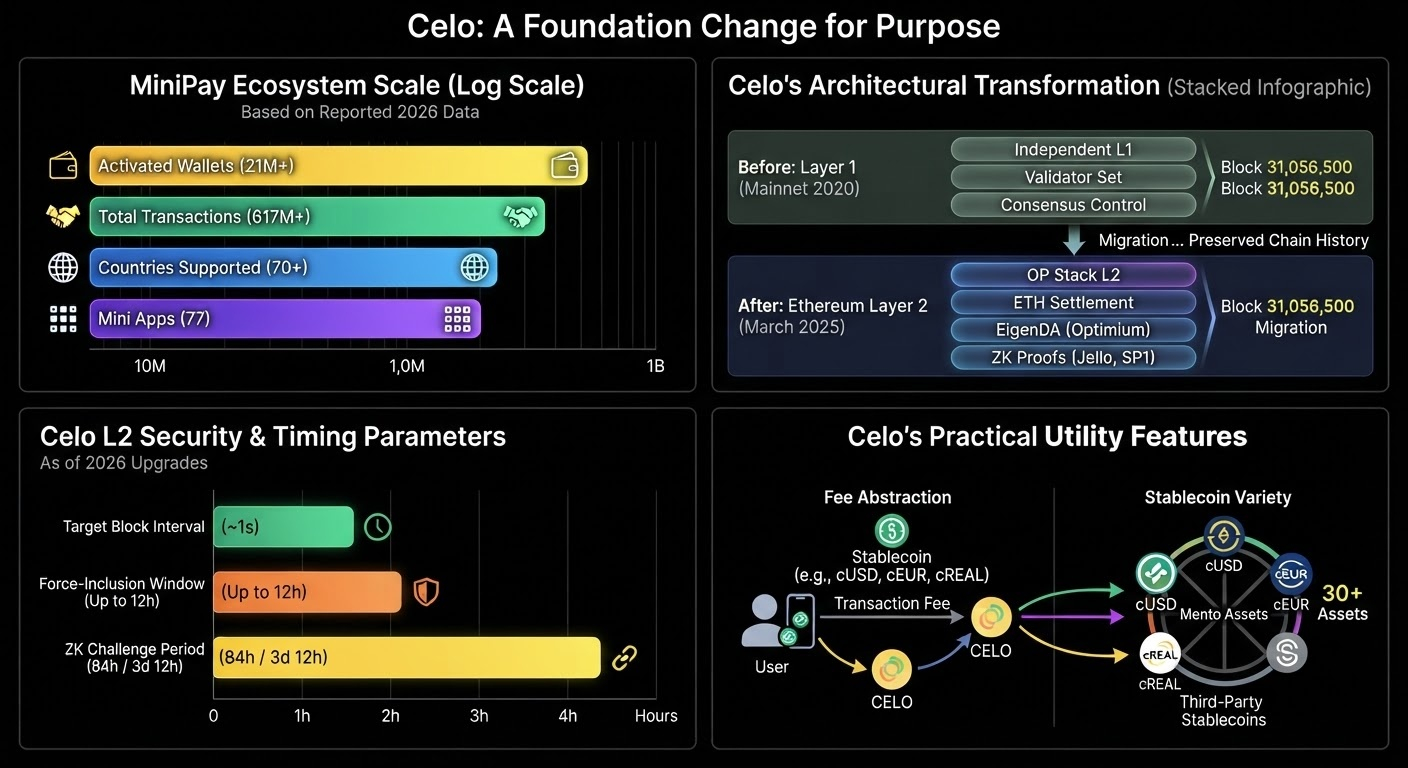
Celo launched its mainnet in 2020 as an independent Layer 1 blockchain. Its early identity was built around a fairly direct observation: financial services are still difficult to access in many parts of the world, while smartphones are increasingly common.
The project wanted to use blockchain technology to make payments and other financial services more accessible through mobile devices.
That wasn't an entirely abstract idea. Celo's early research and development work considered markets where people often depend on mobile phones for communication and financial activity. Its original design thinking focused on making wallets easier to use, reducing the cost of transactions, and allowing people to interact with digital assets without first becoming experts in blockchain technology.
The distinction matters because many blockchain projects begin by building infrastructure and then look for reasons people might use it. Celo's original direction was more closely tied to a specific user problem: how could someone send, receive and hold value using a phone, without needing to understand the complicated systems operating behind the screen?
Stablecoins became an important part of that answer.
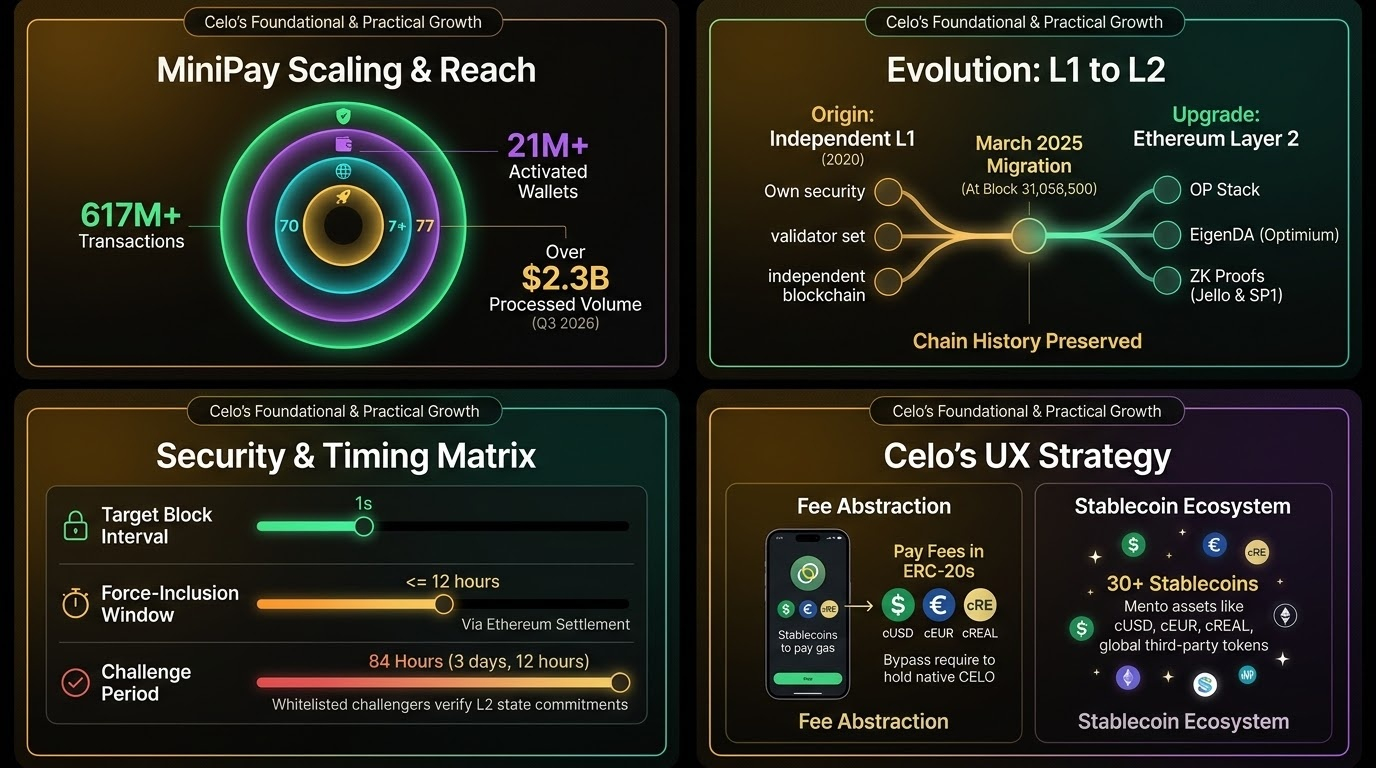
A conventional cryptocurrency can be difficult to use for everyday payments because its value may change significantly. A dollar-linked stablecoin offers a different experience. Its intended value is tied to a familiar unit of account, which makes it easier to think about paying a bill, receiving money for work, or sending a small amount to someone in another country.
That doesn't make stablecoins risk-free. Their reliability depends on how they are issued, what backs them, how redemption works, and whether users can access local payment services. But they can make the experience of using digital money more practical.
Celo's work around stablecoins, mobile wallets and lower transaction costs grew from that original idea. It wanted blockchain technology to become something people could use without having to think about the blockchain every time they made a payment.
That remains a useful way to understand the project today.
Why Celo decided that being an independent Layer 1 was no longer enough
Running an independent blockchain gives a project a great deal of control. It can make decisions about its own consensus system, network rules, transaction processing and technical priorities.
But independence also comes with a long list of responsibilities.
A Layer 1 network needs to maintain its own security infrastructure. It has to attract validators, support node operators, develop tools for programmers, encourage applications to launch, and build enough liquidity for users to move assets around. It also needs to persuade developers that spending time on its ecosystem is worthwhile.
None of those tasks is simple, and they all require resources.
Celo had already established an identity around payments, stablecoins and mobile access. But the wider blockchain industry was changing. Ethereum's Layer 2 ecosystem was becoming an increasingly important place for application development, and the technical resources available through that ecosystem offered a different route for projects that wanted to build on Ethereum without processing every transaction directly on Ethereum mainnet.
The idea of moving Celo to Ethereum was discussed before the migration happened. The proposal developed into a community decision in 2024, followed by the technical work needed to carry it out.
On March 26, 2025, Celo completed the transition and became an Ethereum Layer 2 using the OP Stack. The migration took place at block 31,056,500. Crucially, it wasn't a completely new network launch: Celo preserved its existing chain history and network state rather than starting again from zero.
That last detail deserves attention.
A network can announce a new architecture, deploy new infrastructure and publish a new roadmap. But an established ecosystem has users, applications, assets, contracts and years of activity. Replacing the foundation while preserving that history is a different task from launching a new chain and asking everyone to move.
Celo's migration was designed to carry its existing ecosystem forward.
The network also moved from its previous block production rhythm to approximately one-second blocks. Faster block production can improve the feeling of responsiveness, especially for applications that involve frequent small transactions. But it is worth keeping expectations realistic: a one-second block interval does not mean every process in the Ethereum settlement and withdrawal system is completed in one second.
The transition was therefore both a technical and organisational decision. Celo was choosing to work within a larger infrastructure ecosystem while keeping its own application priorities.
What becoming an Ethereum Layer 2 actually means
The term Layer 2 can sound simpler than it is.
A Layer 2 processes transactions away from Ethereum mainnet, allowing users and applications to operate without requiring every transaction to be executed directly on Ethereum. It then connects its activity to Ethereum through settlement and related mechanisms.
This can reduce the amount of work Ethereum mainnet has to perform for each individual user action. It can also give developers a familiar environment for building applications while retaining a connection to Ethereum's broader infrastructure.
Celo uses the OP Stack, the open-source technology associated with Optimism's rollup ecosystem. That gives Celo a foundation for execution and compatibility with a wider set of Ethereum development tools.
However, not every Layer 2 uses the same design for handling transaction data. That is one of the most important details to understand about Celo.
A network must make enough transaction data available for its state to be checked and reconstructed. If that data cannot be accessed, users and independent operators may face problems verifying what happened on the network or recovering from a failure.
Some rollups publish their transaction data directly to Ethereum. Celo uses EigenDA for data availability instead.
In practical terms, Celo's architecture connects its state commitments to Ethereum while using EigenDA to make the full transaction data available. Ethereum therefore plays an important role in settlement, but transaction data is not simply being published in full to Ethereum as it would be in a rollup that uses Ethereum for data availability.
This difference leads independent risk trackers to classify Celo as an Optimium. An Optimium is a rollup-style system that relies on an external data-availability layer rather than placing all the relevant transaction data on Ethereum itself.
That classification isn't just technical vocabulary. It describes a real design trade-off.
Using an external data-availability system can help manage costs and give the network more flexibility. But it also creates an additional dependency. Users and developers need to understand that the network's security and recovery assumptions involve more than Ethereum alone.
EigenDA is intended to make the data available through its own infrastructure and operator system. Celo's design also includes a fallback mechanism for posting data to Ethereum if the EigenDA route is unavailable. Still, the external dependency remains part of the system's trust model.
This is why I would be careful with a broad statement such as "Celo is now fully secured by Ethereum" without explaining the architecture behind it. Celo is much more closely aligned with Ethereum than it was as an independent Layer 1, but its data-availability arrangements introduce assumptions that deserve to be understood separately.
The move to zero-knowledge proofs adds another layer to the security story
Data availability is only one part of the security picture. A Layer 2 also needs a way to check whether the state it reports is valid.
Celo has been working on a proof system that uses zero-knowledge technology in its dispute process. Its Jello upgrade, activated on mainnet in December 2025, introduced OP Succinct Lite and a ZK-based approach to state-root challenges. Later engineering work included the SP1 Hypercube proving upgrade in 2026.
The basic idea is easier to understand than the underlying cryptography.
A Layer 2 periodically reports information about its state to the settlement layer. That state needs to be checked. If a state claim is disputed, a proof system can be used to demonstrate whether the claim is valid, rather than relying only on a long process of repeatedly narrowing down the disagreement.
Zero-knowledge proofs can make that verification process more efficient, but they don't make every other risk disappear. The proof software must be correct, the verification system must work as intended, and there must be a reliable process for identifying and challenging bad state claims.
Celo's security model includes a challenge period and a set of authorised challengers. According to the independent ETHBeat risk dashboard, the challenge period is currently listed as three days and twelve hours, with a separate proving window when a challenge is made. The dashboard also identifies a group of whitelisted challengers rather than a completely permissionless system in which anyone can immediately take part.
This is progress, but it also shows why security is not something that can be judged from one upgrade announcement.
The presence of zero-knowledge proofs is meaningful. It is not, by itself, proof that all aspects of the network are fully decentralised or free from operational risk.
I find it helpful to separate three questions: Can the network process transactions? Can the network make the information needed to verify those transactions available? And can users rely on the system to recover or protect themselves if a key operator behaves badly or stops working?
Those questions are connected, but they are not interchangeable.
The sequencer question is still important
Celo's transition also changed the role of the people and infrastructure responsible for producing blocks.
In its original Layer 1 design, validators played a central role in the network's consensus and security. As an Ethereum Layer 2, Celo's security model relies more directly on Ethereum-connected settlement and the systems used to operate the rollup.
Celo's initial Layer 2 design uses a centralised sequencer. The project's migration planning described decentralising sequencing as a future direction, while existing validators could continue contributing through community infrastructure and other roles.
A sequencer orders transactions and determines how they are included in the Layer 2's blocks. A centralised sequencer can make operations easier to coordinate and can help deliver fast transaction processing. But it also introduces a concentration of power.
For example, a sequencer may be able to delay or censor a user's transaction. A failure at the sequencer level may interrupt the ordinary transaction experience. There are mechanisms intended to let users force transaction inclusion through Ethereum if necessary, but those mechanisms do not mean the normal service is guaranteed to continue without interruption.
ETHBeat's assessment describes a force-inclusion route that can take up to twelve hours, depending on the circumstances.
That is useful protection, but it is not the same as having a fully decentralised sequencer that continues operating smoothly when one operator goes offline.
The Celo engineering roadmap has also discussed work involving Espresso, with the aim of improving economic finality and censorship resistance. The distinction matters: an integration appearing on a roadmap or in a technical discussion should not be described as a completed mainnet feature until the project confirms that it has shipped and the system is operating.
For now, sequencing is one of the areas where Celo's long-term decentralisation work remains important.
A mobile wallet is where the technical decisions meet real people
The strongest way to understand Celo's practical direction is to look beyond the chain itself and examine the applications built on top of it.
MiniPay is one of the clearest examples.
Developed by Opera, MiniPay is a self-custodial stablecoin wallet designed around mobile use. The aim is to make sending and receiving digital dollars feel less complicated, particularly for people who already use mobile services as part of their daily lives.
It is built on Celo, so the transactions it processes make use of the network's low-cost infrastructure. Users can send stablecoins, receive them and, in supported markets, connect to services that help them move between digital assets and local payment systems.
The numbers have grown substantially.
In its November 2026 announcement, Opera reported more than 20 million activated MiniPay wallets, over 600 million transactions, availability across more than 70 countries and 77 Mini Apps. The live MiniPay site now displays figures above 21 million activated wallets and 617 million transactions.
Those figures suggest that Celo has found a real route into consumer-facing financial applications. But they need to be interpreted carefully.
An activated wallet is not necessarily a unique person who uses the wallet every month. A transaction count does not tell us how many transactions represent a purchase, a remittance, a transfer between a person's own accounts or another kind of activity.
These statistics are useful because they show the scale of activity reported by the wallet provider. They do not, on their own, answer every question about lasting adoption.
Opera's Q3 2026 update also reported approximately $2.3 billion in cumulative processed volume for MiniPay, alongside the wallet and transaction figures. It described users relying on the service for activities such as receiving payments, sending money to family, paying school fees, rent and everyday expenses. Those examples are based on the operator's reporting and user feedback, so they should be understood as reported experiences rather than a complete independent study of all users.
Still, the underlying use case is easy to understand.
Imagine someone who receives payment from a client in another country. They may want to keep some of that value in a dollar-linked asset, send a portion to a family member and eventually convert another portion into local currency. A wallet that can make those steps relatively straightforward has a practical purpose beyond simply offering access to another blockchain.
The hard part is making that experience work consistently.
A payment application is judged by the moments when a user needs it. Does it open when the network is busy? Does the transfer complete? Can the recipient access the money? Can the user convert the stablecoin into something accepted by local shops or banks? And what happens when a third-party provider changes its rules or becomes unavailable?
These questions are much more important to a regular user than the technical distinction between an Optimium and another rollup design.
MiniPay's growth gives Celo a substantial consumer-facing example. Its next challenge is to show that the experience remains reliable as the number of users, countries and supported services increases.
Fee abstraction is a small technical feature with a large user-experience purpose
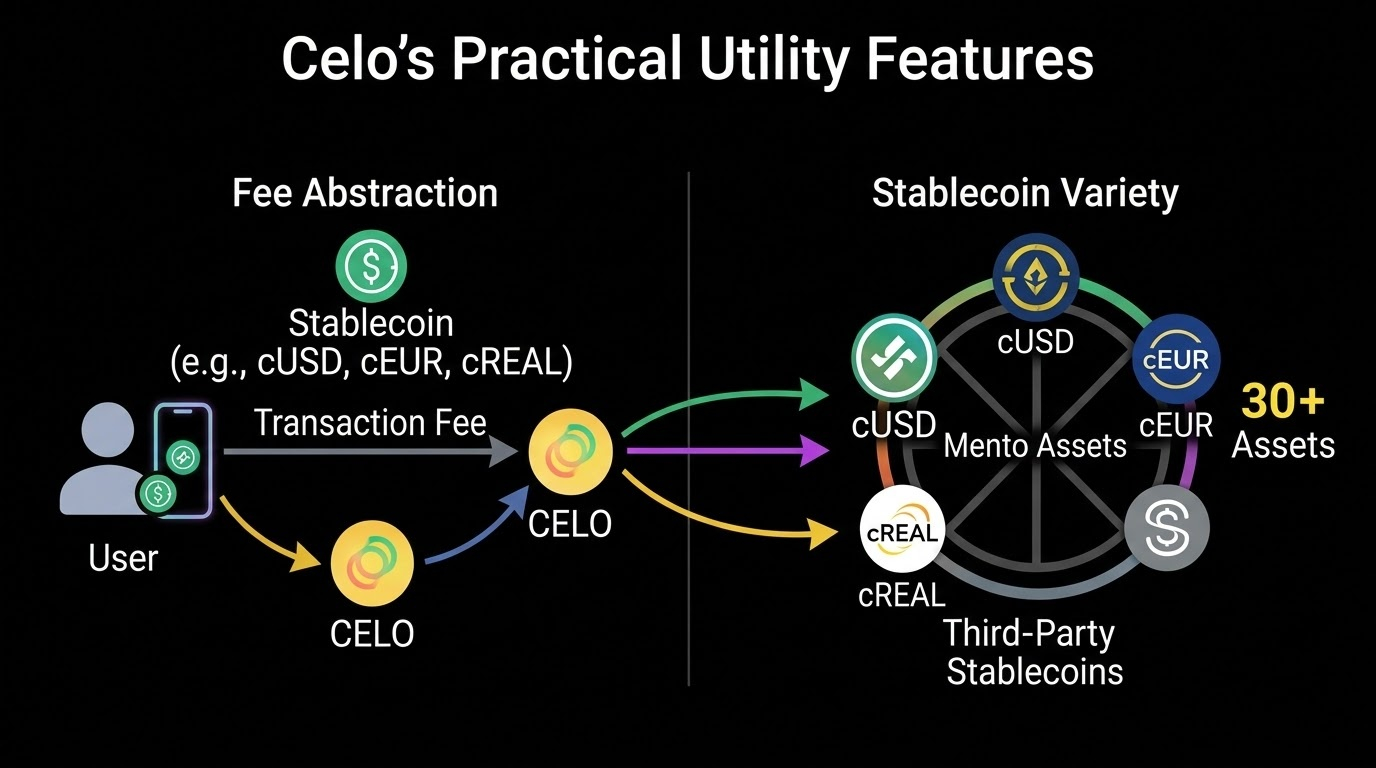
One of Celo's more practical design choices is fee abstraction.
On many blockchains, a user needs to hold the network's native gas token to pay for a transaction. This creates an awkward first-use problem. Someone might hold a stablecoin but still be unable to send it because they don't have the separate token needed to pay the network fee.
Celo has worked to reduce that friction by allowing supported ERC-20 tokens to be used for transaction fees through its fee-currency mechanism.
The idea is straightforward: a person using a stablecoin doesn't always need to obtain CELO first just to make a payment. The transaction can use a supported fee currency, subject to the network's rules and the application's implementation.
This might sound like a small detail, but it matters for people who don't want to manage several different assets just to perform one simple action.
There are still limitations. Not every token automatically qualifies as a fee currency, and the supported list depends on the network's configuration. The mechanism also doesn't mean that transactions are free. It changes the asset used to pay the fee, not the fact that the network has a cost for processing activity.
There can also be additional gas overhead when using a token other than the native asset.
So the important achievement is not that Celo has removed transaction fees. It is that the network has tried to make paying those fees less confusing for someone whose main reason for using the wallet is to hold or transfer stablecoins.
That fits the project's original mobile-first approach.
Local-currency stablecoins give Celo a more specific identity
The stablecoin story is broader than dollar-linked assets.
Celo's ecosystem includes Mento, a protocol that has supported stable assets linked to different currencies. This is relevant because people don't always want to hold or spend dollars. Someone in Brazil, Europe or West Africa may find a local-currency digital asset more useful for budgeting and everyday payments.
The Mento ecosystem has included assets linked to currencies such as the euro, Brazilian real and West African CFA franc, among others. Celo's own 2026 ecosystem reporting described more than 30 stablecoins across the network, including Mento assets and stablecoins issued by other organisations.
