
The next chapter of blockchain adoption will not be decided by how many chains exist. It will be decided by how effectively those chains connect technology with real human needs.
Imagine sending money from Kenya to Brazil, receiving digital dollars on your phone, or paying for an online service without worrying about which blockchain is running in the background.
For the user, it should feel simple.
Behind that simplicity, however, there needs to be infrastructure capable of delivering speed, affordability, security, and reliability.
This is where Celo deserves a closer look.
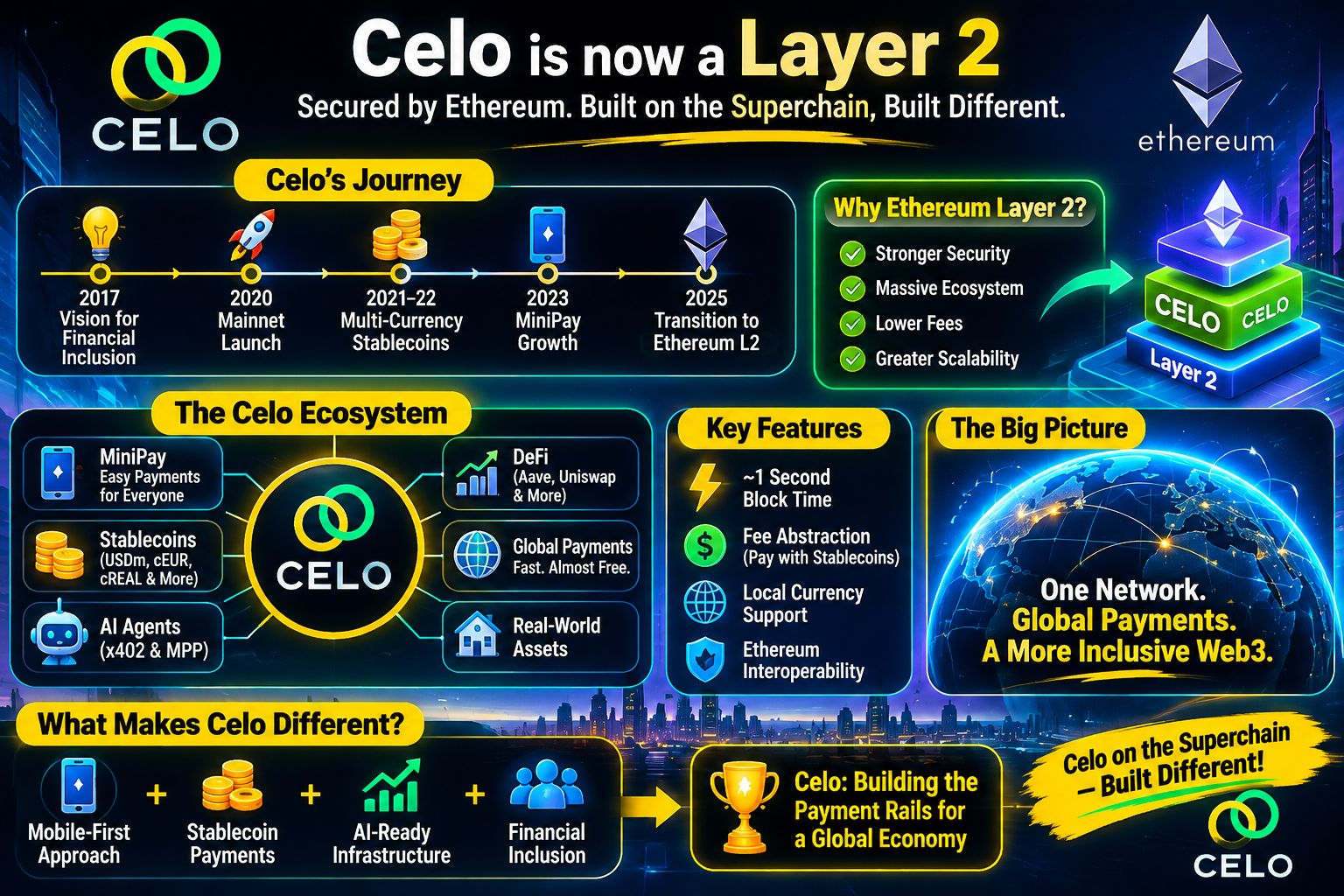
Celo has evolved from a mobile-first Layer 1 blockchain into an Ethereum Layer 2 built using the OP Stack and connected to the broader Superchain ecosystem.
But I believe the most interesting part of this transformation is not simply that Celo became an L2.
It is that Celo is trying to combine Ethereum's security and ecosystem with a very specific mission: making digital payments accessible to the real world.
Let's explore what that actually means.
1. Celo's Evolution: A Bigger Vision Than Another Blockchain
When Celo launched its mainnet in April 2020, its vision was different from that of many blockchain projects.
Rather than focusing exclusively on trading, speculation, or complicated decentralized applications, Celo focused on mobile accessibility, financial inclusion, and global payments.
The thinking was straightforward.
A smartphone is already one of the most important financial tools in the world. Why shouldn't people be able to use it to send, receive, and manage digital money?
This vision influenced Celo's architecture and ecosystem from the beginning.
Its priorities included:
Making blockchain transactions affordable.
Supporting stablecoins and local currencies.
Building mobile-friendly financial applications.
Giving developers an accessible environment for financial innovation.
Reducing the technical barriers between people and digital money.
However, the blockchain industry continued evolving, and Celo recognized that its long-term ambitions could benefit from closer integration with Ethereum.
That led to one of the most important decisions in its history.
2. March 26, 2025: Celo Became an Ethereum Layer 2
Celo officially transitioned from an independent Layer 1 to an Ethereum Layer 2 on March 26, 2025.
This was not just a technical upgrade or a change in branding.
It represented a fundamental shift in how Celo approaches blockchain infrastructure.
The transition was built around the Optimism OP Stack, bringing Celo into the wider Ethereum scaling ecosystem.
Why does this matter?
An independent Layer 1 must maintain its own network infrastructure, validator environment, and security arrangements.
An Ethereum Layer 2 takes a different approach.
It processes transactions through its own execution environment while connecting to Ethereum for settlement and security.
For Celo, this transition created an opportunity to combine its existing payment-focused ecosystem with Ethereum's established infrastructure and developer community.
Importantly, Celo preserved its existing network state and ecosystem during the migration.
It did not need to abandon its original mission to become part of Ethereum's scaling future.
That is what makes this transition particularly interesting.
3. What Does Secured by Ethereum Actually Mean?
This is one of the most important concepts to understand.
Ethereum is more than a blockchain that processes transactions. It provides a settlement and security foundation for a growing ecosystem of Layer 2 networks.
Celo uses the OP Stack to operate as an Ethereum L2.
In simple terms, the architecture separates different responsibilities:
Execution: Celo processes transactions and runs smart contracts.
Sequencing: Transactions are ordered and organized into blocks.
Data availability: EigenDA provides the data availability infrastructure used by Celo.
Settlement: Ethereum provides the underlying settlement layer.
This architecture allows Celo to build a payment-focused environment while aligning with Ethereum's broader security and scaling vision.
Another important component is EigenDA, which helps provide scalable and cost-efficient data availability.
There is an important technical distinction here: Celo's use of an external data availability layer means its security assumptions are not identical to an L2 that posts all transaction data directly to Ethereum. Ethereum settlement is important, but the complete security model also depends on data availability and proof infrastructure.
I believe explaining this distinction matters because real research should make the technology understandable without oversimplifying it.
The goal is not just to call Celo secure.
The goal is to understand how its security architecture works.
4. Built on the Superchain: Why This Matters
The Superchain is one of the most interesting developments in Ethereum's scaling ecosystem.
Instead of treating every Layer 2 as an isolated environment, the Superchain vision is to build a network of chains using common OP Stack infrastructure and shared standards.
Think about the difference.
In an isolated blockchain ecosystem, developers, liquidity, applications, and users can become separated across different networks.
A connected ecosystem creates more opportunities for collaboration, infrastructure reuse, and interoperability.
For Celo, being part of this broader ecosystem means access to an expanding community of developers and infrastructure providers working around the OP Stack.
This matters in several ways:
Shared technology: Developers can work with familiar Ethereum-compatible tools and OP Stack infrastructure.
Ecosystem connections: Celo can participate in a wider network of Ethereum-aligned chains and applications.
Developer opportunities: Builders can create applications that benefit from Celo's payment-focused environment while using familiar development standards.
Long-term scalability: A shared infrastructure approach creates opportunities for the ecosystem to grow beyond individual blockchain networks.
But there is an important distinction: using the OP Stack does not automatically mean every Superchain interoperability feature or shared security mechanism is fully active on every chain.
The real opportunity lies in continued technical alignment and deeper ecosystem integration.
For me, this is one of the strongest reasons to watch Celo's next chapter.
It is not trying to build everything alone.
5. What Makes Celo Different From Other Ethereum L2s?
Ethereum has many Layer 2 networks.
So why should anyone pay attention to Celo?
I think the answer comes down to its focus.
Some networks emphasize general-purpose DeFi, trading infrastructure, or high-performance applications.
Celo has a more specific identity: mobile-first financial infrastructure and real-world payments.
Its architecture is designed around the idea that blockchain should make financial services easier to access rather than introduce another layer of complexity.
Three characteristics stand out.
1. Payment-focused infrastructure
Celo prioritizes affordable transactions and stablecoin-based financial applications.
2. Mobile-first accessibility
Its ecosystem focuses on applications that ordinary smartphone users can understand and use.
3. Ethereum compatibility
Developers can work with familiar Ethereum tools, smart contracts, and infrastructure.
This combination gives Celo a distinct position.
It is not simply trying to become another destination for blockchain activity.
It is trying to make blockchain useful for financial activities people already understand.
6. Fee Abstraction: Removing One of Crypto's Biggest Frictions
One of the most practical features in Celo's architecture is fee abstraction.
Traditional blockchain experiences often require users to hold a particular native token before they can complete a transaction.
Imagine someone receiving USDT into their wallet.
They want to send a small amount to another person, but they cannot proceed because they do not have the required gas token.
For experienced crypto users, this might seem normal.
For someone using digital money for the first time, it is an unnecessary obstacle.
Celo supports paying transaction fees using eligible ERC-20 tokens, including supported stablecoins.
This creates a simpler experience.
Users can interact with financial applications without always needing to acquire a separate token just to pay network fees.
Why is that important?
Because mainstream adoption depends on removing small obstacles that collectively make technology difficult to use.
A payment network should make sending money easier, not require users to understand its entire technical architecture first.
7. MiniPay: Where Blockchain Meets Everyday Users
Technology alone does not create adoption.
People need products they can actually use.
This is where MiniPay becomes an important part of Celo's story.
MiniPay is a self-custodial stablecoin wallet developed by Opera and built on Celo.
Its approach focuses on simplifying access to digital money through a mobile-friendly experience.
Consider a freelancer receiving payment from an international client.
Instead of navigating complicated blockchain interfaces, the user can access supported stablecoins through a wallet designed around everyday usability.
This is the kind of experience that could make blockchain payments more accessible.
MiniPay also demonstrates something important about Celo's strategy:
The network is not relying only on developers and crypto-native users to create demand.
It is building around applications that can introduce blockchain-based financial services to a broader audience.
However, wallet activations should not automatically be treated as unique active users.
Long-term retention, repeat payments, transaction quality, and actual economic activity are much more meaningful indicators of adoption.
That is what I would watch most closely.
8. Stablecoins: The Real Opportunity Behind Celo's Payment Vision
I believe stablecoins are central to understanding why Celo's infrastructure matters.
Cryptocurrencies can be volatile, making them less convenient for everyday payments.
Stablecoins provide another option by tracking the value of currencies such as the US dollar, euro, or other local currencies.
For example:
A freelancer may prefer receiving digital dollars.
A merchant may want to accept payments in a familiar currency.
A family may want to transfer money across borders.
A business may need programmable payments between different markets.
Celo's ecosystem supports stablecoin infrastructure and applications designed around these types of financial activities.
Its Mento ecosystem also focuses on local-currency stablecoins and onchain foreign exchange.
This is particularly interesting for emerging markets, where access to affordable financial services and efficient international payments remains an important challenge.
The bigger opportunity is not simply having more stablecoins.
It is making those stablecoins useful.
Reliable liquidity, redemption mechanisms, issuer transparency, and recurring real-world demand will determine whether this infrastructure can deliver lasting value.
9. The Next Frontier: AI Agents and Programmable Payments
There is another development that makes Celo's payment-focused architecture worth watching.
AI agents.
AI is moving beyond answering questions and generating content.
Agents are increasingly being designed to interact with services, access information, execute tasks, and coordinate digital workflows.
But there is one important requirement:
Agents need a way to pay for the services they use.
Imagine an AI agent that needs access to a paid API, additional computing resources, or a specialized data service.
Traditional payment systems were largely designed around human account holders and conventional payment processes.
Stablecoin-based payments could create a different possibility.
An agent could request a service, receive a payment requirement, authorize a stablecoin transaction, and obtain access after settlement.
Celo's support for x402 payment infrastructure is an interesting step in this direction.
The HTTP 402 Payment Required concept allows online services to communicate payment requirements directly through web interactions.
This creates a potential connection between programmable money and autonomous digital services.
I would not claim that AI agent payments are already a mainstream financial market.
That would be premature.
But the infrastructure is worth monitoring because it could expand the role of blockchain payments beyond human-to-human transfers.
The future payment user may not always be a person.
Sometimes, it could be software acting on someone's behalf.
10. What About CELO? Understanding Network Growth and Token Value
An important question remains.
If Celo's ecosystem grows, does that automatically mean CELO becomes more valuable?
Not necessarily.
Network adoption and token value are related concepts, but they are not identical.
CELO plays an important role in the ecosystem, including governance, staking, and network economics.
Celo's Layer 2 architecture also supports fee abstraction, meaning users can pay transaction fees using eligible assets rather than always needing CELO directly.
This distinction is important.
More stablecoin payments do not automatically translate into equivalent demand for CELO.
For token holders, the important questions include:
How does network activity generate sustainable revenue?
What role does CELO play in governance and network security?
How do staking and token supply affect the economic model?
How effectively does the ecosystem capture value from growing adoption?
Are token-related economic mechanisms delivering measurable results?
I believe these questions deserve more attention than short-term price movements.
A successful blockchain ecosystem needs useful technology.
A sustainable token economy also needs a clear connection between network activity and economic value.
11. The Challenges Celo Still Needs to Address
No serious analysis should discuss opportunities without discussing risks.
Celo has a promising direction, but several challenges remain.
Competition: Ethereum L2s and alternative payment-focused networks are competing for users, developers, liquidity, and applications.
Security assumptions: Its Ethereum settlement architecture, external data availability, and proof infrastructure must continue to mature.
User retention: Initial wallet adoption is encouraging, but recurring usage is the real measure of success.
Stablecoin risks: Issuers, reserves, liquidity, regulation, and redemption mechanisms all matter.
Token value capture: Growing transaction activity must be evaluated against the actual economics of the CELO token.
These are not reasons to dismiss Celo.
They are the questions that will determine whether its long-term vision succeeds.
12. Five Things I Will Be Watching
Rather than judging Celo entirely through market sentiment, I would focus on five measurable developments:
Ethereum alignment: How effectively does Celo continue improving its L2 architecture and security infrastructure?
Superchain integration: Does participation in the broader OP Stack ecosystem create meaningful developer and interoperability opportunities?
MiniPay adoption: Are users returning and completing regular financial transactions?
Stablecoin growth: Is Celo becoming a more useful environment for global payments and local-currency financial activity?
Sustainable economics: Can growing network activity translate into meaningful revenue and a stronger long-term economic model?
These indicators will tell us much more about Celo's progress than headlines alone.
My Final Perspective: Built Different, But the Real Test Is Utility
When I look at Celo's evolution, I see a project that has made a significant strategic decision.
It started with a mobile-first vision.
It built an ecosystem around affordable payments and stablecoins.
It transitioned into an Ethereum Layer 2.
And now it is positioning itself within the broader Superchain ecosystem while exploring new opportunities in global finance and programmable payments.
What makes this journey interesting is the combination of two different strengths.
Ethereum brings an established settlement ecosystem, developer infrastructure, and security foundations.
Celo brings a focused vision around mobile accessibility, stablecoins, and real-world financial applications.
The opportunity is to bring these strengths together.
But I believe the biggest achievement will not be becoming an Ethereum Layer 2 or joining a larger ecosystem.
It will be making digital payments so accessible that people can use them without needing to understand blockchain technology.
That is the difference between building infrastructure and creating something people genuinely need.
Celo's next chapter should not be measured only by how many transactions it processes or how many wallets it activates. It should be measured by how many people depend on it for useful financial activity.
Ethereum provides the foundation. The Superchain creates a broader opportunity. Celo brings its own purpose.
And that is what makes its evolution worth watching.
Built on Ethereum. Connected to the Superchain. Focused on real-world payments. Built different.
Let's Discuss
Do you think Celo's move to Ethereum Layer 2 gives it a stronger long-term position?
Can its mobile-first payment ecosystem become one of the most important real-world use cases within the Superchain?
And what matters more for Celo's future: Ethereum alignment, stablecoin adoption, or everyday user activity?
I'd love to hear your perspective.
Disclosure: This is original educational research prepared for the Binance Square Celo Creator Challenge. The views expressed are my own.
Disclaimer: This article is for informational and educational purposes only. It is not financial or investment advice. Always conduct your own research before making investment decisions.