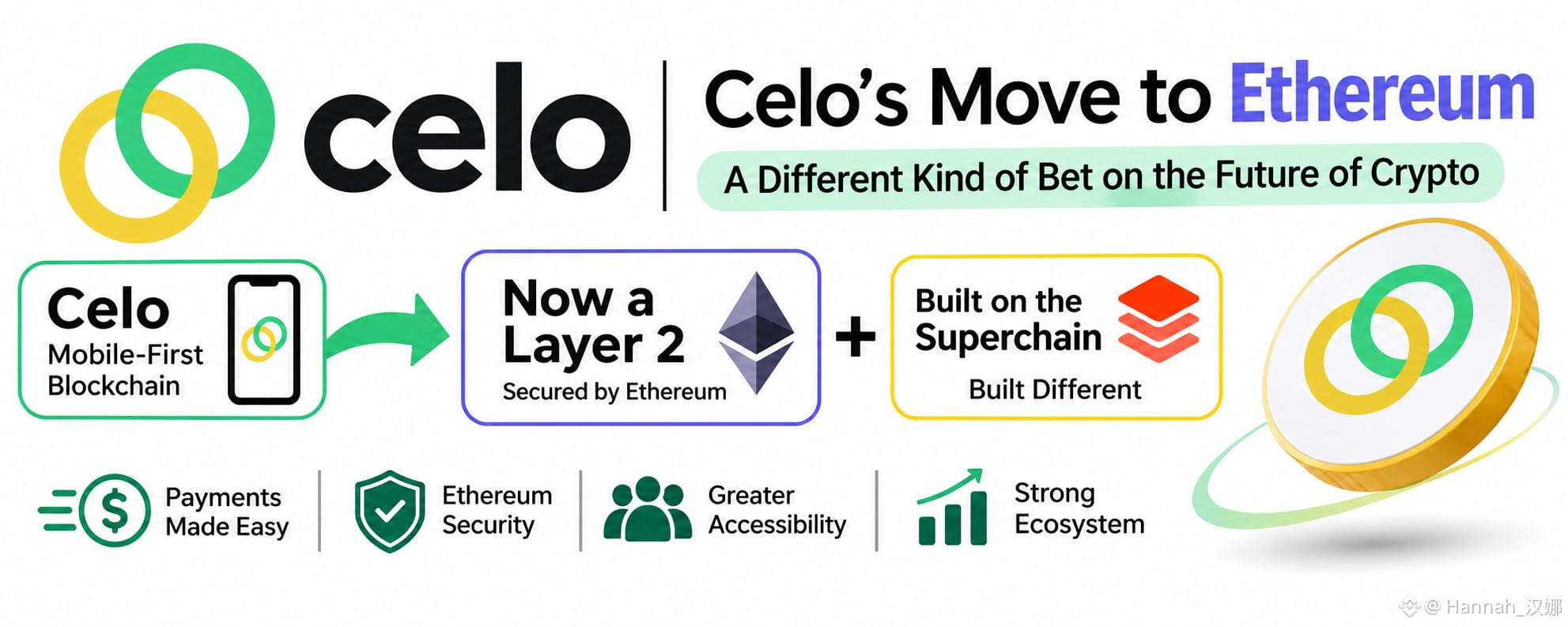


Celo’s Move to Ethereum: A Different Kind of Bet on the Future of Crypto
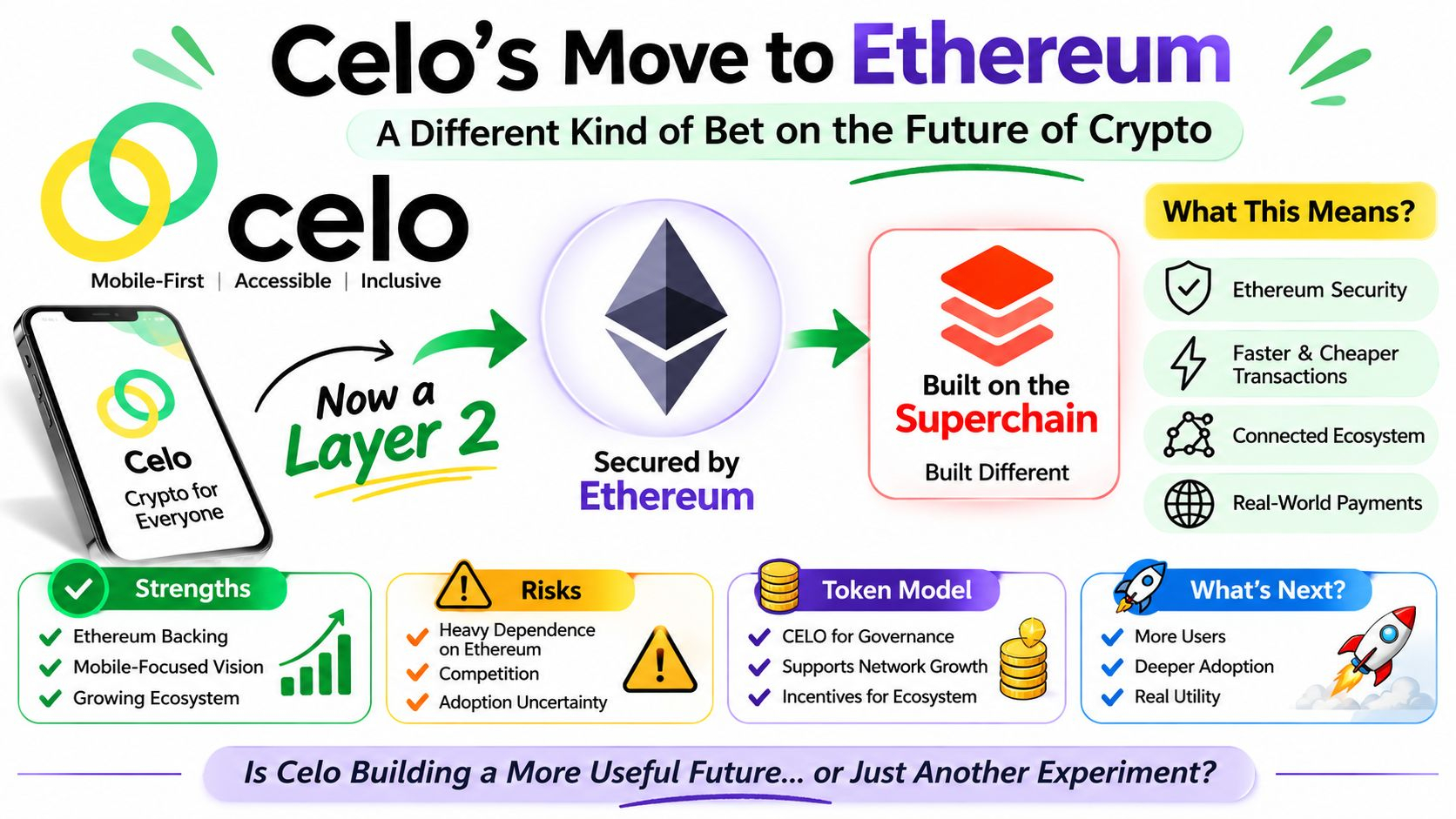
I was looking into the way liquidity moves between #Ethereum and its surrounding ecosystems when Celo caught my attention again. Not because of a sudden price move or some new narrative taking over the timeline, but because of a change that feels more interesting the longer I sit with it. Celo is now an Ethereum Layer 2, built on the OP Stack and part of the Superchain.
At first, I wondered whether this was simply another project changing its technical identity to stay relevant. Crypto has a habit of turning every infrastructure upgrade into a new story, and the market is usually happy to reward a story before it understands what has actually changed. But Celo’s move raises a more useful question: what happens when a blockchain that built its identity around making crypto accessible decides that its future is better connected to Ethereum?
That question matters in a market where liquidity is selective. Capital can move quickly toward AI, restaking, RWAs, or whatever narrative has momentum, but lasting adoption is harder to manufacture. Users do not necessarily care which execution environment a chain belongs to. They care whether transactions work, fees are manageable, applications are useful, and their money can move without unnecessary friction.
$CELO has always had a fairly practical problem in front of it. The world does not need another blockchain simply because another blockchain can exist. It needs networks that make using digital assets less complicated, especially for people who are not already comfortable navigating wallets, bridges, gas tokens, and fragmented applications.
That is where Celo’s mobile-first approach becomes relevant. Its original focus was on making financial tools accessible through smartphones, particularly in places where traditional financial infrastructure can be expensive or inconvenient. Stablecoins and payments are a natural fit for that vision. They are not exciting in the same way as a new trading primitive, but they solve problems that exist outside crypto’s own speculative economy.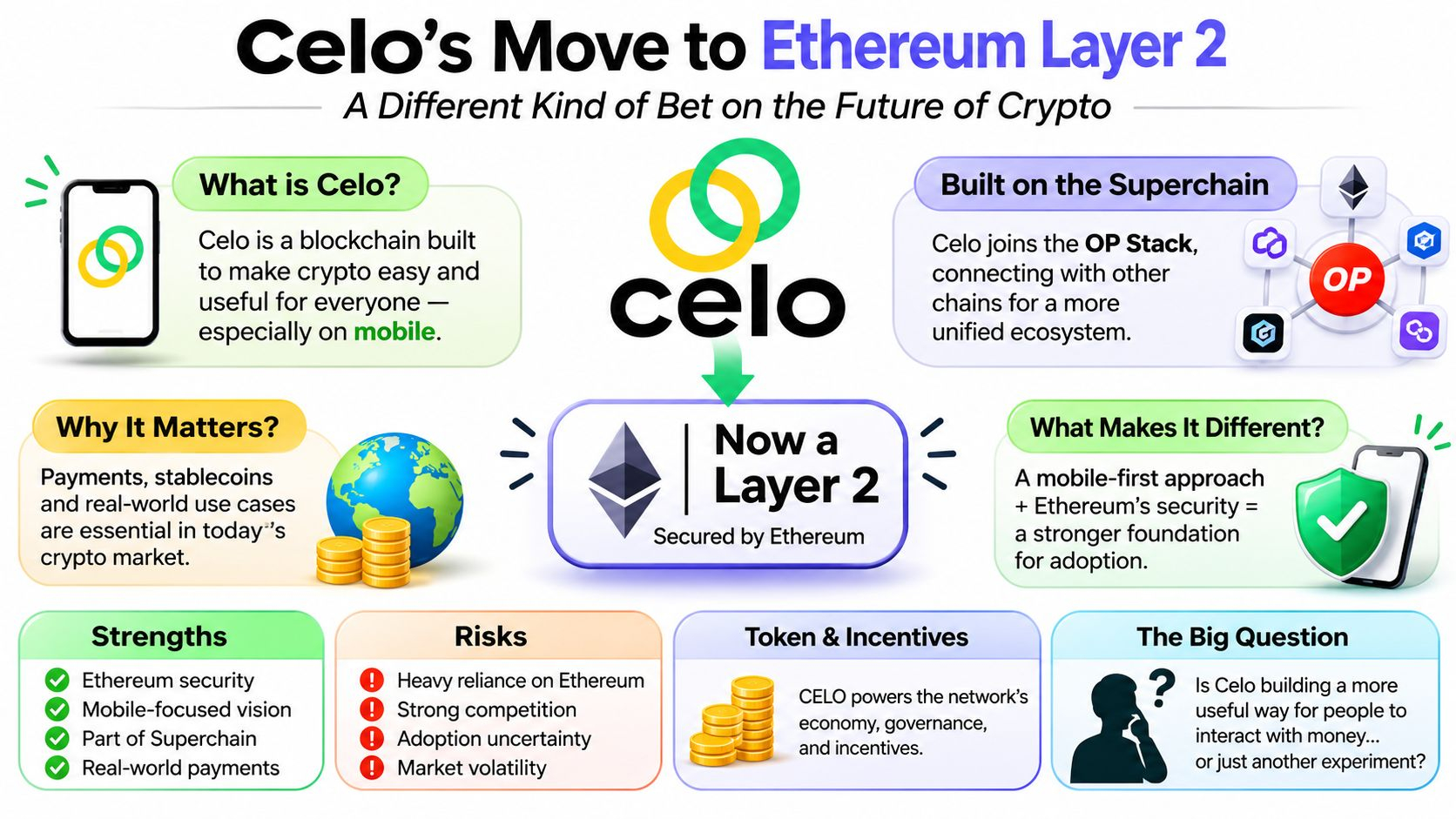
And honestly, that is one reason I think the project deserves a closer look. Payments are not a narrative that needs to be invented every cycle. People already need to send money, receive money, and hold value. The challenge is making blockchain-based alternatives reliable enough that users stop thinking about the blockchain underneath them.
The Ethereum Layer 2 transition changes how Celo approaches that challenge.
Instead of operating as an independent Layer 1 with its own validator set securing the network, Celo now uses Ethereum for settlement and security. Its execution environment is built using the OP Stack, the same underlying framework used across the Optimism ecosystem. In simple terms, transactions can be processed on Celo while Ethereum provides the security foundation for settling them.
That distinction is more important than it might sound. Running an independent chain gives a project control, but it also means carrying the burden of maintaining its own security and convincing users and developers that its ecosystem is worth joining. Connecting to Ethereum can reduce some of that burden while making Celo part of a larger environment where liquidity, tooling, and developer experience already have established roots.
The Superchain angle adds another layer to this. The idea is not just that multiple chains use similar technology. It is that they can become more connected through shared infrastructure and standards, making it easier for applications and users to move between different environments. If that vision works, Celo could benefit from being part of a broader network rather than competing for attention as an isolated ecosystem.
But I would be careful about treating that as an automatic advantage.
Using the same technology does not mean every chain suddenly shares the same liquidity, users, or economic incentives. Developers still need a reason to build on Celo rather than another OP Stack chain. Users still need a reason to stay. And liquidity is not something a project inherits simply because it joins a larger ecosystem.
That is where I see the real test beginning.
Celo’s strongest differentiator may not be its technology at all. It may be the combination of Ethereum connectivity and an existing focus on everyday financial activity. Plenty of networks can offer fast transactions and low fees. Fewer have a clear reason to care about payments, stablecoin usage, and mobile access beyond using those things as talking points.
There is a meaningful difference between building infrastructure that can process transactions and building infrastructure that people actually depend on. Celo has spent years working toward the second problem. Its transition to Ethereum does not erase that history, and it gives the project an opportunity to bring that focus into a more connected environment.
Still, the market has seen this pattern before. A chain gains attention, incentives attract activity, and the numbers look impressive for a while. Then the rewards slow down and everyone discovers that much of the activity was temporary. I have become more interested in what remains after the incentives disappear than in how quickly a new ecosystem can grow.
For celo, I would want to see whether people continue using its payment applications because they are genuinely convenient. Are stablecoins moving because people need to transfer value, or because a campaign makes it temporarily profitable? Are developers choosing Celo because its infrastructure fits their applications, or because they are chasing the next distribution opportunity?
Those questions are not unique to Celo, but they matter especially for a project whose strongest argument is practical utility.
The token also deserves a closer look. CELO has a role in the network’s economics and governance, and the transition brings it into a different technical environment. But I would not automatically translate a change in infrastructure into a change in token demand. A network can become more useful without every additional transaction creating meaningful economic value for its token holders.
That distinction gets lost when people discuss ecosystem growth. More users, more transactions, and more applications are encouraging signals, but they do not all carry the same economic weight. The important question is whether the activity creates a durable reason for the token to be used, held, or participate in the network’s security and governance.
There are risks on the other side of the transition, too. Celo becomes more connected to Ethereum, but it also becomes more dependent on the assumptions and operational realities of that ecosystem. Ethereum settlement is a meaningful security advantage, yet it does not make every application, bridge, or user interaction automatically safe. The OP Stack brings useful infrastructure, but shared technology can also mean shared dependencies.
And then there is the question of identity.
Celo spent years building a story around mobile access and financial inclusion. Joining the Superchain could give that mission better infrastructure and a wider network of potential users. But it could also make Celo harder to distinguish from the growing number of chains using similar technology. If every ecosystem starts to look technically interchangeable, the ones with the clearest reason to exist may matter more than the ones with the most impressive architecture.
There is something slightly under-discussed here: a successful blockchain for payments might not look like a successful blockchain by crypto’s usual standards. It may not need constant speculation, complicated financial products, or a new narrative every few months. It might simply need to become dependable enough that people use it without thinking about it.
That sounds almost boring in a market trained to search for the next big thing. But boring infrastructure can become important infrastructure. The difficulty is that markets often reward the promise of that future long before the evidence arrives.
I think Celo’s move makes sense as a strategic decision. It gives the project a stronger connection to Ethereum, access to a broader development environment, and a chance to build on its existing focus rather than starting over with a completely different identity.
What I am less certain about is whether that advantage will translate into lasting adoption. The transition creates an opportunity, not a guarantee. The real evidence will come from what users do when the incentives are less attractive, when liquidity rotates elsewhere, and when the market stops paying attention.
Maybe the most interesting thing about Celo is that its future depends less on convincing crypto participants that it is different, and more on making that difference useful to people who never cared about the Superchain in the first place.
If that happens, the Ethereum connection could turn out to be more than a technical upgrade. It could become the infrastructure behind a financial network that people actually rely on. But if the technology improves and the everyday experience remains unchanged, then what has really been achieved?
Is Celo building a more useful way for people to interact with money, or is it simply becomi
ng another well-designed experiment competing for liquidity?