

When we invest in stocks, we usually look at what a company actually does.
Does it develop technology? Manufacture products? Provide services? Generate revenue? Solve real-world problems?
But what about cryptocurrency?
Many people see crypto as nothing more than buying a coin at a low price and hoping to sell it higher.
However, some crypto projects are building something much bigger. They are developing infrastructure, financial systems, payment networks and technologies that could play an important role in the future.
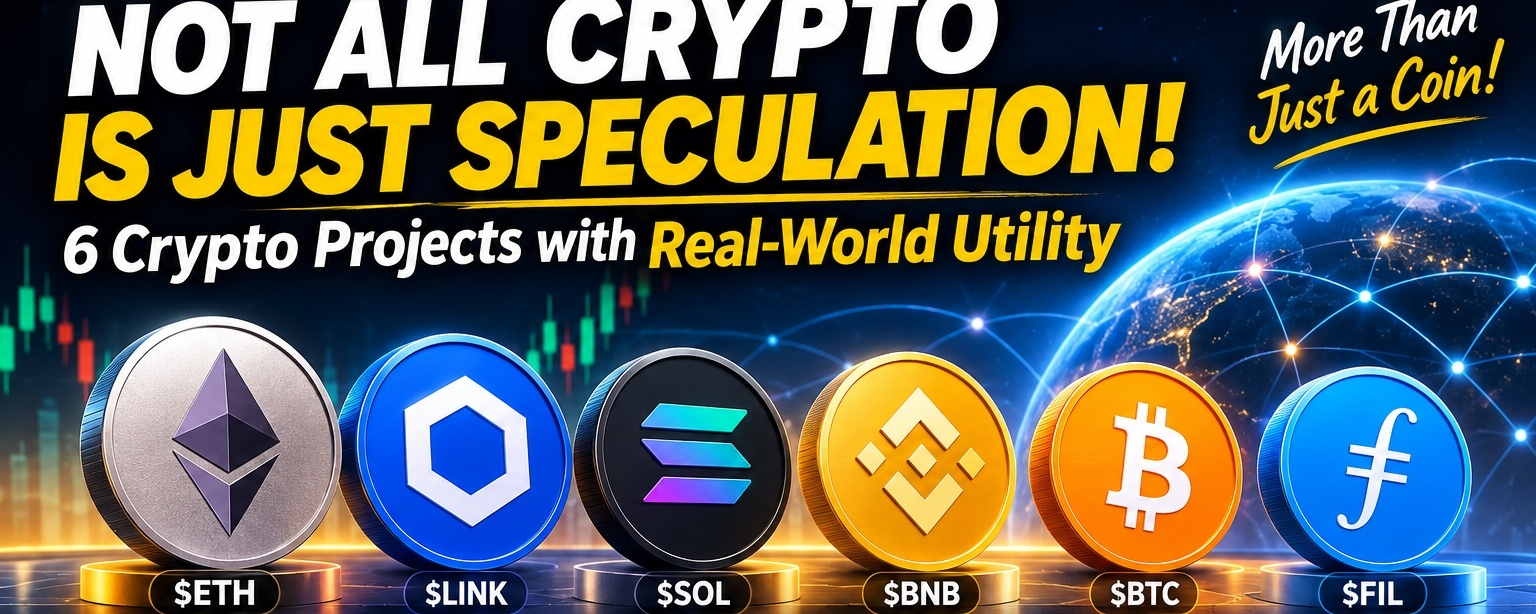
Let's look at 6 cryptocurrency projects that have actual utility beyond speculation.
1. Ethereum ($ETH) – The Foundation of Decentralized Applications
Ethereum is more than a cryptocurrency. It is a programmable blockchain where developers can build applications using smart contracts.
What does it actually do?
- Powers decentralized finance (DeFi).
- Supports smart contracts and decentralized applications.
- Enables tokenization of real-world assets.
- Supports stablecoins and NFT ecosystems.
Think of Ethereum as an operating system for decentralized financial applications.
2. Chainlink ($LINK) – Connecting Blockchain With the Real World
Blockchains cannot independently access most external information. Chainlink helps solve this problem.
What does it actually do?
- Provides real-world data to smart contracts.
- Supplies price feeds to DeFi platforms.
- Supports proof of reserves.
- Enables communication between different blockchains.
- Helps connect traditional financial institutions with blockchain infrastructure.
Think of Chainlink as a bridge connecting blockchain technology with real-world information.
3. Solana ($SOL) – Fast Blockchain Infrastructure
Solana focuses on providing fast and relatively low-cost blockchain transactions.
What does it actually do?
- Supports decentralized exchanges.
- Powers payment applications.
- Supports DeFi and NFT platforms.
- Enables developers to build blockchain applications.
- Provides infrastructure for token transfers and other on-chain activities.
Think of Solana as a high-performance network for digital applications and financial transactions.
4. BNB ($BNB) – Fuel for an Entire Blockchain Ecosystem
BNB is the native cryptocurrency of BNB Chain and has several practical uses.
What does it actually do?
- Pays transaction fees on BNB Chain.
- Supports smart contract interactions.
- Can be staked to help secure the network.
- Provides participation in network governance.
- Offers trading fee utility within the Binance ecosystem.
BNB is not just a trading symbol; it has an important role in powering its blockchain ecosystem.
5. Bitcoin ($BTC) – Decentralized Digital Money
Bitcoin has a different purpose from most other projects.
It was designed as a peer-to-peer digital payment system that does not require a central authority.
What does it actually do?
- Enables peer-to-peer value transfers.
- Operates without a central bank.
- Provides a globally accessible monetary network.
- Offers a scarce digital asset with a maximum supply of 21 million BTC.
Bitcoin's main proposition is monetary independence and decentralized value transfer, rather than supporting complex applications.
6. Filecoin ($FIL) – Decentralized Data Storage
Data storage is an essential part of the internet, and Filecoin aims to provide an alternative to traditional centralized storage providers.
What does it actually do?
- Provides a decentralized storage marketplace.
- Connects people who need storage with storage providers.
- Uses FIL for payments within its storage economy.
- Uses cryptographic verification to help verify stored data.
Think of it as an attempt to create a decentralized alternative to traditional cloud storage.
📊 THE BIGGER PICTURE
These projects are working in different areas:
- ETH – Decentralized applications.
- LINK – Blockchain data infrastructure.
- SOL – Fast blockchain infrastructure.
- BNB – Blockchain ecosystem and transactions.
- BTC – Digital money.
- FIL – Decentralized storage.
💡 MY FINAL THOUGHT
I believe the future of crypto should not be judged only by price movements, market capitalization or hype.
We should also ask:
1. Does the project solve a real problem?
2. Are people actually using its technology?
3. Does the token have a necessary role in the ecosystem?
4. Is the network growing in adoption?
5. Does increased usage create meaningful demand for the token?
One important distinction: owning ETH, LINK or SOL does not mean owning shares in the organizations developing their ecosystems. Token holders generally don't receive traditional company ownership or guaranteed profits.
The real question isn't just which cryptocurrency will pump next. It's which blockchain projects will still be useful 5–10 years from now.
What's your pick? Which crypto project has the strongest real-world utility? 👇


#BitcoinAndStocksSlipAgainAmidTrump’sTariffPlans #WillOctCorePCEShiftFedHikeExpectations? #JensenHuangSaysNvidiaDoesn’tNeedASuccessionPlan #AnthropicBreaksBelowIPOPriceAmidAISlump #Bitcoin'sReboundFadesBelow$60K