


Whilst many chains discuss scalability, Celo delivered this behind the scenes.
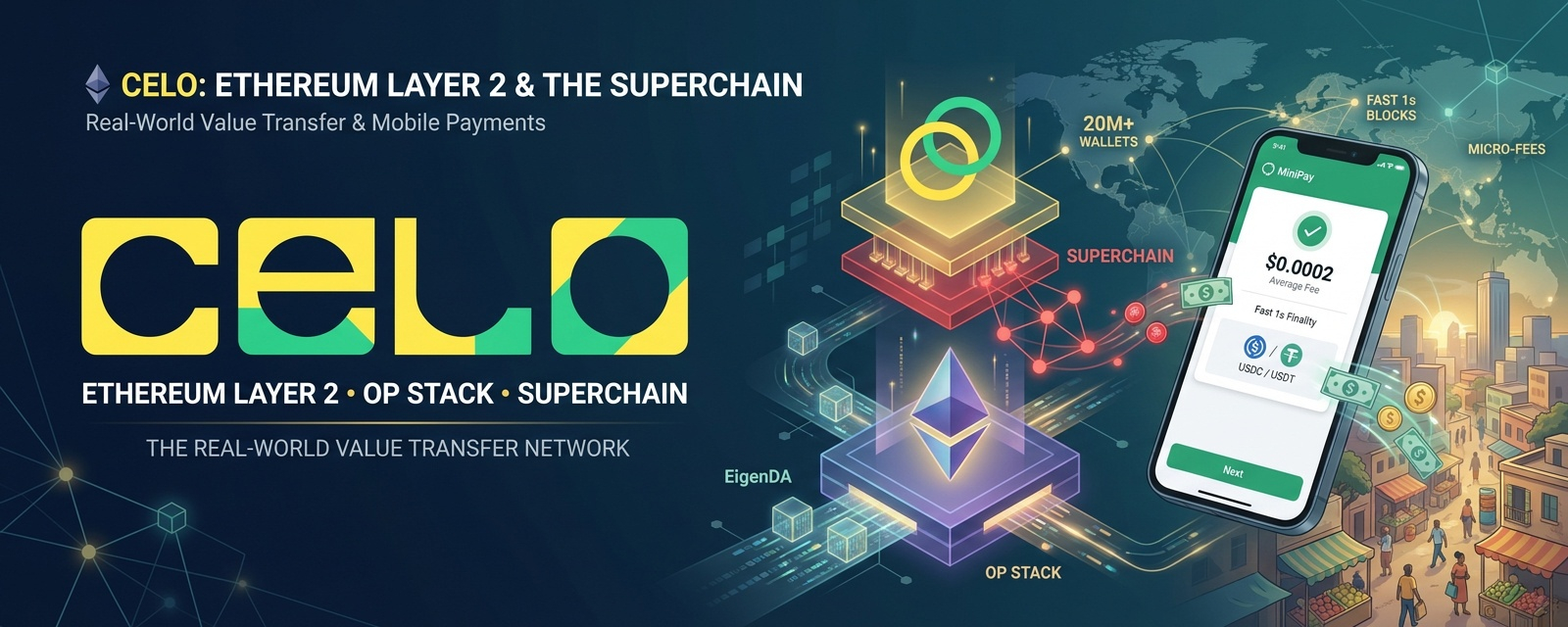
In March 2025 Celo executed perhaps one of the most complex upgrades in Ethereum’s history. It became an Ethereum layer two built on the OP Stack. It also settled on Ethereum and utilised EigenDA for data availability. Crucially, its state and history was maintained. Little change was felt by both users and developers. However, users did appreciate the quicker finality and lower costs.
Whilst this was not a re-brand, there had been a conscious choice to exchange Celo’s self-secured nature for Ethereum’s economic security. Nonetheless, Celo has retained its unique selling points – namely micro-fees, fast 1 second blocks and the option to use stablecoins to cover gas costs.
Why it matters now.
For much of the time, CELO’s price has seemingly not correlated well with the networks’ underlying activity. Despite this, on-chain activity has continued robustly. MiniPay, the stablecoin enabled wallet within Opera Mini, has activated in excess of 20 million wallets. It has executed in excess of 600 million transactions and moved over $2.3bn in value. This has occurred in 70+ countries. Moreover, daily active addresses are frequently in excess of 100,000. Average fees are c.$0.0002.
It is interesting that there appears to be such a disconnection between on-chain reality and CELO’s price. Although there are no certainties, we do know that Celo is being used for what it was intended – efficiently and effectively enabling value transfer. Particularly in regions where conventional infrastructure is costly or inconsistent.
Technical and on-chain perspective.
Celo’s layer two solution is functional. It uses the OP Stack for execution. Rather than Ethereum blobs which are costly, it uses EigenDA to provide data availability.
Settlement occurs on Ethereum. Hence, it is able to deliver quick 1 second blocks and maintain low fees, even at peak periods.
Fee abstraction continues to be a highly functional feature. Customers can settle payments in stablecoins (such as USDT and USDC) and these can be sourced directly from a customers’ standard wallet. There is no need for paymasters or additional tokens. For example, this is hugely helpful for those in Lagos or Nairobi making payments using MiniPay.
Recent statistics confirm that Celo can process hundreds of thousands of daily transactions. Furthermore, stablecoins in circulation total hundreds of millions. Crucially, this is not largely driven by speculative DeFi activity. Rather, much of it relates to payments and value transfer. Again, this is precisely what Celo has always aimed to enable.
Fundamentals and token economics.
Aside from the technological evolution, the fee structure was also reworked. As previously, a section of fees is used for carbon offset initiatives. However, predominantly fees now go towards covering running expenses together with those for data availability, Ethereum settlement, sequencer functions and the necessary portion to remit to the Superchain.
Within the community, there has been much debate regarding the best method to redistribute sequencer income – for example, through buybacks, burning or contributing to a communal fund. This is a healthy dialogue and demonstrates that Celo is both active and seeking to ensure appropriate motivation post-technical evolution. Whether the present approach is perfect is an area for further governance consideration.
Unquestionably, Celo has maintained its distinctiveness and successfully integrated into the wider Ethereum and Superchain ecosystems. In doing so, it gains from interoperability, common tooling and Ethereum’s security spend. For a value-transfer orientated chain, this is highly advantageous.
Risks, opportunities and considerations.
Whilst no networks are wholly without risk, CELO remains a comparatively high volatility asset. Alongside token-specific risks, Celo faces competition from alternative layer twos for payments and stablecoin services. As with all protocols, there are also general execution risks. Furthermore, by becoming an Ethereum layer two, Celo is now reliant on Ethereum for security. It is also subject to the continued good performance of both EigenDA and the OP Stack – again, not purely hypothetical issues.
Nevertheless, the practical offering is highly attractive for some applications. Combining sub-cent stablecoin payment functionality, mobile orientated solutions such as MiniPay and increasing product integration (for instance, Stripe’s Link in certain regions), Celo is well placed to effect real-world value transfer. This is arguably better than most purely DeFi or meme based chains can assert.
Fundamentally, when analysing Celo, people should consider whether user adoption is continuing, whether fees remain low and whether there is clear consideration of token economics within the governance process. So far, indications are favourable on all fronts – although this does not appear to have fully translated into price yet.
Final musings.
Rather than attempting to be a general purpose layer two, Celo has remained payment orientated. It has maintained key customer facing functionality and attached itself to Ethereum’s security. Becoming part of the Superchain also provides further interoperability benefits, without requiring Celo to forsake its initial proposition.
Whilst therefore continuing to represent an underlying-adoption play, there is concrete on-chain and MiniPay data to analyse. Equally, there are genuine risks around token performance and competitive positioning. People should investigate these areas, test products if possible and then develop their own conclusions.
If you are investigating CELO on Binance, or indeed following the current trading boom, recognise that this should be analysed as just another data element. More intriguingly, one should assess whether a payment orientated, Ethereum layer two with millions of real world wallets can continue to transform underlying adoption into enduring value for the network. The narrative on this is yet to be concluded.
Conduct your own research. The chain is active and quantifiable data is available. Beyond that, the market and community will determine further outcomes.