
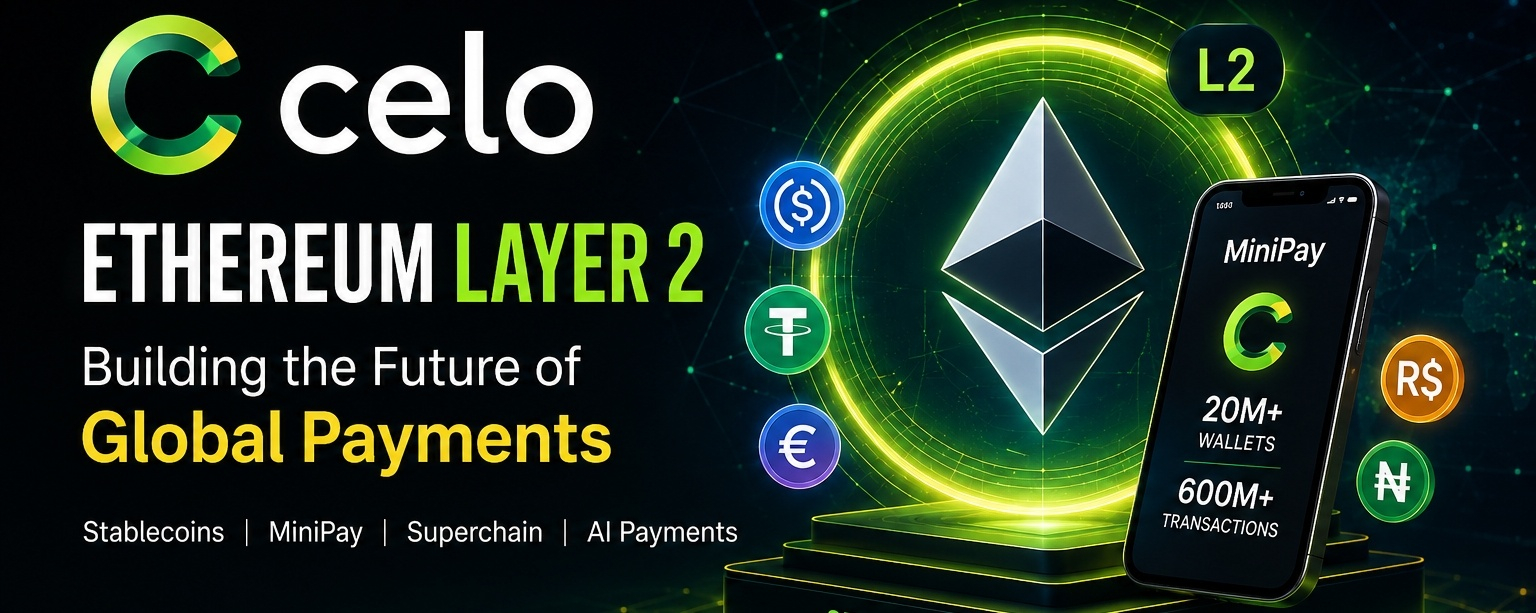

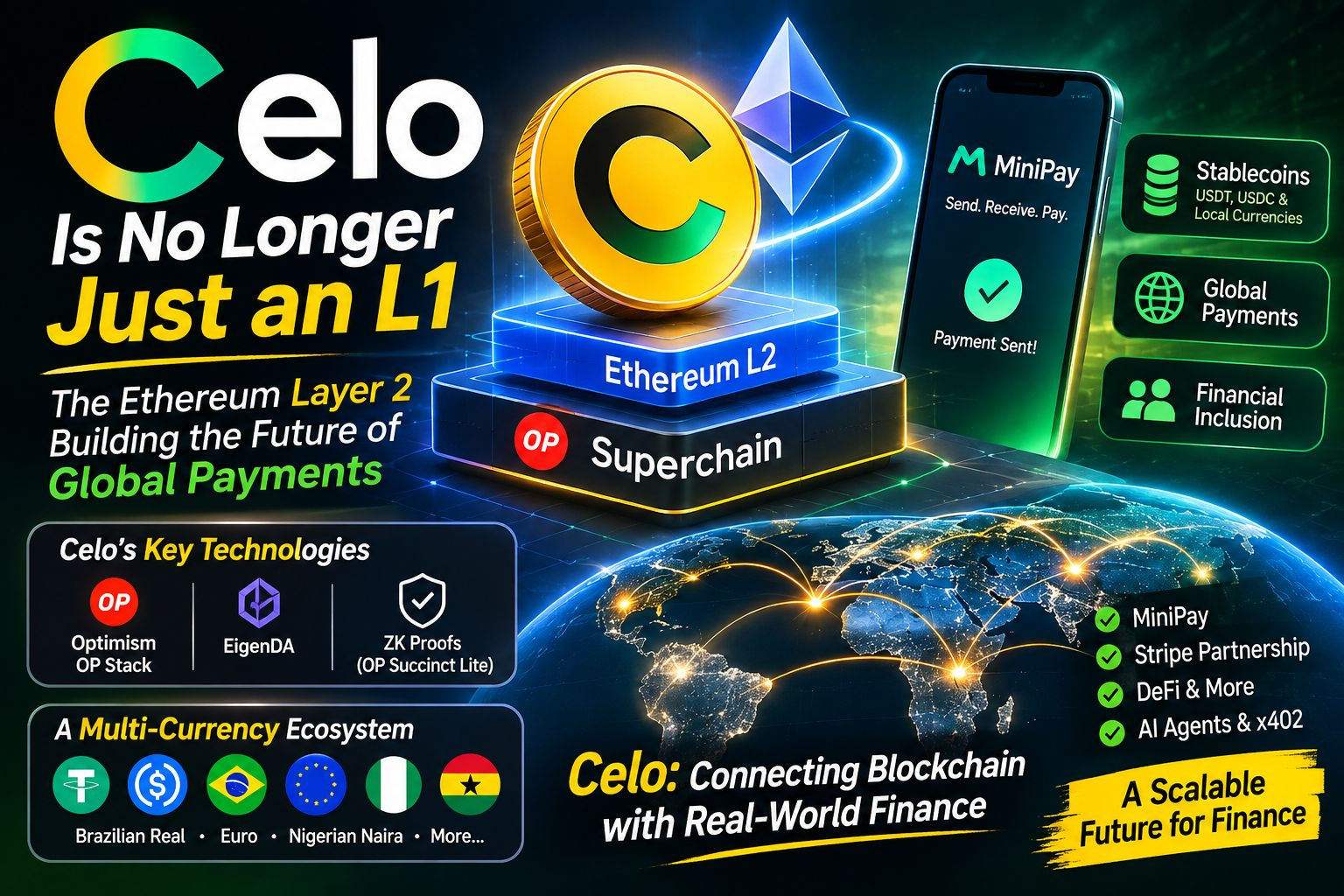
Celo is no longer just another blockchain competing for attention. It has made a major architectural move: becoming an Ethereum Layer 2 while keeping its original mission of making financial services accessible to people around the world.
But what does that actually mean?
Why did Celo move away from being an independent Layer 1? How does Ethereum security fit into its architecture? What is the Superchain? And why are stablecoins, MiniPay, local currencies and everyday payments at the center of its strategy?
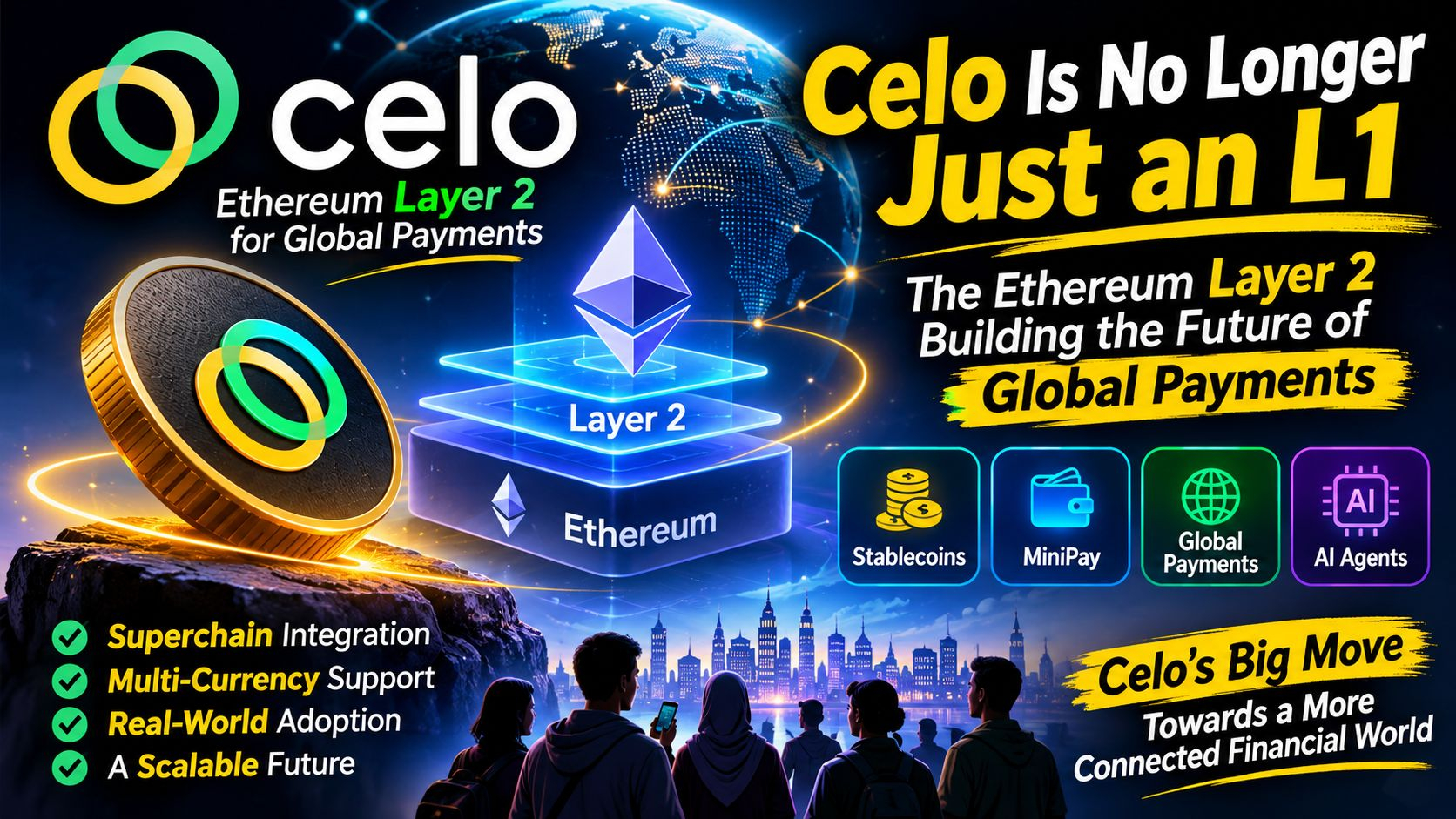
Let's explore the technology, ecosystem, tokenomics and future opportunities behind Celo.
1. Understanding Celo's Transformation
Originally, Celo operated as an independent, EVM-compatible Layer 1 blockchain.
In May 2024, the Celo community approved the proposal to migrate the network to an Ethereum Layer 2.
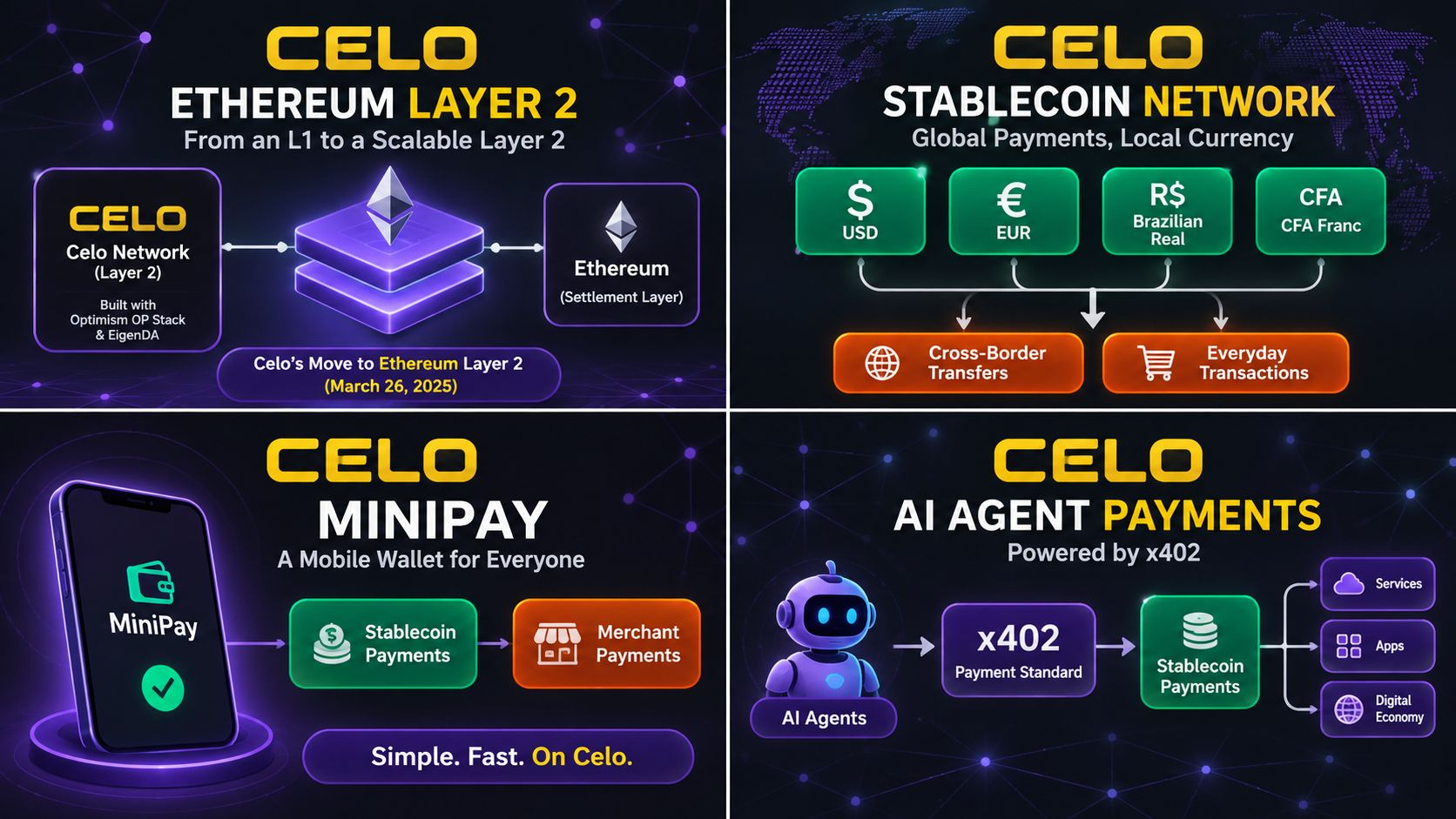
The transition officially went live on March 26, 2025, at block 31,056,500.
This was not simply a branding change. It was a major technical transformation.
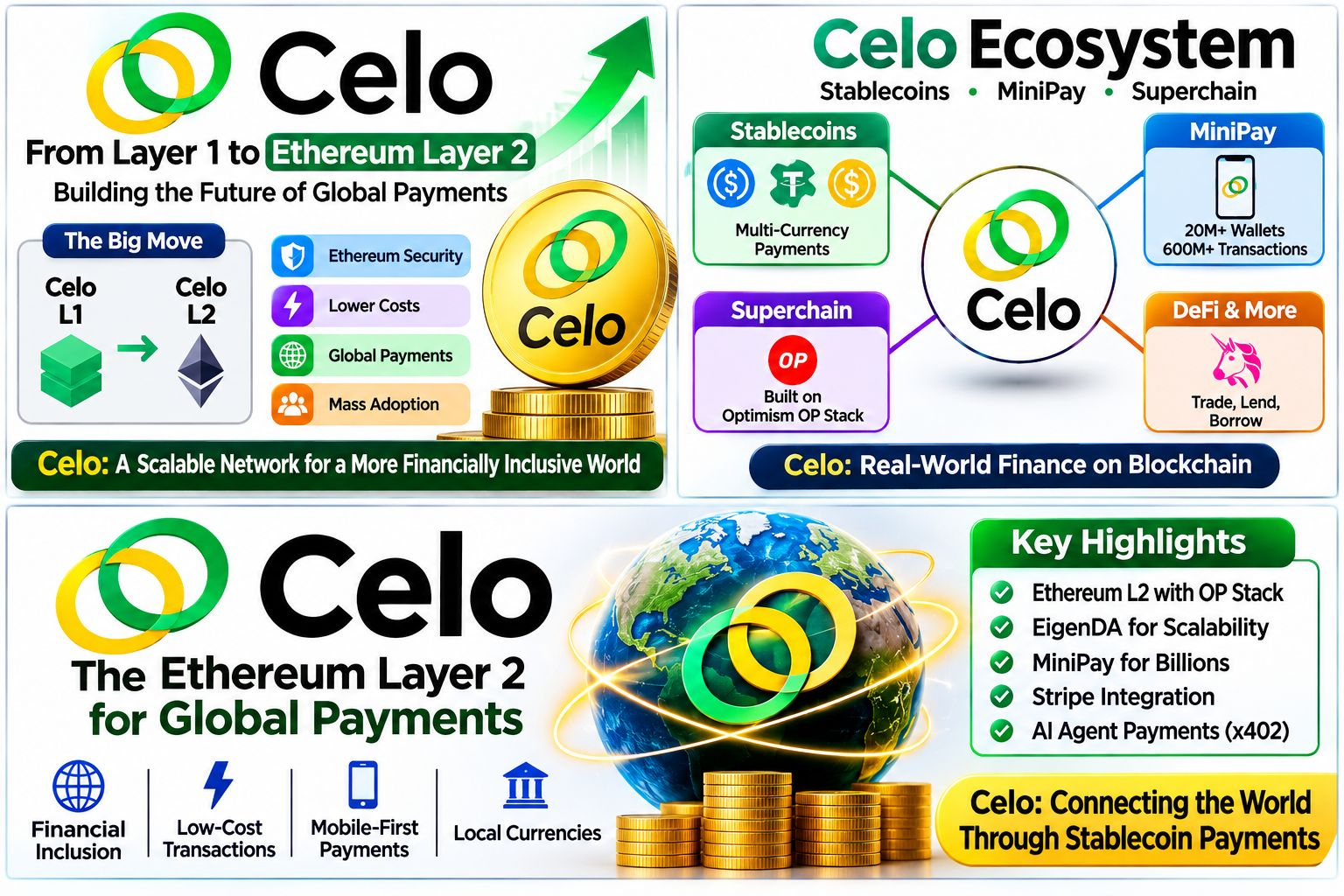
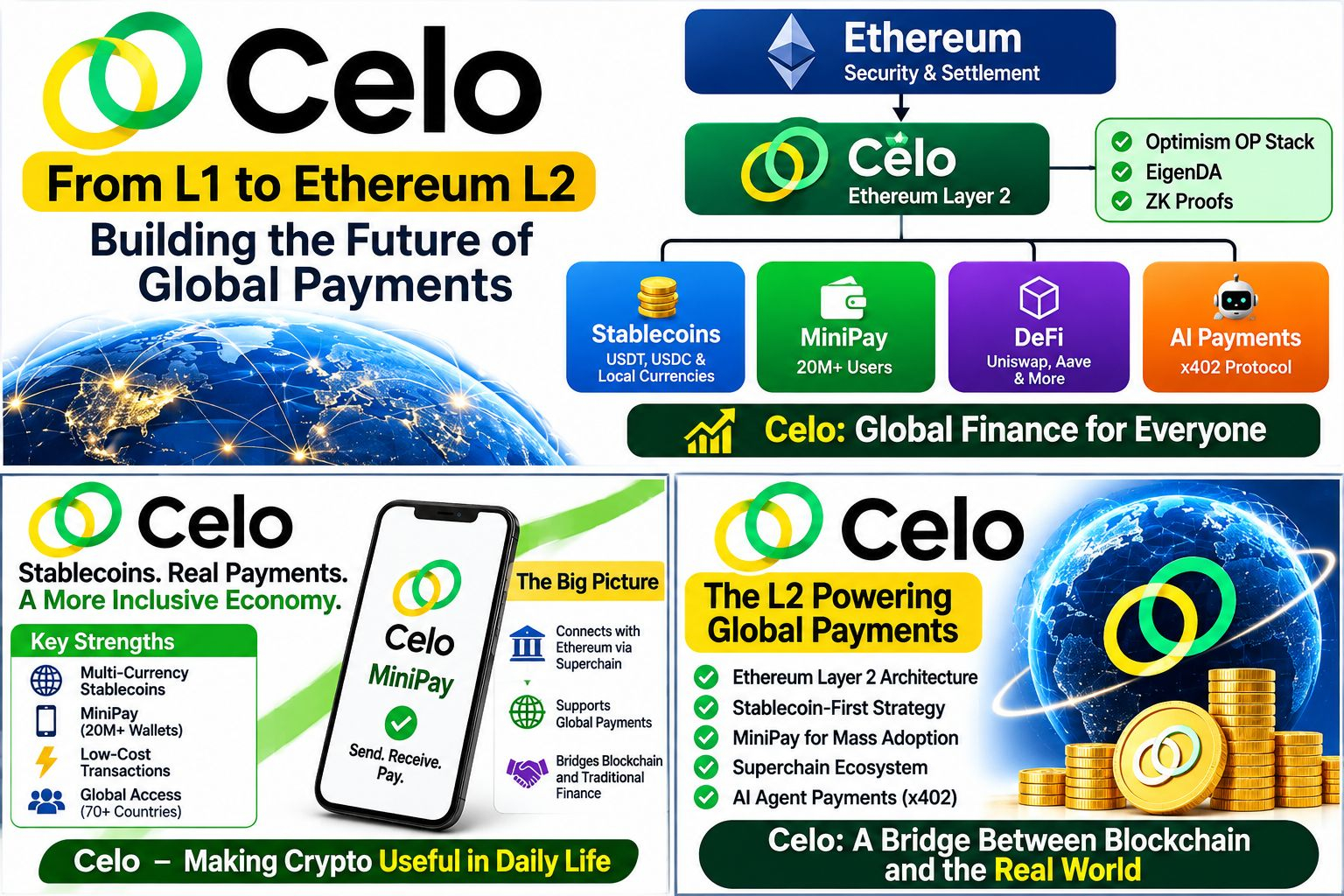
Celo adopted the Optimism OP Stack, integrated Ethereum into its security and settlement architecture, and introduced EigenDA for data availability.
The objective was straightforward:
- Maintain Celo's payment-focused identity.
- Improve its connection with Ethereum.
- Reduce the cost of maintaining independent security infrastructure.
- Make it easier for Ethereum developers and applications to integrate.
- Build a scalable foundation for global financial services.
2. What Does Ethereum Layer 2 Actually Mean?
Think of Ethereum as the main financial settlement infrastructure.
Layer 2 networks process transactions through a separate execution environment while using Ethereum as part of their underlying settlement and security architecture.
Celo's transition means developers can build applications in a familiar EVM environment while benefiting from its connection to Ethereum.
However, Celo uses an Optimium architecture. Its transaction data availability is handled through EigenDA rather than publishing all transaction data directly to Ethereum.
This distinction matters because different Layer 2 designs have different security assumptions.
3. The Technology Behind Celo
Three technologies are especially important.
Optimism OP Stack
Celo uses the open-source OP Stack framework to power its Layer 2 architecture.
This provides Ethereum-compatible infrastructure, familiar development tools and opportunities for integration with other Superchain networks.
EigenDA
EigenDA provides data availability for Celo.
In simple terms, data availability means making sure the information required to reconstruct and verify blockchain activity is accessible.
This allows Celo to pursue higher transaction capacity without publishing all transaction data directly on Ethereum.
OP Succinct Lite and Zero-Knowledge Proofs
Celo's Jello hardfork, activated on December 10, 2025, introduced OP Succinct Lite, developed with Succinct and EigenDA.
It brought ZK-powered fault-proof mechanisms and a verification bridge for EigenDA data availability.
This is an important development because cryptographic proofs can help strengthen the verification process.
However, it does not mean every decentralization milestone has been completed.
4. What Is the Superchain?
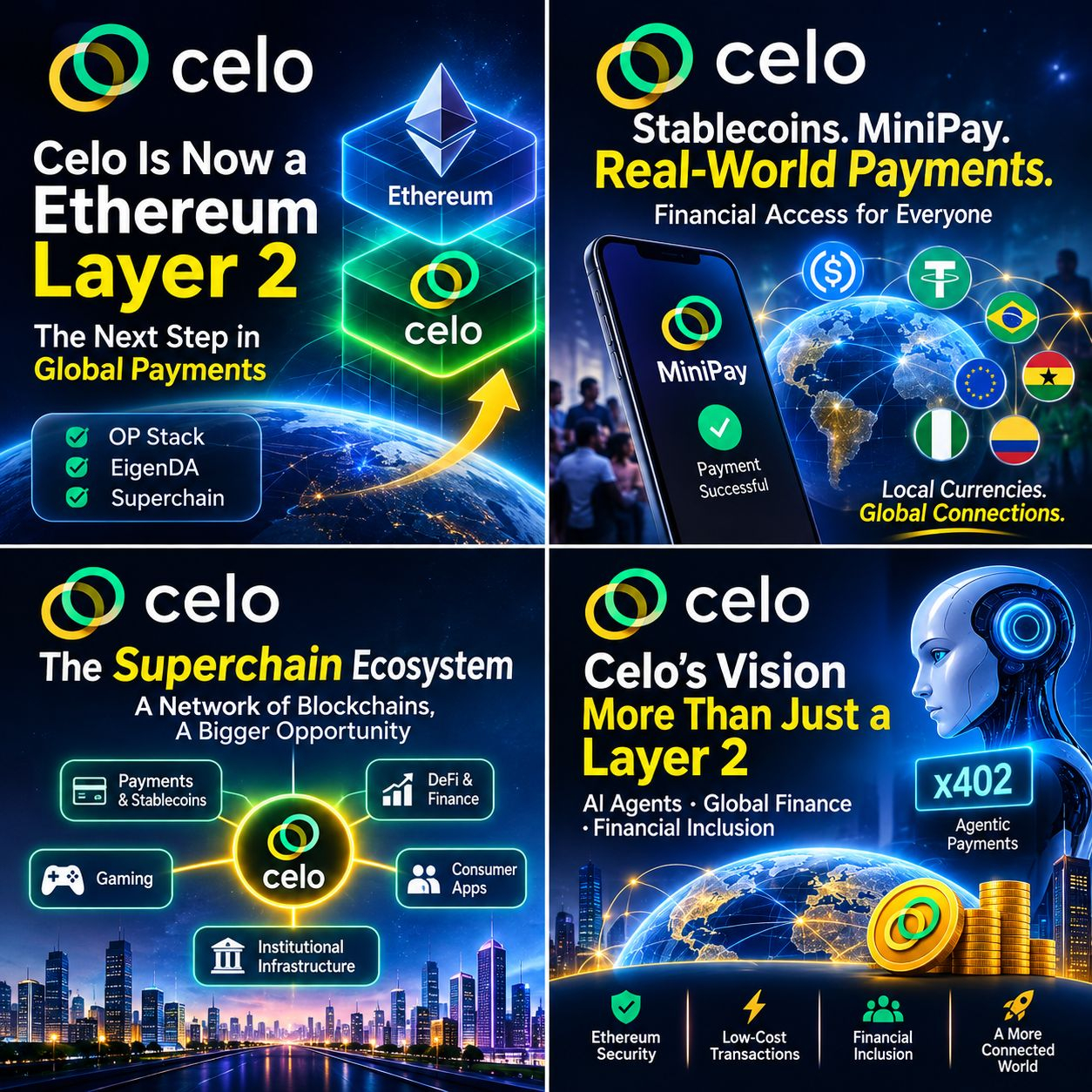
The Superchain is an ecosystem of blockchain networks built using the OP Stack and aligned around shared infrastructure and standards.
Think of it as a network of specialized blockchains rather than one blockchain trying to handle every application.
Different chains can focus on different industries:
- Payments and stablecoins.
- DeFi and financial applications.
- Consumer applications.
- Gaming.
- Institutional infrastructure.
Celo brings something particularly interesting to this ecosystem: its existing focus on mobile-first financial services and real-world stablecoin usage.
Being part of the Superchain creates opportunities for developers, liquidity and applications to connect with a broader Ethereum scaling ecosystem.
However, membership does not automatically mean every chain has identical security, governance or interoperability.
5. Celo's Real Competitive Advantage: Stablecoins
This is where Celo becomes particularly interesting.
Many blockchain networks compete through DeFi incentives, speculative trading or NFT ecosystems.
Celo has spent years developing a different approach: making stablecoins practical for everyday financial activity.
Its ecosystem includes USDT, USDC and Mento's local-currency stablecoins.
These include assets linked to currencies such as:
- Brazilian real.
- Euro.
- Ghanaian cedi.
- Kenyan shilling.
- Nigerian naira.
- Colombian peso.
Why is this important?
Imagine someone in Nigeria wants to receive digital dollars, while someone in Brazil wants to transact using Brazilian reais.
A blockchain supporting multiple currencies can help create more efficient financial connections.
This creates opportunities for:
1. International transfers.
2. Local-currency payments.
3. Onchain foreign exchange.
4. Digital savings.
5. Merchant payments.
6. Financial applications for underserved communities.
Celo is positioning itself not simply as a network where stablecoins exist, but as infrastructure where stablecoins are intended to be used.
6. MiniPay: The Consumer Adoption Engine
One of the strongest examples of Celo's real-world strategy is MiniPay.
MiniPay is a self-custodial stablecoin wallet developed by Opera and built on Celo.
Its goal is to make stablecoin transactions feel more like using a normal mobile financial application.
According to the November 19, 2026 announcement:
- More than 20 million activated wallets.
- Over 600 million transactions.
- Users across more than 70 countries.
- More than 77 Mini Apps.
On November 19, MiniPay announced an upgrade to Privy wallet infrastructure, enabling email, social login and passkey-based access while maintaining self-custody and the ability to export keys.
The partnership builds on MiniPay's integration with Stripe's Link payment infrastructure, announced on November 12, 2026.
This could reduce two major barriers to crypto adoption:
- Complicated wallet creation.
- Difficult ways of moving money into a crypto wallet.
The important point is that Celo is working on the entire user experience, not just the blockchain underneath it.
7. Celo and Stripe: Connecting Blockchain With Traditional Payments
Another development worth understanding is the growing relationship between Celo's ecosystem and Stripe.
Bridge, a Stripe-owned stablecoin infrastructure platform, added support for Celo in 2026.
Bridge provides infrastructure that helps businesses integrate stablecoin payments, transfers and cross-chain functionality.
Businesses need more than cheap transactions. They also need:
- Payment infrastructure.
- Reliable stablecoin liquidity.
- Onramps and offramps.
- Developer-friendly APIs.
- Connections with existing financial systems.
MiniPay's Link integration also allows eligible users in the United States and European Union to purchase stablecoins using familiar payment methods.
The bigger picture is emerging: Celo provides blockchain infrastructure, while partners help connect that infrastructure to financial products people already understand.
8. DeFi Is Another Important Part of the Ecosystem
Celo is not exclusively a payments network.
Its Ethereum compatibility creates opportunities for decentralized finance.
Some notable ecosystem protocols include:
- Uniswap decentralized token trading and liquidity.
- Aave lending and borrowing.
- Morpho lending markets and vault infrastructure.
- Velodrome decentralized trading and liquidity.
Stablecoins become more useful when they can move beyond holding and transferring.
Users and developers need ways to trade, lend, borrow and access financial applications.
The combination of stablecoin liquidity, Ethereum-compatible smart contracts and low transaction costs creates opportunities for a broader financial ecosystem.
The challenge is ensuring that liquidity, security and sustainable demand grow alongside the number of deployed applications.
9. The Next Frontier: AI Agents and Blockchain Payments
One of the most interesting developments in Celo's 2026 ecosystem is the emergence of agentic payments.
AI agents are increasingly capable of performing tasks such as purchasing services, accessing APIs and interacting with digital platforms.
But autonomous agents also need a way to pay.
This is where x402 becomes relevant.
The x402 protocol enables internet services to request payments through HTTP payment flows.
Celo has developed a native x402 facilitator to support stablecoin-based payments by AI agents.
Its October 27, 2026 announcement expanded support to ten stablecoins, including:
- USDC.
- USDT.
- USA₮.
- wARS.
- wBRL.
- wCOP.
- wMXN.
- wCLP.
- wPEN.
- cNGN.
Celo also launched a marketplace called buy, where agents can access more than 700 services and pay using supported stablecoins.
Imagine an AI agent purchasing computing resources from a provider in another country and settling the payment automatically using a digital currency.
This introduces a new potential use case for blockchain payments.
Agentic commerce is still developing, and adoption, reliability, compliance and security will determine its long-term impact.
But Celo is already building infrastructure around this emerging opportunity.
10. Understanding the CELO Token
The native token of the ecosystem is CELO.
Its role includes:
Network Fees: CELO is the network's native gas token. Celo also supports fee abstraction, allowing users to pay transaction fees using supported ERC-20 assets, including stablecoins.
Governance: CELO holders can participate in network governance. Voting power is associated with locked CELO.
Staking and Network Participation: CELO participates in the network's proof-of-stake economic model.
Ecosystem Economics: Governance and community fund mechanisms help direct resources toward network development and ecosystem growth.
One important tokenomics detail: CELO has a maximum supply of 1 billion tokens.
However, investors should understand the distinction between network adoption and token value.
More stablecoin transactions do not automatically translate into higher CELO prices.
The economic relationship depends on fee generation, token demand, staking, governance decisions, supply dynamics and how network revenue is directed.
A growing ecosystem is an important fundamental signal, but it is not a guaranteed investment return.
11. The Security Question: What Should Users Understand?
Celo's transition to Ethereum L2 improves its relationship with Ethereum, but it does not mean every security responsibility has automatically moved to Ethereum.
Independent infrastructure tracker ETHBeat classifies Celo as an Optimium and Stage 0 network.
Its assessment identifies several important considerations:
- Transaction data availability relies on EigenDA.
- Proposer and challenger permissions remain relevant.
- Some upgrades are controlled through multisignature arrangements.
- Withdrawal and dispute mechanisms have specific trust assumptions.
The Jello upgrade introduced ZK-based fault-proof infrastructure, which is meaningful progress.
However, Stage 0 indicates that additional decentralization requirements remain.
A serious blockchain ecosystem should be judged not only by transaction speed and adoption, but also by how independently its security mechanisms operate.
12. What Makes Celo Different From Other Ethereum Layer 2 Networks?
Many Layer 2 networks compete around transaction costs, DeFi liquidity, developer incentives and scalability.
Celo has a more specialized identity.
Its strategy combines four major areas:
- Infrastructure: Ethereum L2 using OP Stack.
- Data availability: EigenDA.
- Payments: Stablecoins and MiniPay.
- Future applications: AI-agent payments and global finance.
Its biggest differentiator is the combination of mobile-first distribution and local-currency financial infrastructure.
A network may have impressive DeFi applications, but that does not automatically mean millions of people are using it to move money.
Celo is trying to connect both sides: blockchain infrastructure and practical financial applications.
13. What Should We Watch Next?
There are five developments worth following.
1. Superchain Interoperability
How effectively Celo connects with other OP Stack networks could determine how much additional liquidity and application activity it attracts.
2. Stablecoin Adoption
Watch the growth of USDT, USDC, USA₮ and local-currency stablecoins. More importantly, examine actual transfers and economic activity rather than simply counting supported tokens.
3. MiniPay Expansion
The growth of MiniPay, its Stripe integrations and its expanding payment ecosystem could be important indicators of consumer adoption.
4. Security Decentralization
Further improvements to challengers, fault proofs, data availability and governance would strengthen the network's long-term architecture.
5. AI-Powered Financial Applications
The x402 ecosystem could become an interesting source of new demand if autonomous agents begin making payments at meaningful scale.
Final Thoughts: Celo Is Building More Than Another Layer 2
The most interesting thing about Celo is not simply that it moved from Layer 1 to Layer 2.
It is the reason behind that decision.
Celo is combining Ethereum-oriented security and infrastructure with a long-standing focus on global payments, stablecoins and financial accessibility.
Its Superchain integration provides a broader technical foundation. EigenDA and OP Succinct Lite represent important infrastructure developments. MiniPay demonstrates how stablecoins can reach everyday mobile users. Stripe integrations strengthen the connection between blockchain and familiar payment experiences. Meanwhile, x402 introduces a new direction for AI-powered commerce.
There are still challenges around decentralization, data availability, liquidity and sustainable token economics.
But the larger vision is worth understanding.

The next generation of blockchain adoption may not come from people buying more tokens. It may come from people using blockchain technology without even realizing they are interacting with it.
And that is the future Celo is trying to build.
Celo is now a Layer 2. Secured by Ethereum. Built on the Superchain. But its real ambition is to become infrastructure for how the world moves money.
@Binance Square Official