
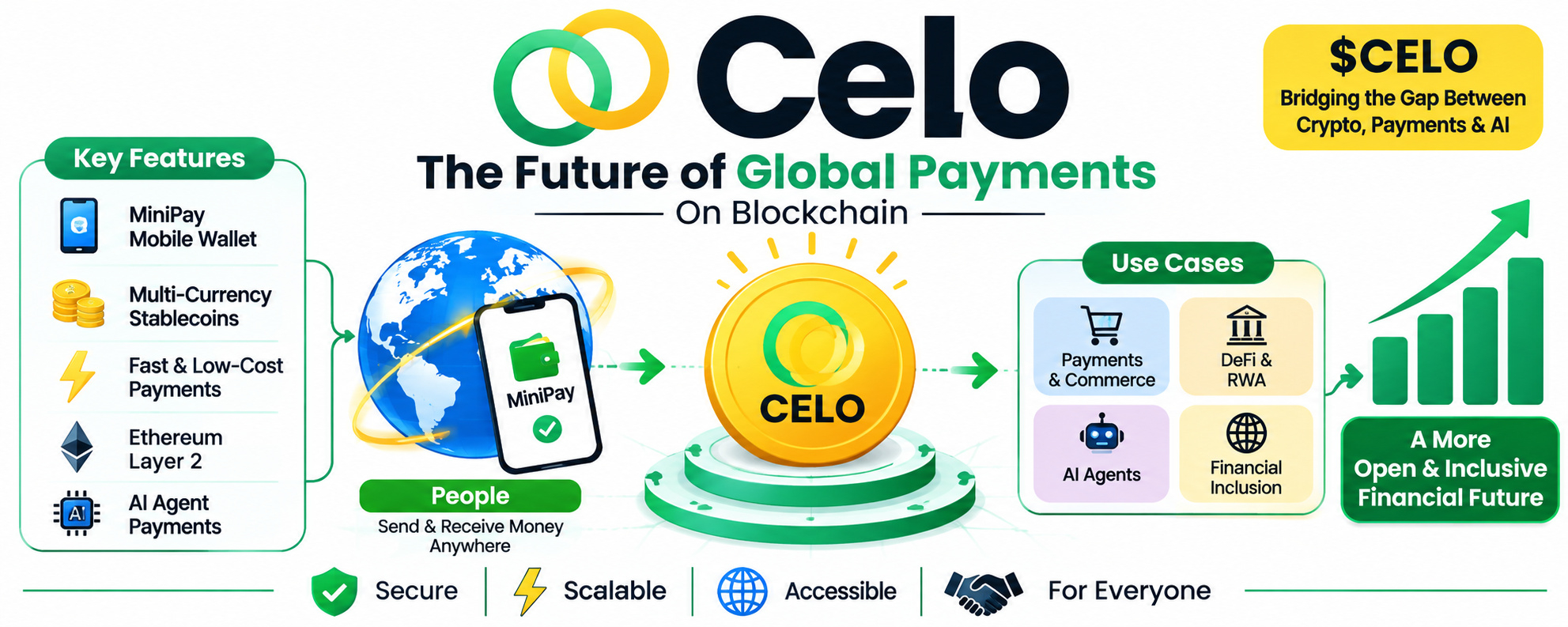

Beyond Crypto Trading: How Celo Is Connecting Stablecoins, Mobile Payments, Ethereum, and the Emerging AI Economy
What if sending money across borders became as simple as sending a message?
What if someone in Africa could receive digital dollars from Europe, a freelancer in Asia could get paid instantly, and an AI agent could purchase online services without depending on traditional banking infrastructure?
This is the kind of financial future that blockchain technology promises. And one project working to make that vision practical is Celo ($CELO).
I believe the most interesting thing about Celo is not simply its blockchain technology. It is the problem it is trying to solve: making digital payments accessible, affordable, and useful in everyday life.Celo Is Building More Than Another Blockchain
Celo launched in 2020 with a clear mission: make financial tools accessible to everyone, especially people who are underserved by traditional financial systems.
In March 2025, Celo completed its transition from an independent Layer 1 blockchain to an Ethereum Layer 2 network.
Why does this matter?
Because Celo combines an Ethereum-aligned development environment with infrastructure designed around fast, affordable payments.
Its architecture brings together:
OP Stack: Provides the Layer 2 execution environment.EigenDA: Supports cost-efficient data availability.Ethereum: Provides the settlement and security foundation.
- Fee Abstraction: Helps users pay transaction fees with supported assets rather than needing a separate gas token.
The bigger objective is simple: blockchain should become easier to use without requiring ordinary people to understand its technical complexity.
MiniPay: Bringing Crypto Payments to Everyday People
One of the most interesting parts of Celo's ecosystem is MiniPay, a mobile-first, self-custodial wallet developed by Opera.
Think about a freelancer receiving an international payment.
Traditional payment systems can involve intermediaries, currency conversion, delays, and additional costs.
With stablecoin-based payment applications, users can access another way to receive and transfer digital value.
MiniPay aims to simplify this experience through an accessible mobile interface.
Its importance goes beyond wallet technology. Distribution matters.
A powerful blockchain with complicated access may struggle to reach ordinary users. A simple wallet connected to useful payment infrastructure has a different opportunity.
Celo's connection with MiniPay gives its ecosystem an interesting route toward mainstream adoption.
Stablecoins: The Real Foundation of Celo's Payment Vision
Here is where I think Celo becomes particularly interesting.
Stablecoins are transforming how people think about digital money.
Unlike volatile cryptocurrencies, stablecoins are designed to maintain a relatively stable value against a reference currency or asset.
Celo supports a growing multi-currency stablecoin ecosystem, including assets such as USDT, USDC, and local-currency-focused stablecoinsWhy is this important?
Because global payments should not be limited to one currency.
A freelancer in Nigeria, a merchant in Brazil, and a business in Europe may all have different financial requirements.
Local-currency stablecoins can help make digital payments more relevant to these different markets.
The opportunity is not simply moving money between wallets. It is building financial infrastructure that can support payments, savings, lending, and international commerce.
Of course, stablecoin quality, liquidity, reserves, and redemption mechanisms remain important considerations.
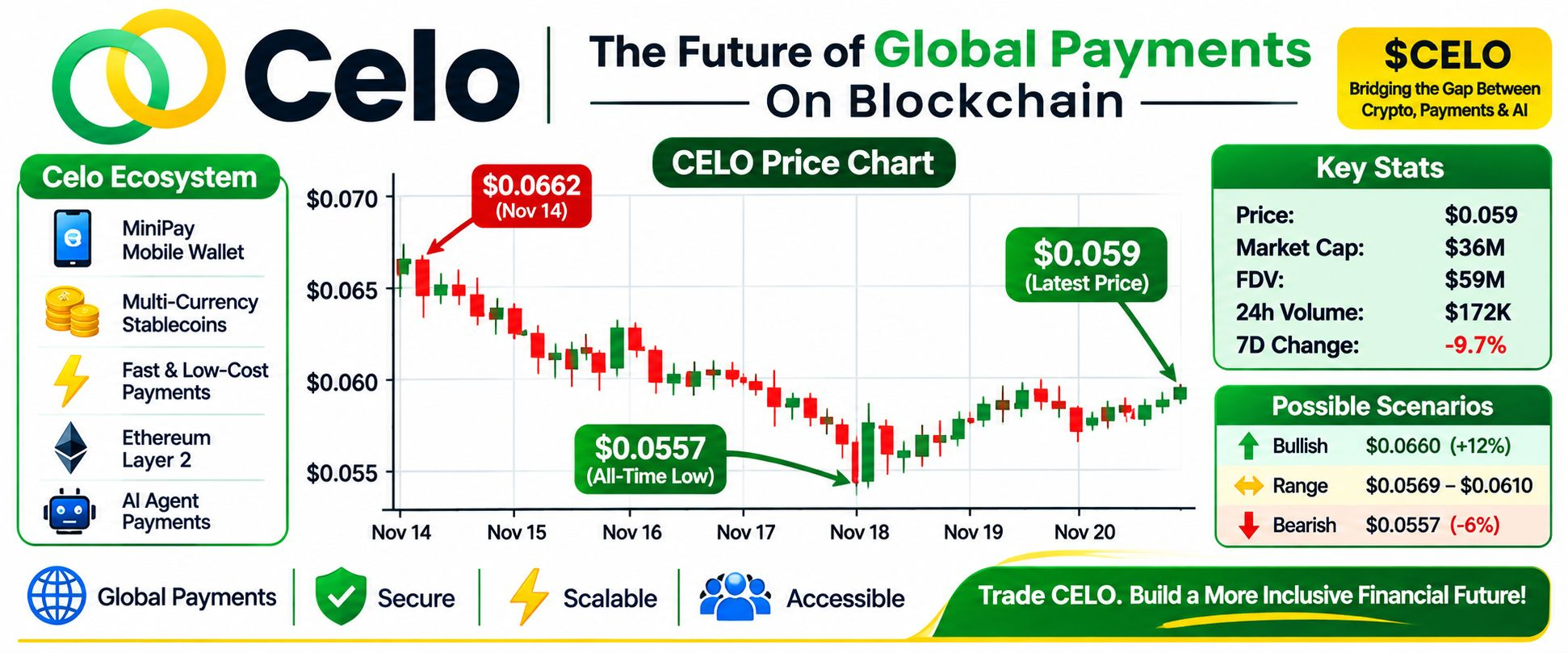
The Next Opportunity: AI Agents That Can Make Payments
Perhaps one of the most exciting developments in the blockchain industry is the growing relationship between artificial intelligence and digital payments.
AI agents are becoming capable of performing tasks, accessing information, interacting with applications, and using online services.
But there is one important question:
How will an autonomous AI agent pay for the services it uses?
Traditional payment systems were largely designed around human users, bank accounts, and conventional subscriptions.
Blockchain-based payment infrastructure introduces another possibility.
Celo's work with the x402 payment ecosystem explores how internet services can request stablecoin payments before providing access.
Imagine this process:
An AI agent requests access to a paid service. The service communicates its payment requirements.
The agent authorizes a stablecoin payment. The payment infrastructure verifies and facilitates settlement. The service becomes available after payment confirmation.
This could create opportunities for automated payments between software, services, and AI agents.
However, infrastructure development should not be confused with widespread adoption. Real usage, security, and recurring payment activity will determine how significant this opportunity becomes. Understanding the $CELO Token
A strong ecosystem also needs a sustainable economic mode$CELO is the native token of the Celo ecosystemIts roles include:Network governance.
Staking and participation in network security.Supporting the ecosystem's economic infrastructure.Participation in the protocol's tokenomics.
One development worth watching is CELOccelerate, an initiative designed to connect network economics with the CELO ecosystem through sequencer-revenue-based acquisitions.
The broader idea is to create a relationship between actual network activity and token economics.
This is an important distinction.
A blockchain can attract users and process transactions, but sustainable value creation also depends on whether its economic model captures meaningful value.
For CELO, the long-term question is whether growing payment activity can translate into stronger and more sustainable token economics.What Could Make Celo Different
In my view, Celo's opportunity comes from bringing several important sectors together
Payments: Making digital money easier to transfer.
Stablecoins: Supporting practical digital currencies across different markets.
Mobile Adoption: Connecting blockchain infrastructure with accessible applications.
Ethereum Compatibility: Giving developers an established smart-contract environment.
AI Payments: Exploring a new financial layer for autonomous software.
Individually, these areas are interesting. Together, they create a broader vision of an internet-native financial system.
But there are challenges too.
Competition from other payment networks, stablecoin regulation, security, liquidity, network decentralization, and sustainable token demand will all matter.
No blockchain project is guaranteed to succeed simply because its vision sounds promising.
Execution is what separates a strong narrative from a successful ecosystem.My Final Perspective: Judge Celo by What People Can Actually Do With ItI don't think the future of blockchain will be decided only by which network has the loudest community or the biggest marketing campaign.It will be decided by usefulness.Can people send money more easily?Can businesses accept digital payments?
Can developers build applications that solve real problems?
Can stablecoins support everyday financial activity?Can AI agents eventually participate in an open payment economy?
These are the questions I believe are worth asking when evaluating Celo.
The real opportunity is not simply creating another cryptocurrency. It is building financial infrastructure that people can actually use.
Celo's vision is ambitious: make money move more freely, make blockchain less complicated, and connect the global payment economy with the next generation of digital services.
And that is why I believe $CELO deserves attention beyond its market price.
The future of finance will need more than tokens. It will need useful infrastructure.
What do you think? Will mobile-first stablecoin payments and AI-powered transactions become major drivers of blockchain adoption?
Let's discuss the future of Celo.