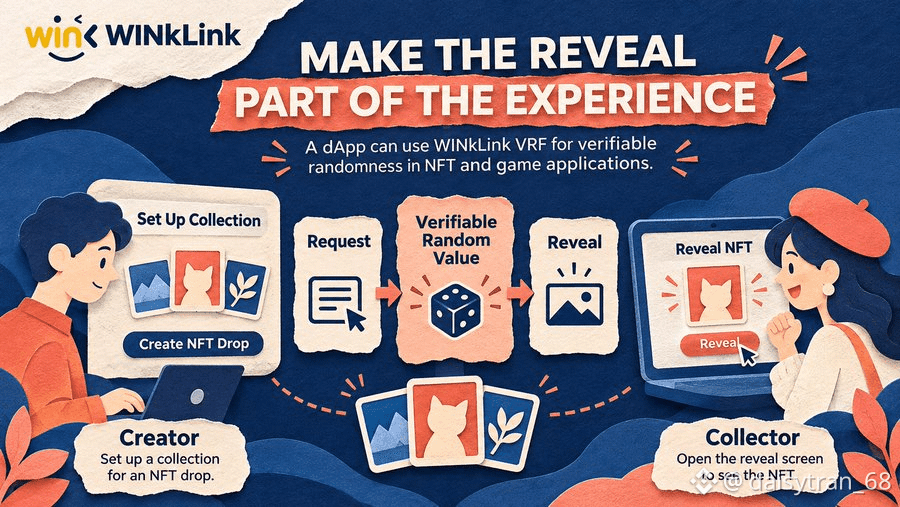
MAKE THE REVEAL PART OF THE EXPERIENCE.
Imagine minting an NFT, waiting for the reveal, and finally discovering which character, trait, rarity, or reward you've received.
That moment of anticipation is one of the most exciting parts of NFT collections and blockchain games. But there's an important question behind the experience:
How can developers make sure the random result is verifiable rather than simply controlled behind the scenes?
This is where WINkLink VRF (Verifiable Random Function) can play an interesting role.
Here's how developers can use it:
1️⃣
Create the reveal moment
When a user opens an NFT reveal or triggers an in-game action, the dApp can request a random result for that interaction.
2️⃣
Generate verifiable randomness
WINkLink VRF provides a randomness mechanism designed to produce results that can be cryptographically verified.
3️⃣
Use the result on-chain
The dApp can use the returned random value to determine an outcome, such as selecting an NFT trait, assigning a character, or deciding an in-game reward.
4️⃣
Make fairness easier to verify
Instead of relying entirely on a developer's private random-number generator, developers can integrate verifiable randomness to make the selection process more transparent and trustworthy.
Personally, I think randomness is an underrated part of blockchain gaming and NFT experiences.
Users don't just want an exciting reveal. They also want confidence that the outcome wasn't secretly manipulated or predetermined in an unfair way.
Of course, not every NFT collection or blockchain game uses WINkLink VRF. It's an infrastructure option developers can choose to integrate when their applications require verifiable randomness.
The reveal creates the excitement. Verifiable randomness helps build the trust behind it.
@Justin Sun孙宇晨 #TRONEcoStar @WINkLink_Official