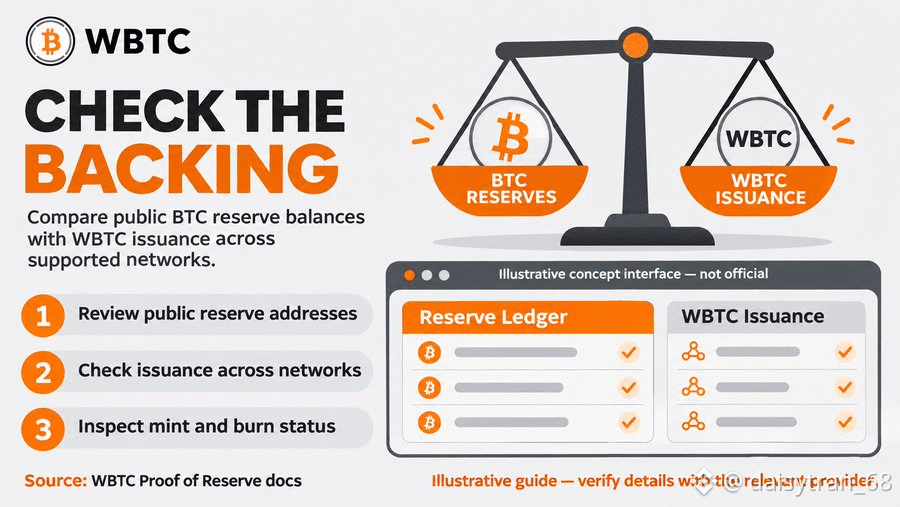
HOW TO CHECK WBTC RESERVES AND ISSUANCE
Reserve transparency is useful when readers know which balances and records to compare.
Instead of relying only on a headline claim about WBTC backing, users can examine public reserve information alongside token issuance records to understand how the system is accounted for.
1️⃣
Start With Official Transparency Data
Open the official WBTC transparency dashboard or public data source.
Look for the reserve information, custodian details, and WBTC issuance figures across supported networks. Make sure you are reviewing the latest available data.
2️⃣
Check the BTC Reserves
Review the reserve addresses and balances listed for the custodians.
You can use a Bitcoin block explorer to independently inspect these public addresses and verify their on-chain balances.
This gives you a way to compare published reserve information with observable blockchain data.
3️⃣
Compare Reserves With WBTC Issuance
The next step is to compare the total BTC reserves with the combined WBTC issuance across supported networks.
According to WBTC documentation, reserves should equal or exceed the combined issuance for the system to be fully solvent.
One important detail: don't compare BTC reserves with the issuance on just one network. The comparison needs to account for WBTC issued across all supported networks.
4️⃣
Review Mint and Burn Records
Mint and burn records help explain changes in WBTC supply.
→ Mint: New WBTC is issued as part of the process of representing BTC on supported networks.
→ Burn: WBTC is destroyed as part of redemption, reducing the corresponding token supply.
Also check whether transactions are pending or complete. A pending operation should not be treated as a finalized change in reserves or issuance.
@Justin Sun孙宇晨 #TRONEcoStar