$BCH: Counting Traders vs. Order Size
$BCH: Does high participant count always mean strong demand? Not necessarily.
Myth: Many small buyers beat fewer large sellers.
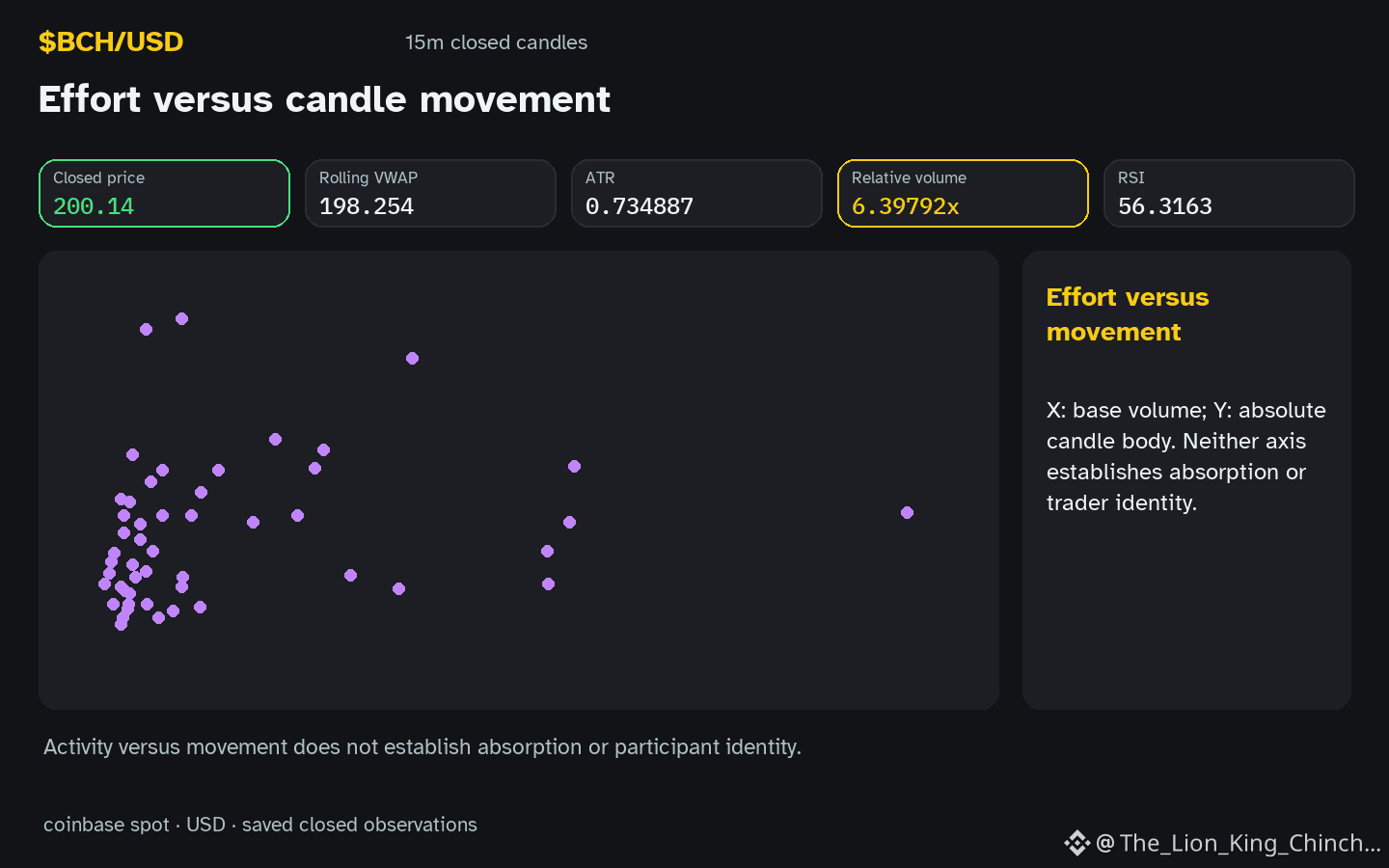
Reality: Volume measures trade size, not headcount. One large order fills many small asks. If $BCH shows volume above baseline while price trends down, the sell pressure includes significant size. RSI at 56.3 confirms momentum but cannot identify who trades.
Think of a coin as a scale. Ten small weights do not lift the scale against one heavy weight. Relative volume 6.40x baseline quantifies total size traded, not the number of participants. It does not prove accumulation.
A counterexample helps. Imagine one trader places a large bid. It fills fifty small sell orders. Headcount favors sellers. Size favors buyers. The chart shows the size impact. It hides the headcount data.
Limitations: This is a hypothetical mechanism. Candles do not reveal participant counts. We cannot infer motives from this chart. The current data shows price inside the recorded range with hourly direction down.
A useful next observation: Watch if relative volume rises again while price remains below 200.89. If volume spikes but price fails to advance, the large order may be absorbing small sells. This suggests size asymmetry. If price breaks down on high volume, the large order may be driving the drop. Reassess by checking if the next candle closes above the recent low. Until then, treat volume as a size metric, not a crowd vote. The distinction between counting orders and measuring sizes changes how we read the chart.
Probabilistic market research, not a recommendation or guaranteed return.
#BCH