
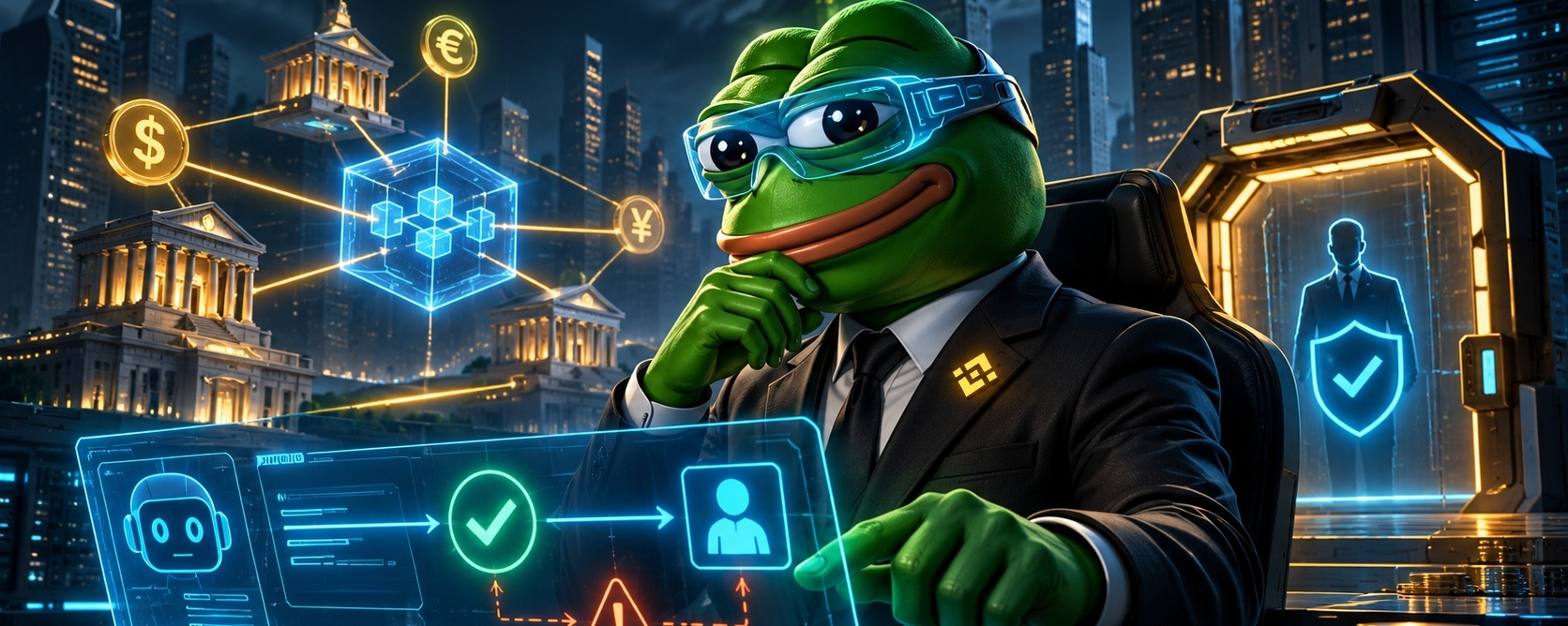

AI Agents Are Coming for Your Money. Is Blockchain Ready?
The next financial revolution might not have a human sitting behind the keyboard.
Imagine waking up, checking your phone and discovering that an AI agent has already compared exchange rates, moved funds, negotiated a transaction and completed a payment while you were asleep.
No bank queues. No manual instructions. No waiting for someone to approve every routine transaction.
Sounds convenient.
It also raises a rather uncomfortable question:
What happens when the machine making financial decisions makes the wrong one?
We're getting closer to finding out.
The experiment that makes this interesting
On November 18, Hyundai Card revealed a proof-of-concept developed with JPMorgan's Kinexys blockchain platform.
The experiment involved AI agents representing hypothetical overseas subsidiaries.
Here's how it worked:
1. An AI agent monitored the balance of one subsidiary.
2. It identified when additional funds were needed.
3. It compared foreign-exchange quotes from multiple banks.
4. It instructed JPMorgan's AI agent to execute the currency conversion and transfer.
5. The receiving system verified identity and authorization before acting.
Transactions within predefined authorization limits could execute automatically. Anything outside those limits was escalated for human approval or rejected.
This wasn't a public crypto wallet autonomously trading on an open exchange. It was a controlled proof-of-concept using JPMorgan's permissioned, Ethereum-based infrastructure.
But the underlying idea is significant.
We're beginning to see AI agents move beyond answering questions and generating recommendations. They're being tested as participants in financial operations.
And that changes the conversation around blockchain.
Why AI and blockchain could become a powerful combination
AI agents are good at processing information, comparing options and coordinating tasks.
Blockchain infrastructure can provide programmable transactions, verifiable records and settlement mechanisms.
Put the two together and you get something interesting:
An AI agent that doesn't just tell you where to send money, but can potentially carry out an authorized transaction.
Think about the possibilities:
1. Autonomous payments
Businesses could use AI agents to manage routine payments, reconcile accounts and coordinate international transfers.
2. Smarter DeFi participation
Agents could monitor lending rates, assess liquidity conditions and interact with decentralized protocols within predefined permissions.
3. Machine-to-machine commerce
One AI agent could purchase a service from another, verify delivery and trigger payment without requiring a person to manually approve every step.
4. Global financial coordination
Blockchain-based settlement infrastructure could help systems operating across different jurisdictions coordinate transactions more efficiently.
These are potential applications, not guarantees of mass adoption. The technical, regulatory and security challenges remain substantial.
But there's a problem nobody should overlook: AI isn't free.
Here's where the story gets even more interesting.
According to Reuters' reporting on McKinsey's Global Banking Annual Review, the cost of tokens powering AI agents could reach 20% of banks' total labour costs.
Why?
Because agents don't necessarily work alone.
One agent might ask another to research a transaction. Another might compare prices. A third might verify information.
Every interaction can consume additional computing resources.
It's a little like hiring an employee who invoices you every time they think.
And when you're running thousands of automated interactions, those costs become important.
Banks are already looking more carefully at where agentic AI can generate measurable financial returns.
This is an important distinction: the technology might be impressive, but its economics still need to work.
The trust problem: Who is responsible when an AI moves money?
This is arguably the biggest challenge.
Imagine an AI agent makes an unauthorized payment, interacts with a malicious smart contract or misunderstands an instruction.
Who takes responsibility?
The person who deployed it?
The company that developed it?
The financial institution that processed the transaction?
Or the infrastructure that recorded it?
Blockchain can provide a verifiable transaction history, but a permanent record of a mistake doesn't automatically prevent the mistake.
We need more than fast settlement.
We need:
- Verifiable agent identities.
- Explicit spending limits and permissions.
- Human approval for high-risk transactions.
- Secure smart contracts and transaction monitoring.
- Clear accountability when something goes wrong.
The Hyundai and JPMorgan experiment is interesting precisely because it included identity verification, authorization and human escalation mechanisms.
The goal shouldn't be to remove humans from finance entirely.
It should be to make automation accountable.
What this means for crypto
The opportunity isn't necessarily another token promising to revolutionize AI.
It's the infrastructure underneath the experience.
If AI agents eventually become regular participants in digital commerce, they'll need reliable ways to:
- Identify themselves.
- Authenticate other agents.
- Exchange value.
- Verify completed work.
- Manage permissions.
- Settle transactions.
Blockchain networks, stablecoins and decentralized financial infrastructure could play important roles in that ecosystem.
But there's a difference between a compelling use case and a successful investment.
Not every project with AI in its name will benefit from this shift. Real adoption, security, transaction demand and sustainable economics will matter far more than marketing.
The bigger picture
Binance Square is currently discussing both the economics of the AI boom and the evolution of blockchain infrastructure.
Those conversations might seem separate, but they're increasingly connected.
The AI industry wants more computing power, more autonomy and more ways to monetize intelligent systems.
The crypto industry has spent years developing programmable financial infrastructure.
Now we're starting to see experiments that bring those worlds together.
And perhaps the most interesting development isn't that AI can write code, generate images or answer questions.
It's that AI is beginning to participate in economic activity.
My take: The next major opportunity at the intersection of AI and crypto may come from the infrastructure that allows autonomous agents to transact safely, rather than from the loudest AI-themed token.
The winners won't simply be the projects with the best AI demos.
They'll need to solve the boring but essential problems: trust, identity, security, permissions and settlement.
Because giving an AI access to your wallet is one thing.
Explaining to your bank that the AI spent your money by mistake is another. 😂
---
Let's discuss
Would you trust an AI agent with permission to manage a portion of your crypto portfolio or make payments on your behalf?
A. Yes, provided I set the limits.
B. Only for small, everyday transactions.
C. Absolutely not. I'll keep control of my money.
I'd genuinely like to hear where the community stands.