$PENGU: Effort Justification in Range Traps
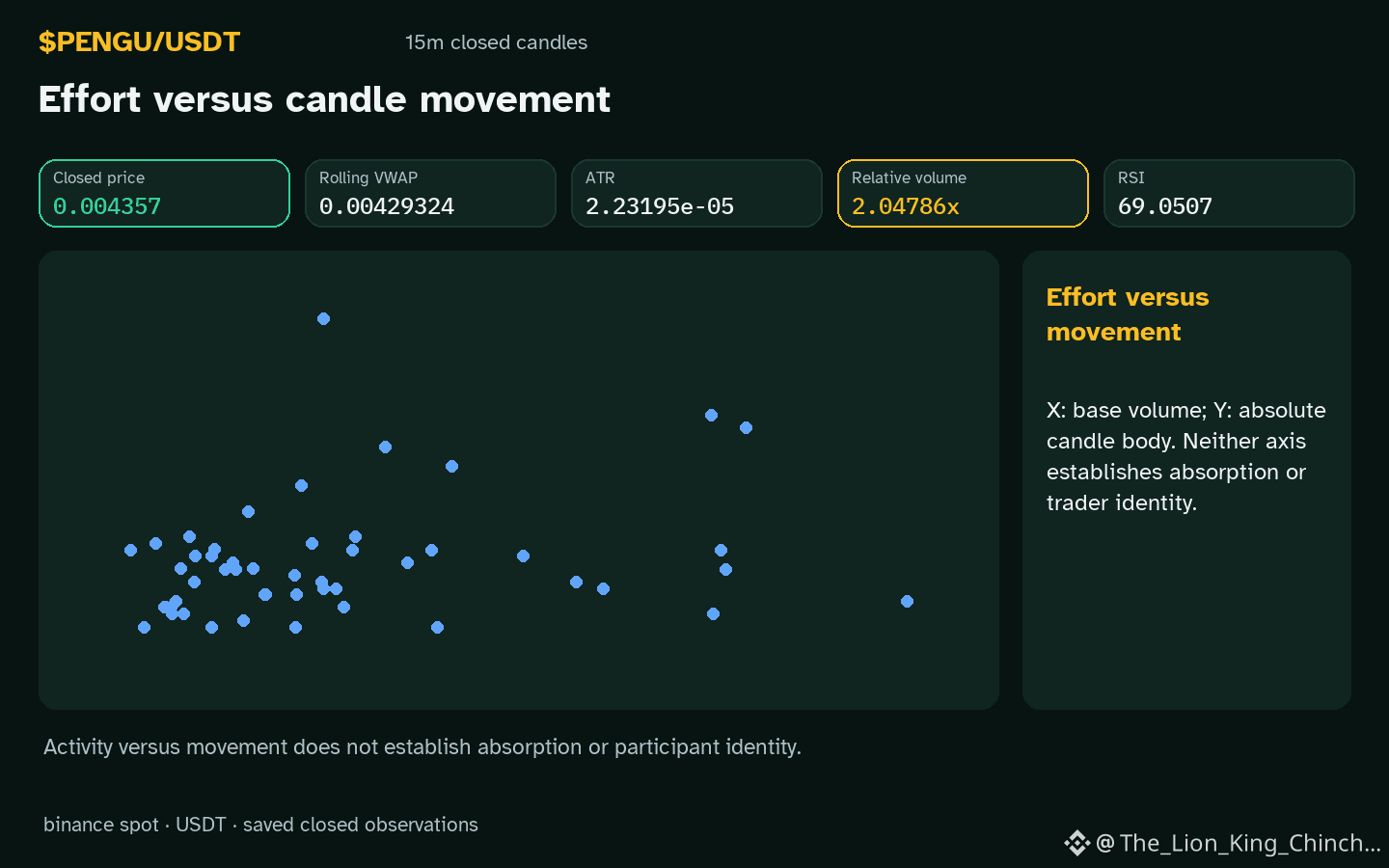
Does $PENGU above local support justify holding after hours of research? The chart shows price 0.004357 inside a recorded range, with volume 2.05x baseline. This is the observation context for exploring effort justification bias. Imagine a trader who spent significant time analyzing this setup. They might refuse to revise their rule after a missed move, valuing the effort invested over new data. This hypothetical mechanism suggests that prior work can distort current judgment. A counterexample is easy to construct. If the next closed candle closes below the local support level, the earlier effort did not prevent the loss. The price action invalidates the initial thesis regardless of how much research preceded it. Candles and volume do not prove motives or success probabilities. They only describe past closed-candle measurements. Future ticks will confirm or refute the setup. To avoid this bias, use a practical self-check. Before holding a position, ask if you would make the same decision today with zero prior time invested. If the answer is no, the effort is influencing the choice rather than the data. Note that the hourly direction was up and volume was above baseline in this snapshot. These metrics describe the saved observation, not a guarantee for the next hourly or daily window. If the asset trades below the recorded support, the interpretation weakens. Reassess based on live price action, not sunk time. This keeps the analysis focused on market evidence rather than personal validation. 🧐
Probabilistic market research, not a recommendation or guaranteed return.
A useful cross-check: $BTC has hourly direction up and volume above its baseline; $SOXLB has hourly direction up and volume above its baseline. This alone does not establish correlation.
#PENGU