


My Research, Understanding and Personal Perspective on the Emerging Autonomous AI Economy
I have been researching different blockchain projects, and one sector that I find particularly interesting is the connection between Artificial Intelligence and blockchain infrastructure.

Most people associate AI with chatbots, image generation, automation and content creation.
But I believe there is another development worth watching.
What happens when AI agents start managing tasks that require actual financial transactions?
Imagine an AI agent that can purchase information, pay for computing resources, access premium applications and communicate economically with other AI agents.
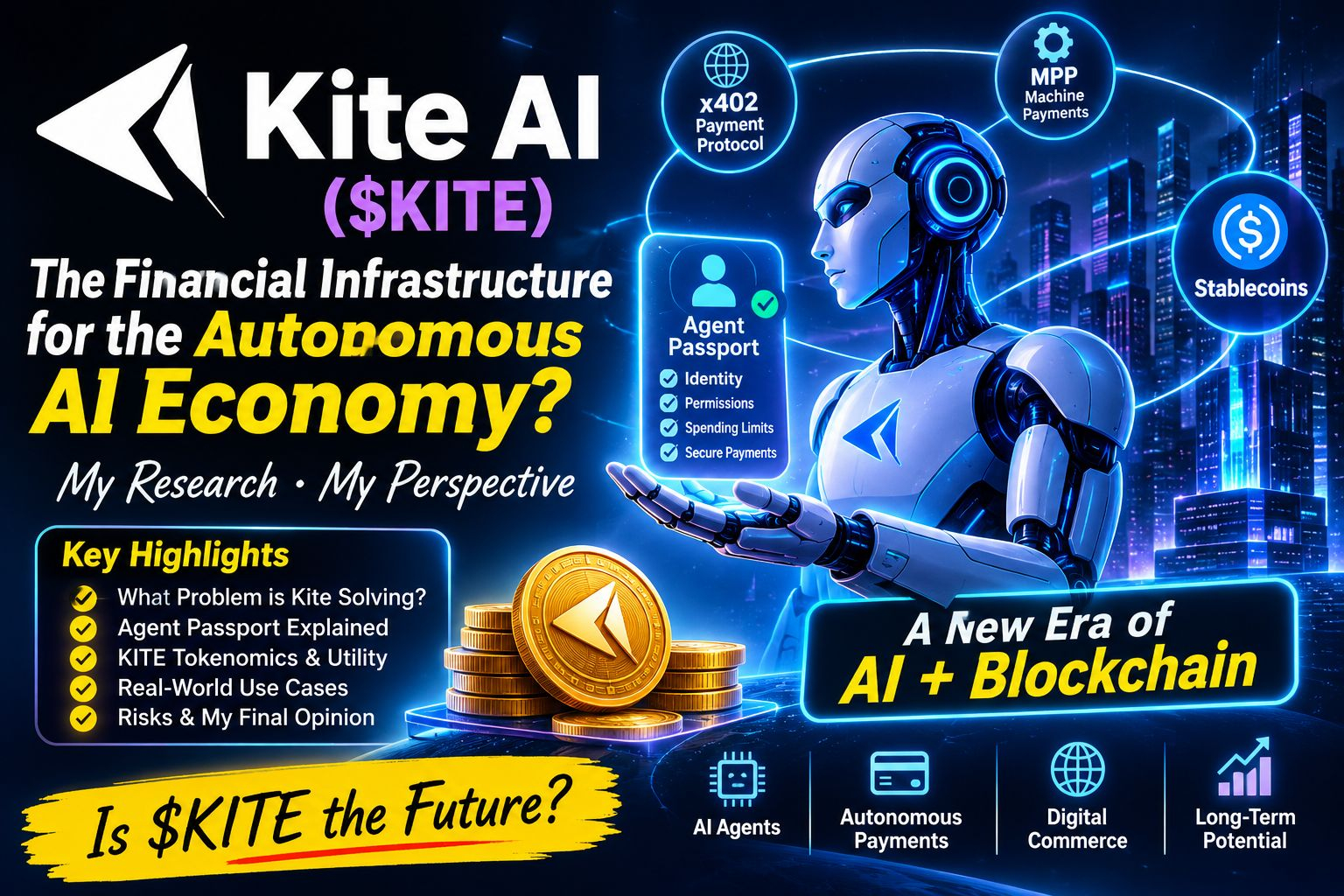
For this to work, AI needs more than intelligence. It needs identity, payment access, financial permissions and security.
This is where Kite AI ($KITE) caught my attention.
I want to explain what the project is building, why I find its direction interesting and what I believe investors should carefully monitor.
1. My Understanding: What Problem Is Kite Trying to Solve?
Today, AI agents can perform many digital tasks, but financial independence is a different challenge.
Consider a simple example.
You ask an AI agent to research five cryptocurrency projects. During its research, it needs access to a paid database, an analytics platform and computing resources.
Normally, these services require subscriptions, payment credentials or manual approvals.
Kite is working on infrastructure that can make these financial interactions more suitable for autonomous agents.
Its vision is to connect AI agents with identities, wallets, programmable permissions and payment systems.
My perspective: I think this problem could become increasingly important as AI agents move from answering questions to completing real-world digital tasks.
2. Agent Passport: A Feature I Find Interesting
One of the most interesting parts of Kite is Agent Passport.
Let me explain it simply.
Imagine giving your AI agent a $100 budget.
You can define:
- A maximum spending limit.
- A limit for each transaction.
- Approved services.
- An authorization period.
- Financial permissions.
The agent can then perform permitted transactions without asking you to manually approve every individual payment.
You still define the boundaries and can manage or revoke permissions.
This is important because I don't believe autonomous AI should have unrestricted access to financial accounts.
My point of view: Financial control will be just as important as intelligence in the future of AI. A powerful AI agent without proper spending restrictions could create serious problems.
3. Why x402 and MPP Matter
Two concepts worth understanding in Kite's ecosystem are x402 and MPP.
x402: It allows online services to request payment through an HTTP-based interaction. An AI agent can potentially pay for a particular service or API request instead of depending entirely on traditional subscriptions.
MPP: Machine Payments Protocol is designed for payments between software and services, including automated payment interactions.
Why does this matter?
Imagine thousands of AI agents purchasing small amounts of data, computing power and digital services.
A pay-per-use payment model could make these interactions easier.
My perspective: I believe machine-to-machine payments are an interesting area to research because AI agents will need ways to purchase services independently.
However, the success of these protocols depends on actual developer adoption.
4. Why Stablecoins Could Become Important
I believe stablecoins could play an important role in the future of autonomous payments.
Imagine an AI agent making 100 transactions in one day.
Using a volatile cryptocurrency for every payment could make budgeting difficult.
Stablecoins offer a more predictable unit of account.
Kite Passport documents support for several payment networks and assets, including USDC and PYUSD on supported networks.
This multi-network approach is interesting because the future of digital payments may involve different blockchains rather than one single ecosystem.
5. Understanding KITE Tokenomics
Now let's discuss the investment side.
A strong technology project does not automatically mean its token will become valuable.
According to the published tokenomics, KITE has a maximum supply of 10 billion tokens.
Allocation:
- Ecosystem and Community: 48%
- Modules: 20%
- Team, Advisors and Contributors: 20%
- Investors: 12%
The token is designed for staking, governance, network participation, module liquidity and ecosystem incentives.
Its tokenomics also describe a mechanism connecting AI service commissions with KITE through conversion and distribution.
This is an important area to monitor.
My biggest question as an investor: If Agent Passport adoption increases, how much economic value will actually flow toward the KITE token?
I would not assume that more AI transactions automatically mean a higher token price.
Real token demand, unlocks and supply dynamics matter.
6. Recent Developments I Am Watching
Kite's November product updates include:
- November 19: Uniswap swaps through a new DeFi skill on Base.
- November 18: Kite Chain removed from Passport, with a December 15 bridge shutdown referenced in the changelog.
- November 13: Google sign-in and unified dashboard and CLI login improvements.
- November 10: Improvements to merchant failure handling and Solana transfers.
One development deserves special attention.
The removal of Kite Chain from Passport and the shift toward Base-based settlement raise questions about the future infrastructure strategy.
I would like to see more clarity on how this transition affects long-term KITE utility.
I consider this something investors should research rather than ignore.
7. What Makes Me Interested in This Sector?
My interest is not based simply on the AI narrative.
I see three potential long-term developments:
First: AI agents becoming service users.
AI agents may increasingly need access to paid applications, information and computing resources.
Second: Automated digital commerce.
Machines could potentially purchase and sell services without requiring human approval for every transaction.
Third: Financial infrastructure for AI.
Identity, permissions, payment verification and settlement could become important infrastructure requirements.
Kite is attempting to position itself in this area.
I find this direction interesting, although the market still needs to prove how large the opportunity will become.
8. What Concerns Me?
I also want to discuss the risks because every investment has two sides.
1. Competition: Established payment networks and other blockchain projects could develop similar solutions.
2. Adoption: A working product does not guarantee widespread usage.
3. Token utility: The connection between product activity and KITE demand must become measurable.
4. Token unlocks: Supply growth can create selling pressure.
5. Security: Autonomous agents require strong protection against unauthorized transactions.
6. Infrastructure changes: The Kite Chain transition needs careful monitoring.
These are not reasons to dismiss the project, but they are reasons to avoid investing based only on excitement.
9. My Final Opinion
Personally, I find Kite AI an interesting project to research because it is focused on a problem that could become more important as autonomous AI develops.
I believe the next stage of AI adoption may involve agents doing more than generating answers. They may interact with businesses, purchase digital services, manage approved budgets and transact with other agents.
But I want to see three things before becoming more confident about its long-term potential:
- Genuine adoption of Agent Passport.
- Increasing developer and business participation.
- Clear and sustainable value capture for the KITE token.
I don't believe every AI cryptocurrency will succeed just because artificial intelligence is growing.
The projects that solve real problems, attract users and create sustainable economic activity will have a stronger foundation.
For me, the interesting question is not how high $KITE can go. It is whether Kite can become useful infrastructure for an economy where AI agents transact independently.
That is the development I will be watching.
Let's Discuss
I want to hear your genuine opinions:
1. Do you think AI agents will eventually manage their own financial transactions?
2. Can blockchain become the payment infrastructure for autonomous AI?
3. What do you think is Kite's biggest strength and biggest weakness?
4. Are you following $KITE for its technology or its investment potential?
Share your research and thoughts. Different perspectives help all of us understand a project better.
#KITE #Mr_SPONDY_13 @KITE AI 中文
Educational research and personal opinion, not financial advice. Always verify official information and conduct your own research before investing.