

In a dual-class share structure, a sunset clause is a charter or bylaw rule that automatically terminates super-voting stock—converting high-vote shares (for example, 10 votes per share) into standard low-vote shares (typically 1 vote per share)—when a defined trigger occurs. Rather than locking in founder voting control forever, sunset clauses are designed to realign voting power with economic ownership over time or after major transitions.
How Time-Based Sunsets Work
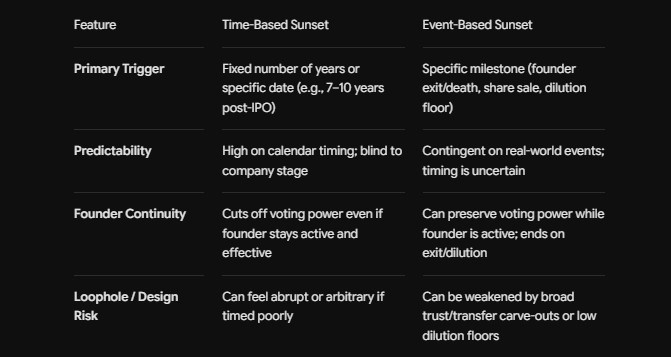
A time-based sunset sets a fixed calendar date or duration after an IPO or charter adoption—commonly 5, 7, 10, or 15 years—after which all remaining super-voting shares convert automatically to standard voting rights.
Predictable Expiration: Investors and boards know the exact horizon when special voting privileges end, giving outside shareholders a clear date for eventual accountability.
Extension Mechanics: Some charters allow a time-based sunset to be extended only if approved by a supermajority of shareholders, a majority of unaffiliated (disinterested) shares, or a special committee of independent directors.
Arbitrary Cutoff Risk: A fixed calendar year ignores whether the business is mid-cycle, in the middle of a multi-year R&D buildout, or still led by an active, high-performing founder.
How Event-Based Sunsets Work
An event-based sunset ties conversion to specific corporate, ownership, or leadership milestones rather than the passage of calendar time alone. Common triggers include:
Founder Departure, Disability, or Death: Super-voting shares convert automatically if the founder steps down as CEO or executive chair, becomes incapacitated, or passes away—preventing control from passing to heirs or successors who did not build the company.
Ownership Dilution Thresholds: Conversion triggers once the founder’s or insiders’ economic stake falls below a set percentage of total shares (for example, less than 5% or 10% of outstanding stock), curbing "skin-in-the-game" asymmetry after major stock sales.
Transfer / Sale Restrictions: When super-voting shares are sold or transferred outside permitted family trusts or estate vehicles, those transferred shares convert into standard 1-vote shares.
Side-by-Side Comparison
Why Boards Debate Sunset Clauses
Boards—especially those pre-IPO or navigating governance engagement with institutional shareholders—debate sunset design across several practical fault lines:
Preventing Permanent Entrenchment vs. Preserving Long-Term Vision: Governance advocates argue that perpetual super-voting control insulates management from accountability over decades, whereas founders and some directors contend that major product, infrastructure, or market bets often take longer than a standard 7-to-10-year window to mature.
Protecting Against Succession & Misconduct Shocks: When a founder exits abruptly or faces a major controversy, event-based sunsets tied to leadership departure or ownership thresholds can force a clean reset—whereas a long, unconditioned time-based sunset leaves super-voting power intact even after the founder leaves.
Drafting Loopholes & Minority Protections: Investors scrutinize how sunsets are written. Weak dilution thresholds (such as 1% or 2% of equity) or sweeping exceptions allowing shares to stay super-voting when moved into trusts can render a sunset largely symbolic in practice.
Investor & Index Pressure: Institutional stewardship guidelines frequently push for sunsets (often 7 years or less, or strong event-based triggers), forcing boards to weigh valuation, IPO readiness, and shareholder support against founder preferences for control.