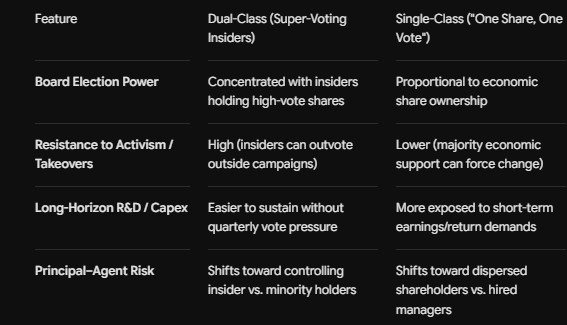
A dual-class share structure separates a company’s economic ownership (who gets dividends and sale proceeds) from its voting power (who elects directors and approves major corporate actions). By issuing two or more classes of stock with unequal votes per share—commonly 1 vote per share for public investors and 10 or more votes per share for founders or insiders—founders can raise public equity while retaining majority control even after their economic stake shrinks.
How Dual-Class Share Structures Work
Unequal Voting Rights: A standard model uses Class A shares (1 vote each, publicly traded) and Class B shares (e.g., 10 votes each, held by founders, early insiders, or trusts). Even if insiders hold 15% of total equity, super-voting shares can give them well over 50% of the voting power.
Economic Parity (Usually): Both share classes typically participate equally—or nearly equally—in dividends and liquidation proceeds per share, meaning outside shareholders share in financial upside while holding far less say in board elections or mergers.
Transfer & Conversion Mechanics: Super-voting shares are often non-publicly traded and subject to conversion rules. When sold to an outside buyer, they frequently convert automatically into standard 1-vote shares—unless an exception lets a founder transfer shares into a family trust or estate vehicle without losing control.
Sunset Clauses (Time vs. Event): Some charters include sunset provisions that convert super-voting shares into 1-vote shares after a set number of years (a time-based sunset), upon a founder’s death or departure, or once insider ownership drops below a set threshold (an event-based sunset). Many high-profile tech issuers, however, omit time-based sunsets or set very long horizons.
Why Institutional Investors Debate Them
Institutional investors—such as pension funds, asset managers, and stewardship teams—weigh a classic governance tension between long-term founder conviction and accountability to outside capital.
Arguments Made by Critics (Institutional Skeptics)
Weakened Accountability & "One Share, One Vote": When a controlling shareholder cannot be voted out by ordinary shareholders, boards face less market discipline over executive pay, related-party transactions, capital allocation, or leadership missteps.
Misaligned Risk & Downside Protection: Because super-voting insiders can retain control even after selling down much of their economic stake, they may pursue high-risk strategies whose downside falls heavily on minority holders—or block value-enhancing buyouts that a controlling insider dislikes.
Index & Governance Friction: Many stewardship guidelines favor "one share, one vote" or mandatory sunset clauses, and several major equity index providers have debated or adjusted rules around non-voting or multi-class listings over the years.
Arguments Made by Proponents (Founders & Supportive Investors)
Protection Against Short-Termism: Supporters argue that activist campaigns or quarterly earnings pressure can force management to cut R&D, cloud/infrastructure capex, or multi-year product bets that take years to pay off.
Shielding Strategic Continuity: Concentrated voting power helps prevent hostile takeovers or boardroom disruptions during long-horizon builds, letting founders steer product and technical direction consistently.
Market Pricing & Choice: Proponents point out that institutional investors are not forced to buy dual-class stock—if governance discounts outweigh growth prospects, investors can price that risk into valuation or pass on the shares entirely.
Key Governance Trade-Offs at a Glance