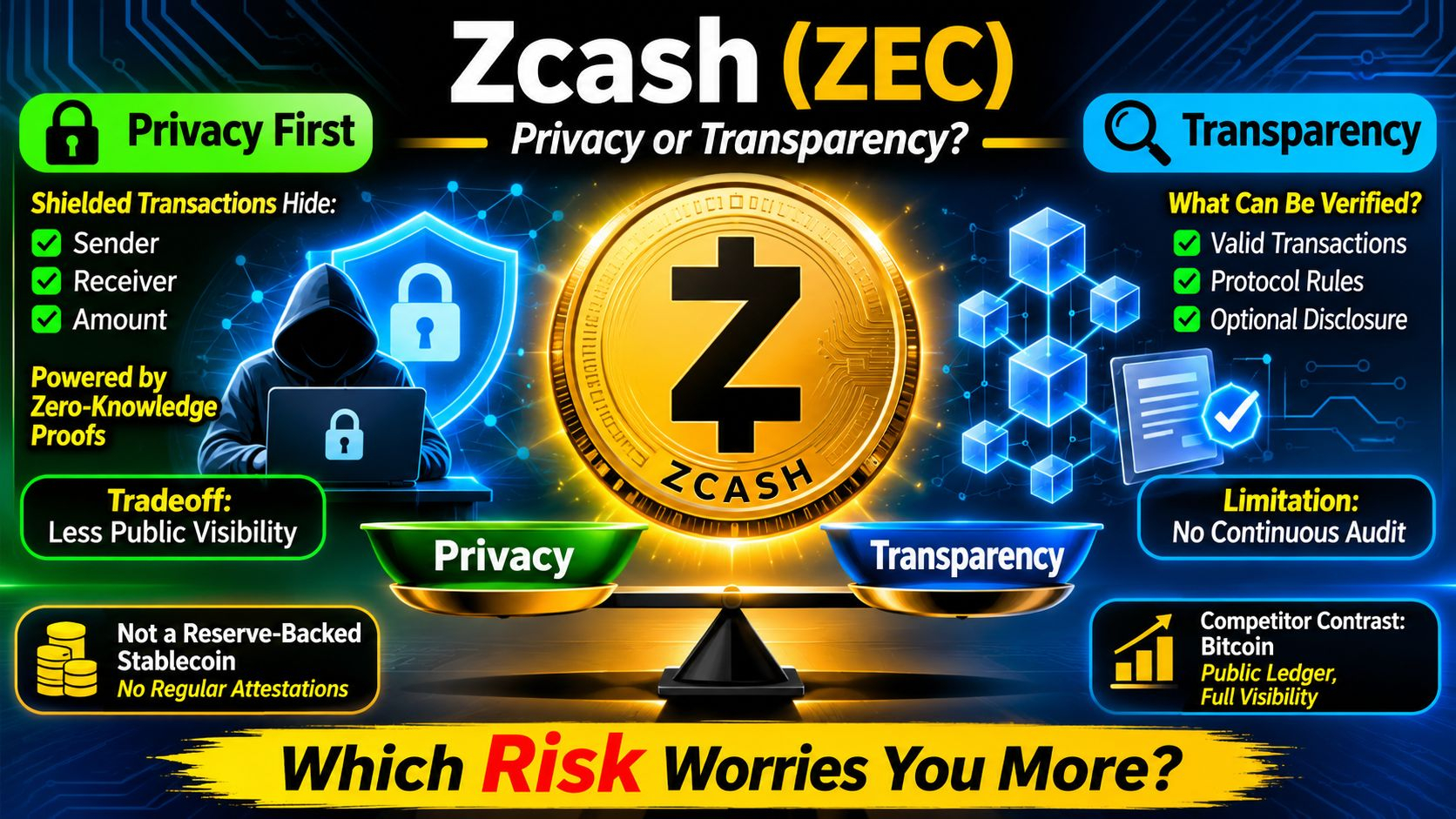

Zcash (ZEC) is designed to make financial transactions private without sacrificing cryptographic verification. But there is one important detail: shielded transactions hide sender, receiver, and transaction amounts from public blockchain observers.
That's not an oversight. It's a stated choice.
Zcash uses privacy to reduce financial surveillance, address tracking, and exposure of sensitive transaction activity. The tradeoff is that independent observers lose the ability to inspect individual transfers and reconstruct complete wallet histories.
Holders can still verify that transactions follow protocol rules through zero-knowledge proofs, which allow network nodes to validate transactions without seeing their private details. Zcash also supports viewing keys, allowing users to selectively disclose transaction information to trusted third parties.
However, ZEC is not a reserve-backed stablecoin. It has no reserve custodian or recurring reserve attestations from firms like BDO or Deloitte. There is no monthly backing report to examine. Outsiders cannot independently inspect individual shielded transfers whenever they want. Zcash Documentation 6.12.2 documentation +2
Bitcoin (BTC) chooses the opposite approach. Its public ledger exposes transaction amounts, addresses, and transaction histories for anyone to examine. More exposure, in exchange for greater public scrutiny and traceability. Bitcoin +1
Neither approach removes counterparty risk. Bitcoin exposes financial activity to surveillance and tracking. Zcash limits public visibility but requires greater reliance on cryptography, wallet implementation, and selective disclosure.
ZEC clearly chooses privacy over universal transaction visibility.
Which risk worries you more — financial surveillance through complete public transparency, or limited independent visibility through priva