$RENDER: Selective Attention and Chart Clarity
Can reducing sensory clutter improve analytical consistency for $RENDER? The asset is currently trading inside its recorded range while the hourly direction is up.
Filtering noise is a primary challenge when daily change sits at 2.26749%. A common trade-off involves entry quality versus the urge to chase a moving price. Consider a thought experiment where an observer only views charts once per hour. By ignoring every flickering tick, the observer avoids reacting to temporary spikes that do not change the structural trend. This hypothetical mechanism prioritizes the closing price over intra-candle volatility. While this approach might result in a slightly worse entry price if a trend moves fast, it prevents constant over-analysis of insignificant data points.
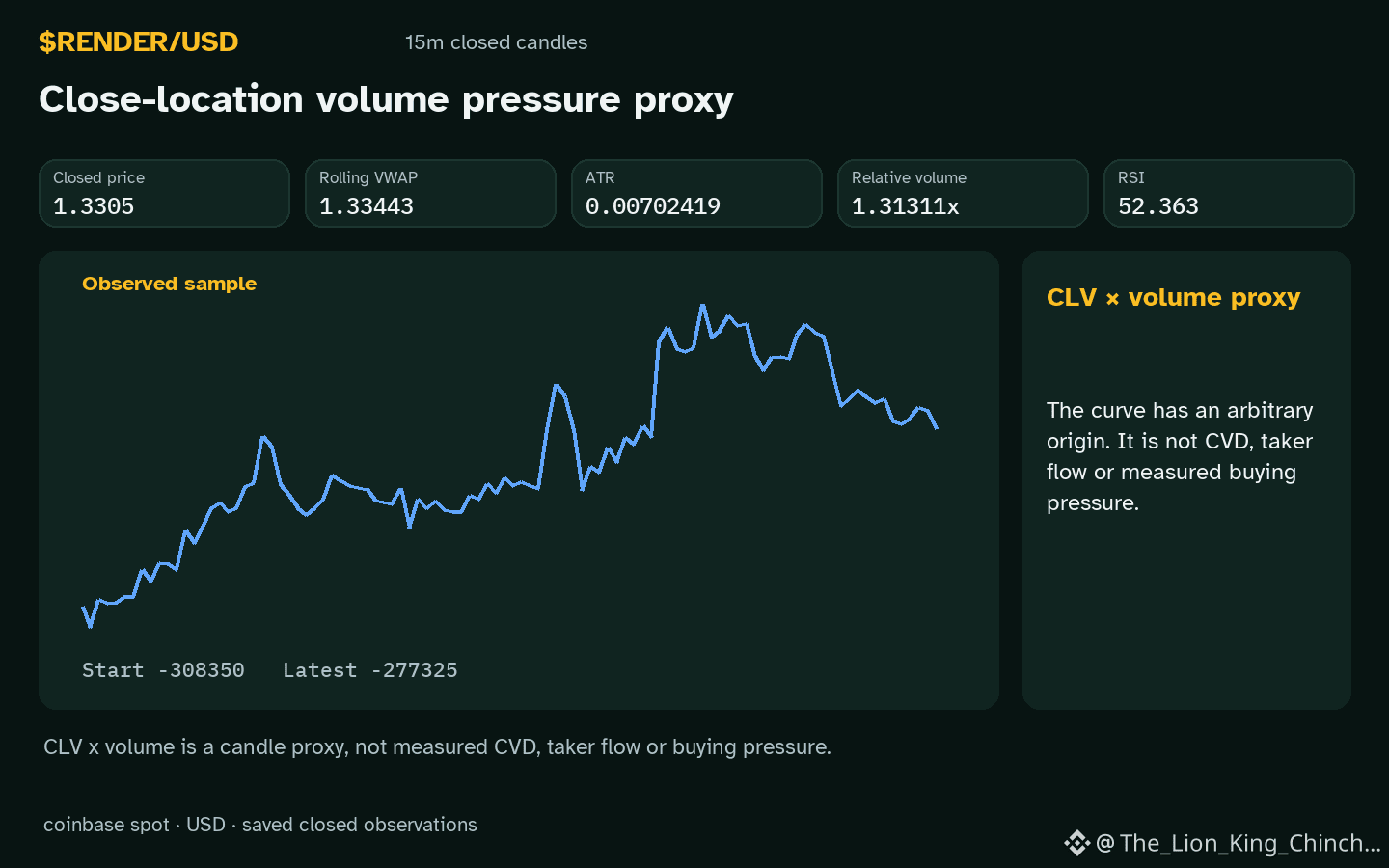
Relative volume is currently 1.31x the baseline, which often attracts intense focus. However, a self-check for this digital minimalism involves comparing the current RSI 52.4 to the broader range. If the price remains between support 1.3088 and resistance 1.34 despite the volume, the sensory input of high activity might be a distraction rather than a signal for action. A counterexample occurs when a narrow focus on a single indicator leads to missing a breach of local levels. One way to reassess this interpretation is to wait for a closed candle above resistance. If the price fails to hold that level on a closing basis, the perceived strength may have been mere noise.
Probabilistic market research, not a recommendation or guaranteed return.
#RENDER