

Nvidia has become one of the most closely watched companies in the stock market, largely because of its position in the artificial intelligence industry. But even a company with strong technology, major customers and an established market position can face developments that force investors to reconsider their expectations.
The important question is not simply whether Nvidia’s share price rises or falls. It is whether something changes in the business that justifies a different investment outlook.
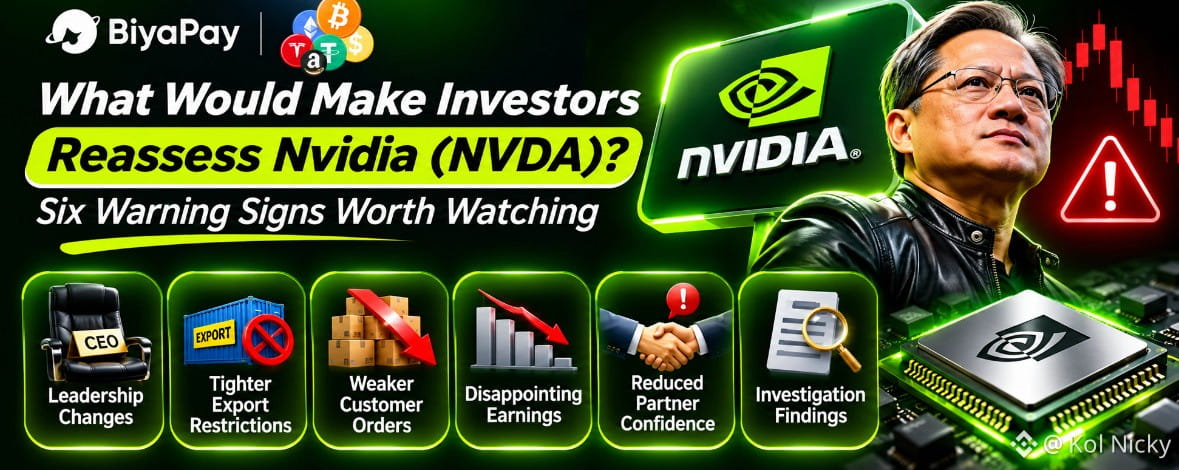
For investors following NVDA, I would pay particular attention to six developments: leadership changes, tighter export restrictions, weaker customer orders, disappointing earnings, reduced partner confidence and findings from ongoing investigations.
These developments do not automatically mean Nvidia is a bad investment. However, they could change how investors assess its future growth, risks and valuation.
1. Leadership Changes and Succession Risk
Leadership is one of the first areas I would monitor.
Jensen Huang co-founded Nvidia and spent more than three decades building the company into a major force in accelerated computing and artificial intelligence. His influence extends beyond executive management into product strategy, industry relationships and the company’s long-term direction.
On November 12, 2026, Nvidia announced that Huang had resigned as president and CEO, effective immediately. CFO Colette Kress was appointed interim CEO while the board began searching for a permanent successor.
This is a significant development for shareholders.
The question is whether Nvidia can maintain its strategic direction without the person most closely associated with its growth.
Investors should watch for clarity around succession, executive responsibilities, product development and the board’s ability to maintain confidence across the organisation.
A leadership transition does not automatically weaken a company, but uncertainty surrounding the transition can influence how investors value its future.
2. Tighter Export Restrictions
Nvidia operates in a global market, and access to international customers is an important part of its commercial environment.
However, restrictions on advanced semiconductor exports, particularly to China, remain an important risk.
Governments can introduce new licensing requirements or expand restrictions on the types of chips that companies are allowed to sell to certain markets.
For Nvidia, tighter controls could limit its addressable market, reduce potential sales and complicate its international business strategy.
This is not just about losing access to one market. Restrictions can also affect product planning, customer relationships and the company’s ability to compete against alternative suppliers.
Investors should monitor government announcements, export licences and any changes in Nvidia’s financial outlook relating to restricted markets.
The key question is whether these restrictions remain manageable or begin to affect the company’s growth expectations.
3. Weaker Customer Orders
Strong demand has been one of the biggest reasons behind Nvidia’s growth.
Technology companies, cloud providers and AI developers have invested heavily in computing infrastructure. Nvidia has benefited from this demand through its GPUs, networking products and complete AI computing systems.
But demand should never be assumed to remain strong indefinitely.
If major customers begin reducing orders, delaying infrastructure projects or slowing their spending plans, investors may start questioning the sustainability of Nvidia’s growth.
One important distinction is between delayed orders and cancelled orders.
A temporary delay does not necessarily indicate a serious problem. However, repeated reductions in customer commitments could suggest that demand is weakening.
I would pay close attention to major customer spending plans, data centre investment and management commentary about future orders.
If customers are becoming more cautious, Nvidia’s future revenue expectations may need to be reconsidered.
4. Disappointing Earnings and Financial Guidance
Financial results remain among the most important indicators of Nvidia’s business performance.
Investors should monitor revenue growth, earnings per share, gross margins, operating expenses and management’s guidance for upcoming quarters.
For context, Nvidia reported third-quarter fiscal 2027 revenue of $115.8 billion on November 17, representing 103% growth year over year. Its data centre business generated $107.6 billion.
The company also forecast fourth-quarter revenue of approximately $130 billion, plus or minus 3%.
These figures demonstrate substantial business growth. However, strong historical performance does not guarantee that future expectations will be achieved.
The bigger concern would be a consistent pattern of missing revenue forecasts, declining margins or weaker forward guidance.
Investors must also distinguish between a company delivering good results and delivering results that exceed what the market already expects.
Sometimes, a company can report impressive earnings and still experience selling pressure if investors were expecting even stronger numbers.
That is why I would monitor both financial performance and market expectations.
5. Reduced Confidence Among Business Partners
Nvidia’s success depends on a wider network of technology companies, manufacturers, cloud providers and other industry partners.
These relationships help support production, distribution, infrastructure development and adoption of its products.
If partners begin expressing concerns about leadership stability, product delivery, commercial terms or the company’s long-term direction, that could become an important warning sign.
Investors should monitor whether major partners continue committing resources to Nvidia’s platforms and whether announced collaborations translate into actual deployments.
A change in commercial relationships could affect future demand and the company’s competitive position.
However, it is important not to confuse ordinary business adjustments with a loss of confidence. Evidence of cancelled commitments, reduced deployments or repeated delays would carry more weight than speculation.
6. Findings From the Independent Investigation
The investigation surrounding Huang is another development worth following.
On November 8, Nvidia’s board announced an independent investigation following reports that Huang had been targeted by a foreign intelligence effort.
The board stated that it had no reason to believe national security or Nvidia’s secrets had been compromised, while confirming that the investigation would examine the available information.
For shareholders, the important issue is what the investigation eventually establishes.
Findings that reveal governance failures, security weaknesses or previously undisclosed risks could create additional uncertainty.
On the other hand, findings that resolve concerns without identifying material problems could help restore confidence.
Investors should avoid treating allegations as established facts. The investigation’s conclusions, rather than speculation surrounding it, should guide their assessment.
What Should NVDA Investors Watch Next?
I would organise these developments into three categories.
Leadership and governance: Watch for a permanent CEO appointment, clear executive responsibilities and the outcome of the independent investigation.
Business performance: Monitor customer orders, data centre spending, revenue growth, earnings guidance and profit margins.
External risks: Follow export regulations, international market access and the strength of Nvidia’s commercial partnerships.
These indicators provide a more useful picture than reacting to every headline or short-term movement in NVDA.
Final Thoughts
My position is simple: investors should not reassess Nvidia based on controversy alone. They should reassess it when developments begin affecting the company’s leadership, financial performance, customer demand or long-term competitive position.
Nvidia remains a major participant in the AI infrastructure market, but its position does not make it immune to business and governance risks.
The November leadership transition is already a material development. What matters now is how the company handles succession, maintains customer confidence and delivers on its financial expectations.
For anyone following NVDA, the goal should be to identify changes that genuinely affect the investment thesis rather than reacting emotionally to headlines.
Disclaimer: This article is for informational and educational purposes only. It is not financial or investment advice. Always conduct your own research before making investment decisions.