
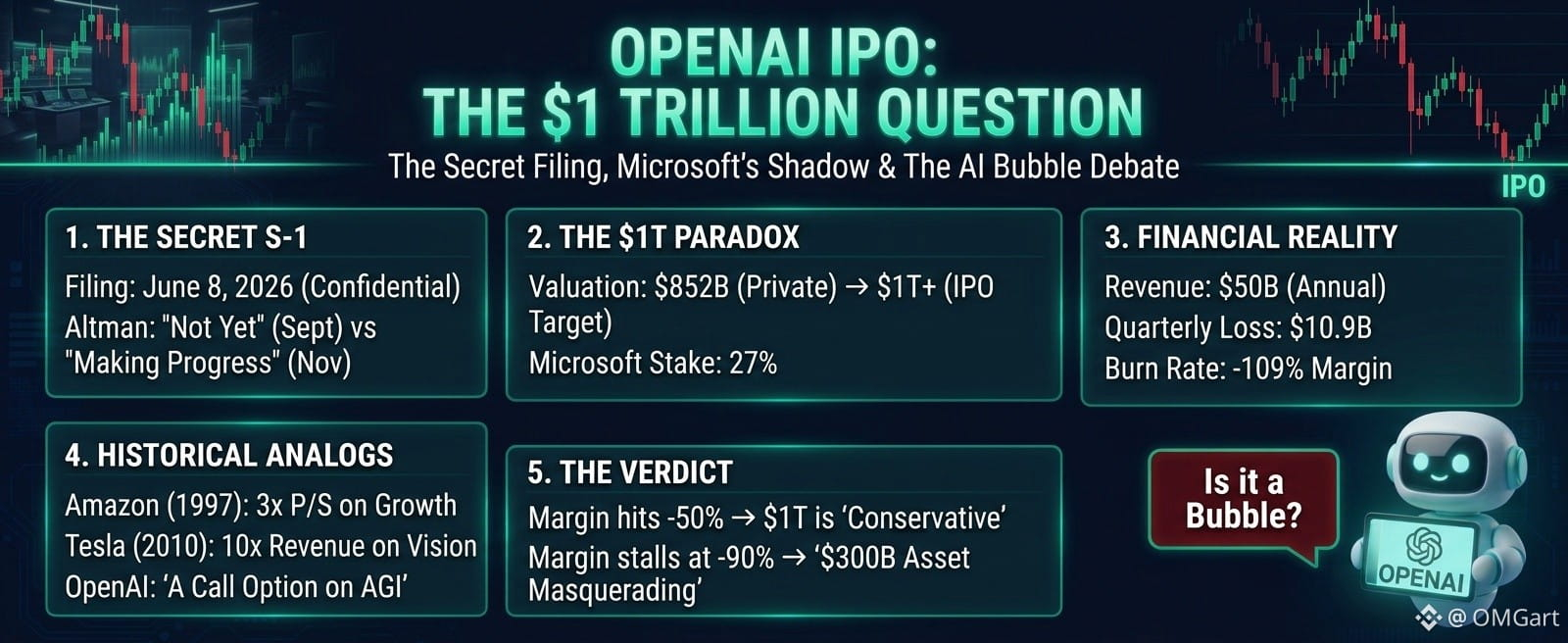

# Did you know that OpenAI filed for an IPO secretly, but Altman says 'not yet'?
**Reading time: 6 min • Focus: IPO Mechanics, Valuation Paradox & Microsoft's Shadow**
---
## The Short Version (TL;DR)
OpenAI secretly filed for an IPO in June 2026 while its CEO publicly said "not in 2026." By November, the narrative shifted to "we're making progress." The company targets a $1 trillion+ valuation — despite losing $1.09 for every $1 of revenue. Microsoft's 27% stake ($324B at target) creates a shadow IPO dynamic where real price discovery is years away. This isn't a bubble; it's a call option on AGI with a $10B/quarter burn rate as the premium.
---
## Why OpenAI Matters to You
Whether you're a developer building on GPT-4o, an enterprise paying for ChatGPT Team, an investor watching Microsoft's stock, or simply someone using AI daily — OpenAI's IPO changes the economics of intelligence itself. If a money-losing research lab can command a $1T valuation, every AI startup's ceiling just moved. If it can't, the "AI bubble" narrative gets its clearest test case yet.
---
## 1. The Secret Filing: What We Know
**June 8, 2026.** OpenAI submitted a confidential draft registration statement on Form S-1 to the SEC under Rule 135. The company announced it on their own website — an unusual move to preempt leaks. The filing gives OpenAI the option to go public sooner if market conditions align, while completing pre-IPO SEC review in private.
**Myth:** "OpenAI is going public tomorrow."
**Reality:** A confidential S-1 is a *placeholder*, not a launch. It preserves optionality. The SEC reviews it privately; OpenAI can amend, delay, or withdraw. No timeline is committed.
**September 2026.** Sam Altman, speaking at a conference, explicitly said: "We don't plan to go public in 2026." The market heard: *no IPO this year.*
**November 18, 2026.** Altman on Yahoo Finance: "We plan to be public... we're making progress on the IPO." The contradiction is deliberate — the filing keeps the clock running; the public comments manage expectations.
---
## 2. The $1 Trillion Question
### The Valuation Paradox
How does a company justify a $1T+ valuation when it loses **$1.09 for every $1 of revenue**?
**OpenAI at $1T+ is not a bubble — it's a call option on AGI with a $10B/quarter burn rate as the premium.**
### Historical Analogs: Amazon (1997) & Tesla (2010)
| Metric | Amazon at IPO (1997) | Tesla at IPO (2010) | OpenAI (Projected) |
|--------|---------------------|---------------------|-------------------|
| Revenue | $148M | $112M (2009) | ~$50B run-rate |
| Net Loss | $30M | $55.7M | ~$43B annualized |
| Market Cap | $438M | $1.6-2.2B | $1T+ target |
| Key Metric Rewarded | Revenue growth velocity (doubling annually) + market share | Technology moat + TAM + vision premium | Inference margin trajectory + enterprise NRR |
| Path to Profitability | 4-5 years to GAAP profit; real engine = AWS (launched 2006) | 10 years to sustained profit (2020); required Model 3/Y volume | Plausible 2027-28 IF training capex % declines from 50% → <20% |
**The Amazon lesson:** Markets priced 3x P/S on $148M revenue because growth *rate* justified it. Core retail operated at breakeven for decades; the market rewarded FCF inflection and TAM expansion, not quarterly EPS.
**The Tesla lesson:** Markets accepted 10-15x revenue on near-zero revenue because they bought *option value* on transportation disruption. Delivery growth CAGR >50% and gross margin expansion mattered — not current earnings.
### OpenAI Assessment: Feature or Bug?
**Burn is a feature — but with an expiration date.**
The $2.09 spend per $1 revenue funds:
1. **GPU cluster capex** (H100/B200) depreciating over 3-5 years
2. **Model training runs** creating IP moat
3. **Enterprise sales motion** building $50B+ ARR runway
Unit economics *are* improving: margin moved from -150% → -109% QoQ because inference cost curves bend down faster than revenue grows.
**But it remains a feature ONLY if:**
- Inference margins reach 60%+ at scale
- Enterprise NRR >120% with logo churn <5%
- Training capex as % of revenue declines from ~50% to <20% by 2028
- No open-source model (Llama 4, Nemotron, Qwen) reaches GPT-5 parity within 18 months
- Regulatory regime doesn't impose per-token taxes adding 20%+ to CoGS
- Microsoft partnership renews favorably post-2032 IP license expiry
**Collapse conditions:**
- Inference margin compresses to <40% due to price war (Anthropic, Google, xAI, open-source)
- Enterprise adoption plateaus at <$25B ARR
- GPT-5 fails step-function capability jump over 4o
- Training capex accelerates to >$50B/yr without proportional revenue lift
- Key talent exodus erodes research velocity
- Major safety incident triggers regulatory moratorium
### Microsoft's Shadow IPO Dynamic
> **Foundation (~26%) + Microsoft (~27%) + SoftBank (~13%) + employee lockups = >65% locked up long-term.**
Realistic IPO float: **5-15%** (mega-cap tech norm). At $1.2T valuation, 10% float = **$120B** — largest tech IPO ever, but thin float amplifies volatility.
Microsoft's stake alone ($324B at $1.2T) = **8.5% of MSFT market cap**, creating reflexive pricing: MSFT becomes an OpenAI proxy.
**No true price discovery until float expands.** Private rounds ($852B, $1.4T talks) set marks with preferential terms (liquidation prefs, anti-dilution). Public market would price daily on: quarterly ARR/loss trajectory, Microsoft Azure consumption ($250B contracted), competitive dynamics.
**Microsoft holds four cards:**
1. 27% equity upside
2. $250B Azure purchase commitment (revenue visibility)
3. IP license through 2032 (model weights, training data)
4. Exclusive commercialization rights for enterprise
Microsoft wins if OpenAI wins, *and* wins if OpenAI loses (Azure still gets inference workloads). MSFT trades at discount to sum-of-parts because the market can't price the OpenAI option; IPO crystallizes this but removes Microsoft's control over timing.
---
## 3. The Financial Reality: Growth vs. Burn
| Metric | Figure | Context |
|--------|--------|---------|
| Annual Revenue Run-Rate | **$50B** | Up from $20B in Jan 2026; $13.07B actual 2025 |
| Quarterly Loss | **$10.9B** | Q3 2026; implies $43.6B annualized |
| Loss per $1 Revenue | **$1.09** | Adjusted operating margin: -109% |
| R&D Spend (Annual) | **~$19B** | Model training, research talent |
| CoGS (Annual) | **~$7.5B** | Inference serving, Azure credits |
| Microsoft Azure Credits (2025) | **$10.6B** | Both cost and strategic subsidy |
**Myth:** "OpenAI is burning cash with no path to profit."
**Reality:** Inference economics already work at serving layer. GPT-4o mini: ~$0.15/1M tokens input cost → retail $0.60 = **75% gross margin**. Training is sunk capex; the question is whether serving margin + enterprise uplift covers amortized training + sales ($5.7B) + G&A.
**At $50B run-rate with 60% serving margin:** $30B gross profit minus $25B opex (ex-training) = **$5B operating profit** — plausible by 2027-28 *IF* training capex growth slows.
---
## 4. Microsoft's $225B Shadow
Microsoft's ~27% stake is worth **~$225B at $852B private valuation**, scaling to **$324B at $1.2T IPO target**.
This isn't just an investment — it's a **strategic stranglehold**:
- **Revenue visibility:** $250B Azure consumption commitment from OpenAI
- **IP control:** License to model weights and training data through 2032
- **Commercial moat:** Exclusive enterprise distribution rights
- **Talent pipeline:** Shared researchers, joint hiring
**Myth:** "Microsoft owns OpenAI."
**Reality:** Microsoft has *economic exposure* and *commercial rights*, not governance control. OpenAI's capped-profit structure (investor returns capped at 100x, declining in future rounds) and non-profit board oversight limit Microsoft's direct control. But the economic interdependence is absolute.
The "shadow IPO" means: **Microsoft shareholders already own OpenAI exposure** — just at a discount and without liquidity. An OpenAI IPO forces price discovery on an asset MSFT already carries.
---
## 5. What's Next?
### Timeline Catalysts
| Catalyst | Timeline | Impact |
|----------|----------|--------|
| S-1 goes public (amended filing) | H1 2027 (earliest) | First look at audited financials, risk factors |
| GPT-5 release | 2027 | Step-function capability proof; validates premium |
| Microsoft partnership renewal talks | 2029-2032 | IP license expiry creates renegotiation leverage |
| Open-source parity (Llama 4/Nemotron) | 2027-2028 | Margin compression risk if GPT-class models go free |
| Regulatory framework (US/EU AI Acts) | 2026-2028 | Could add 20%+ to CoGS or limit deployment |
### Key Metrics to Watch
1. **Q/Q margin inflection slope** — must hit -50% by Q4 2026 for $1T to look conservative
2. **Enterprise NRR cohorts** — >130% = compounding machine; <110% = saturation
3. **Open-source benchmark gaps** (LMSYS Elo) — narrowing gap = pricing power erosion
4. **Microsoft Azure consumption vs. $250B commitment** — utilization rate signals real demand
### The Verdict
If margin hits -50% by Q4 2026 **and** NRR >130%, the $1T valuation becomes *conservative*.
If margin stalls at -90% **and** NRR <110%, it's a **$300B asset masquerading as $1T**.
Real price discovery is **2-3 years away**. Until then, valuation is a negotiation between Sam Altman and a few large LPs — not a market-clearing price. #OpenAI
---
## Sources
- OpenAI Official Announcement: *Confidential Submission of Draft S-1 to the SEC* (June 8, 2026)
- Fortune: *OpenAI Files Confidentially for IPO* (June 9, 2026)
- The Information: *OpenAI Told Investors It's Running at $50B Annual Revenue Rate* (October 2026)
- Financial Times / CNBC / Reuters: *OpenAI 2025 Audited Financials Leaked* ($13.07B revenue, $20.92B operating loss)
- TechCrunch: *Microsoft Recorded $10 Billion in Revenue from OpenAI* (October 28, 2026)
- Yahoo Finance: *OpenAI CEO Sam Altman on Potential IPO: 'We Plan to Be Public'* (November 18, 2026)
- AI Now Institute: *Public Good, Private Gain — OpenAI Business Structure Analysis*
- OpenAI Corporate Governance Filings (California & Delaware Attorney General submissions)
- Pedrum Shokouhi / QAI: *OpenAI Private Company Valuation Tracker* ($852B post-money Mar 2026)
- Amazon & Tesla IPO Prospectuses (SEC EDGAR) — historical financial comparables