
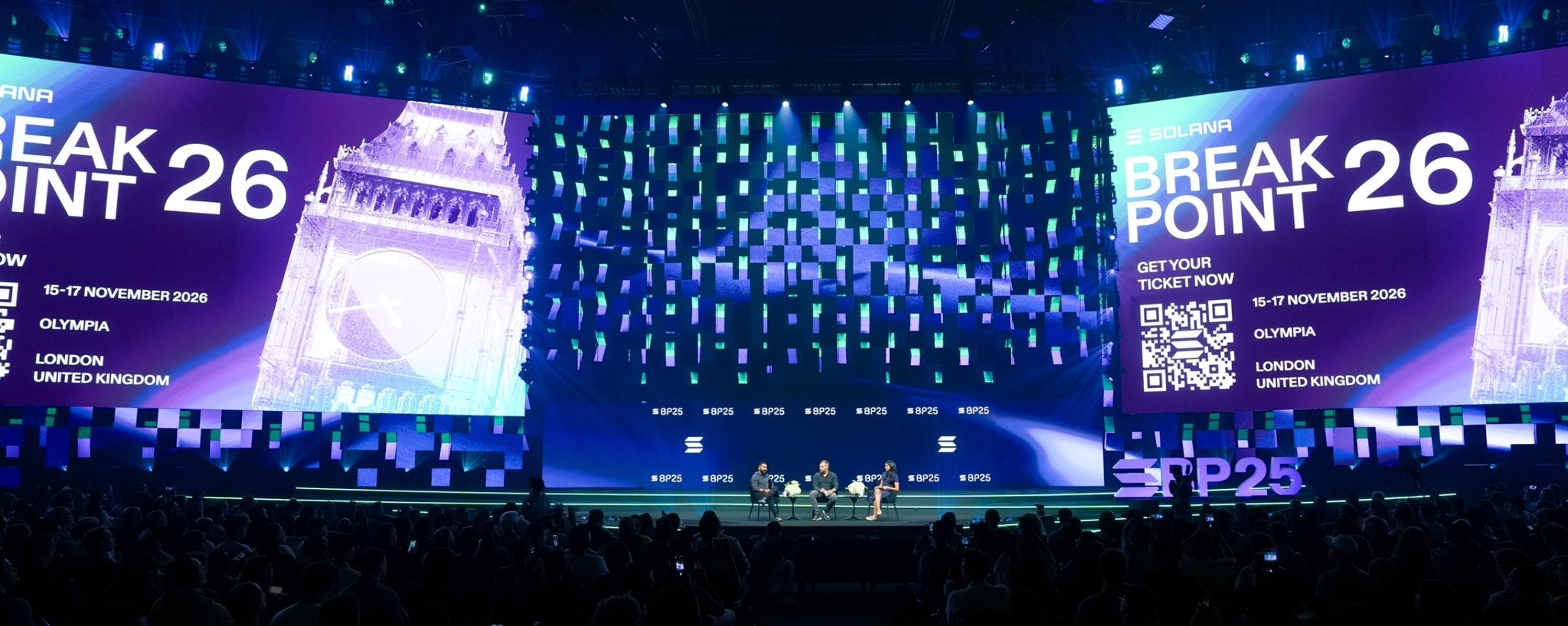

Solana just drew its biggest technical picture yet, and the market barely blinked. That gap between the plan and the price is the whole story.
At Breakpoint 2026 in London, Anza chief executive Brennan Watt laid out Solana's 2027 roadmap on November 17. Anza builds Agave, the validator software much of the network runs on, and the plan covers four areas: performance, expressivity, market structure and resilience.
The headline number is performance. Compute capacity is set to double, from around 250 million compute units per second to 500 million by the end of 2027. At the same time, the compute needed for token-account transactions is to be cut by 80%, freeing block space without forcing every validator to buy bigger hardware.
The rest of the plan reaches further. Native vector processing would let AI models run directly on-chain. One transaction would be able to touch 96 accounts instead of 64, which helps aggregators reaching across more liquidity pools. Rotor is planned to replace Turbine, the system that spreads new blocks across the network, and Constellation would add a second block proposer, sharpening competition between validators over transaction ordering.
This follows a real delivery. The Alpenglow upgrade went live on October 21, cutting transaction finality from about 12.8 seconds to roughly 150 milliseconds, and Solana formally retired its long-running "mainnet beta" label, moving to protocol version 1.0 on November 16. That track record gives the 2027 plan more weight than a wish list, but the bigger items are still targets, not live code. No binding schedule has been published for them, and Watt's own line at the event was telling: the team does not do multi-year roadmaps, it ships updates directly.
Two other announcements from the same week show where Solana is aiming beyond raw speed. On November 17, the final day of Breakpoint, the Solana Foundation took a majority stake in CoinGecko, the crypto data platform with 18 million registered users and around 180,000 API customers. The price and the exact stake were not disclosed. The plan is to build Solana-powered trading into CoinGecko, GeckoTerminal and the app, turning a price-checking habit into a funnel straight into the ecosystem. Questions about data neutrality were raised straight away, and they are fair ones to keep asking.
Then there is the institutional piece. On November 12, the DTCC announced its tokenization service will connect with Solana in the second half of 2027, letting eligible securities held at its depository be issued as tokens on the network, with the same investor protections as the underlying securities. The depository looked after $114 trillion in securities in 2025. The eligible slice is narrow for now — large-cap US stocks, major index ETFs and Treasuries — but the endorsement is heavyweight, and it is still a year away.
So why is SOL struggling near $70? The price fell to $67.37 on November 15, its lowest since June, and it was trading around $70.53 when checked this evening, down more than 31% over the past month. US spot Solana ETFs recorded $32.05 million in net outflows in the week ending November 13, a sixth straight week of withdrawals totalling $197.4 million, with combined net assets falling from $1.31 billion to $1.14 billion. The original deep dive also flags a sharp cooling in on-chain transaction counts from October to mid-November. One small turn has appeared since: November 16 brought $11.6 million of net ETF inflows, the first daily inflow in 24 days.
That is the tension in one line. The roadmap is a capability proof, not a demand guarantee. Doubling capacity only matters if real usage arrives to fill it. The levels the post highlights are $67.50 as support, the November low, and $73.60 as resistance. For the longer view, the things to watch are two straight months of recovering on-chain activity and sustained ETF inflows, not another roadmap slide.
If DTCC tokenization lands, AI agent payments scale and the CoinGecko funnel works, the story around SOL could shift from meme casino to financial infrastructure. Until then, the builders are moving fast and the money is still deciding.
Is Solana's problem really speed, or is it that nobody has yet given the extra capacity a reason to be used?