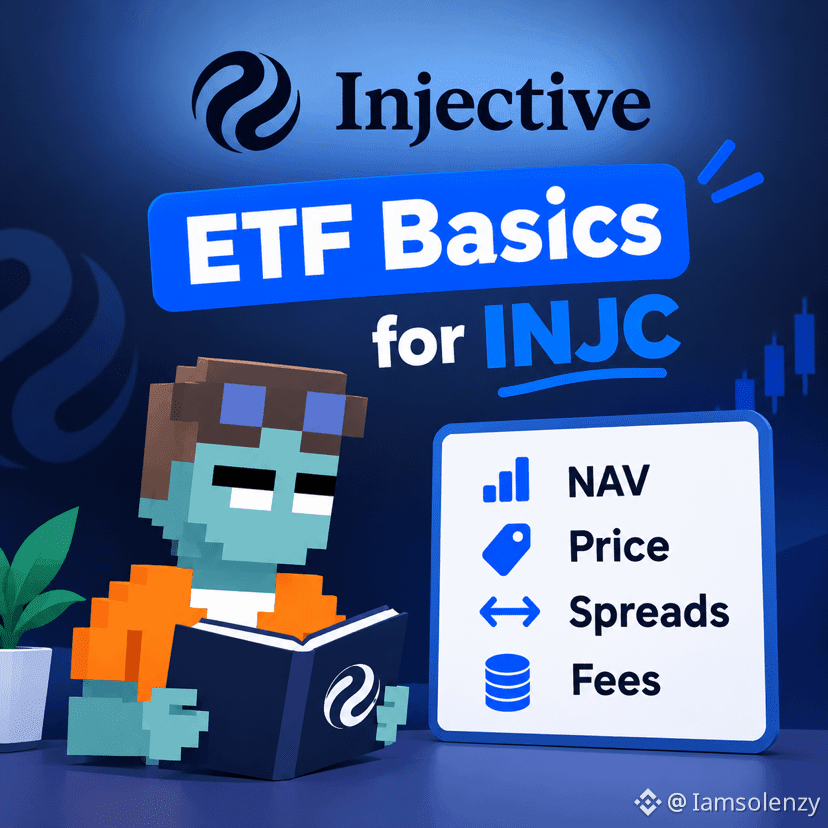
ETF Basics: What Investors Should Know About $INJC the Canary Staked INJ ETF by @Injective
Understanding an ETF goes beyond knowing what it holds. You also need to understand how its value is measured and what affects trading costs.
Take $INJC, the Canary Staked INJ ETF, as an example.
INJC provides exposure to $INJ through a traditional brokerage account. Here are some important terms to understand:
✔️ NAV: Net asset value is the fund’s assets minus liabilities, divided by shares outstanding. INJC calculates NAV once each trading day using a CoinDesk INJ rate based on a 60-minute time-weighted average, at 4 p.m. ET.
✔️ Market price: The actual price at which shares trade. It can be above NAV (premium) or below NAV (discount).
✔️ Bid, ask and spread: The bid is the highest price a buyer offers; the ask is the lowest price a seller accepts. The difference is the spread. Wider spreads can increase trading costs.
✔️ Market vs. limit orders: A market order seeks execution at the best available price. A limit order sets the maximum buying price or minimum selling price, but may not execute.
✔️ Fees: The expense ratio reflects annual fund operating expenses. Staking-related fees, brokerage commissions and spreads may also affect overall costs. Check the fund’s current prospectus for applicable fee details.
✔️ Trading hours: $INJ trades around the clock. INJC trades during exchange hours, so overnight or weekend price movements may be reflected when the market reopens.
✔️ Creations and redemptions: Authorized participants can create or redeem large blocks of ETF shares. This process can help keep market price aligned with NAV. Individual investors generally trade through their brokerage accounts.
Understanding what an ETF holds is only part of the picture. NAV, premiums and discounts, spreads, order types, fees and trading hours all matter.