$PARTI: Dollar Participation as a Shared Metric
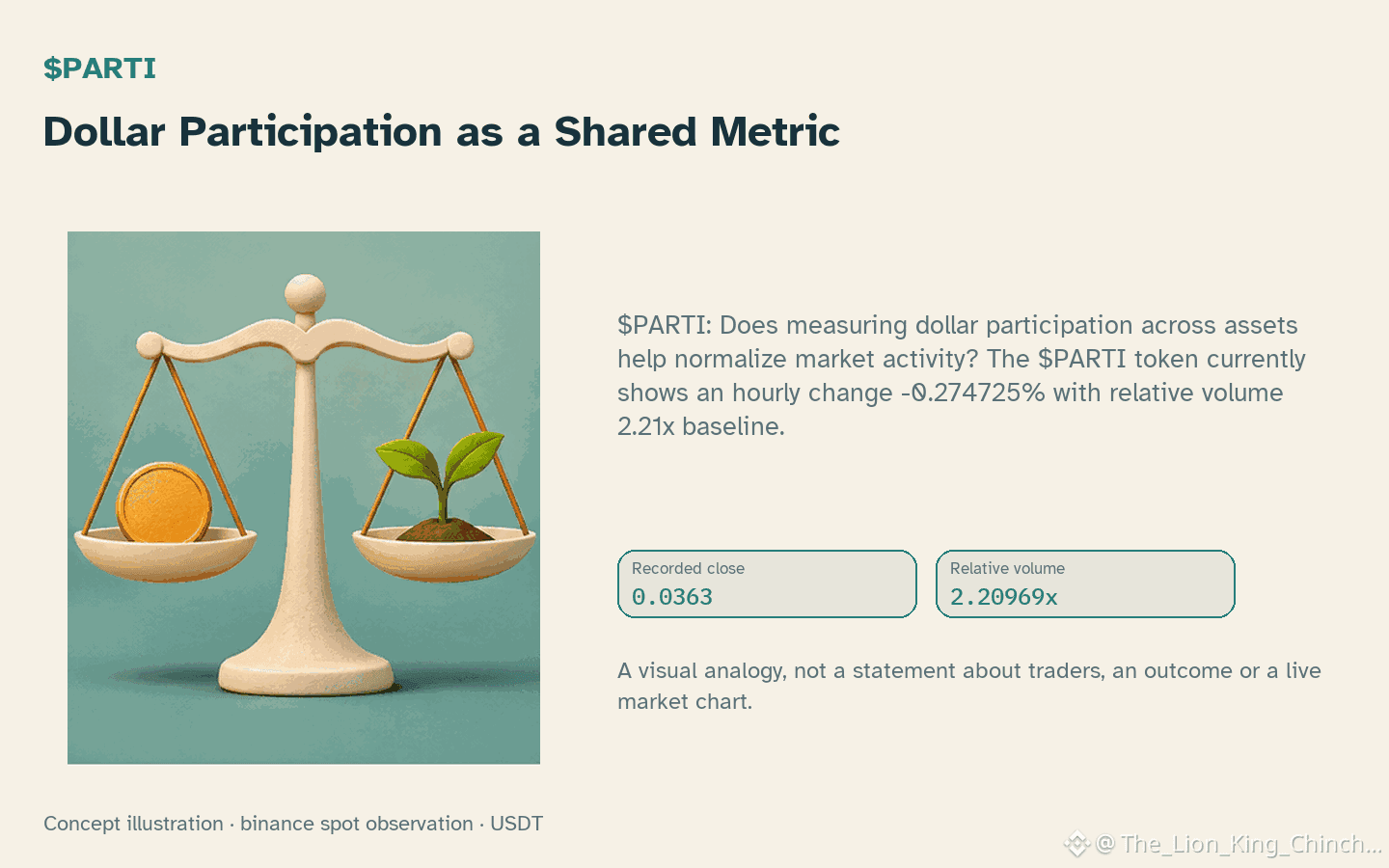
$PARTI: Does measuring dollar participation across assets help normalize market activity? The $PARTI token currently shows an hourly change -0.274725% with relative volume 2.21x baseline.
Standardizing participation involves viewing volume as a common unit of dollar value rather than token counts. This hypothetical mechanism allows a comparison of activity levels between peers like $PARTI and BTC despite their different price scales. When relative volume sits above a baseline while price moves, it suggests a temporary increase in the intensity of participation compared to the local history. This metric does not define a trend but measures how much attention is currently directed toward one venue.
Contextual limits are essential. While BTC shows an hourly direction up and volume not above its baseline, $PARTI moves downward. These same-venue differences show that shared directions or timing are not evidence of a common cause. A counterexample occurs when two assets move together on low volume; this might reflect a lack of local resistance rather than standardized participation. We can reassess this by watching if price returns to the local resistance 0.0366 on declining relative volume, which would weaken the idea of sustained participation. Using RSI 49.9 as a secondary gauge can help identify if these moves occur near previous range extremes.
Probabilistic market research, not a recommendation or guaranteed return.
For a wider view: $BTC has hourly direction up and volume not above its baseline; $AIGENSYN has hourly direction down and volume not above its baseline. This alone does not establish correlation.
#PARTI #BTC