$BTC: The Logic of Reassessment Rules
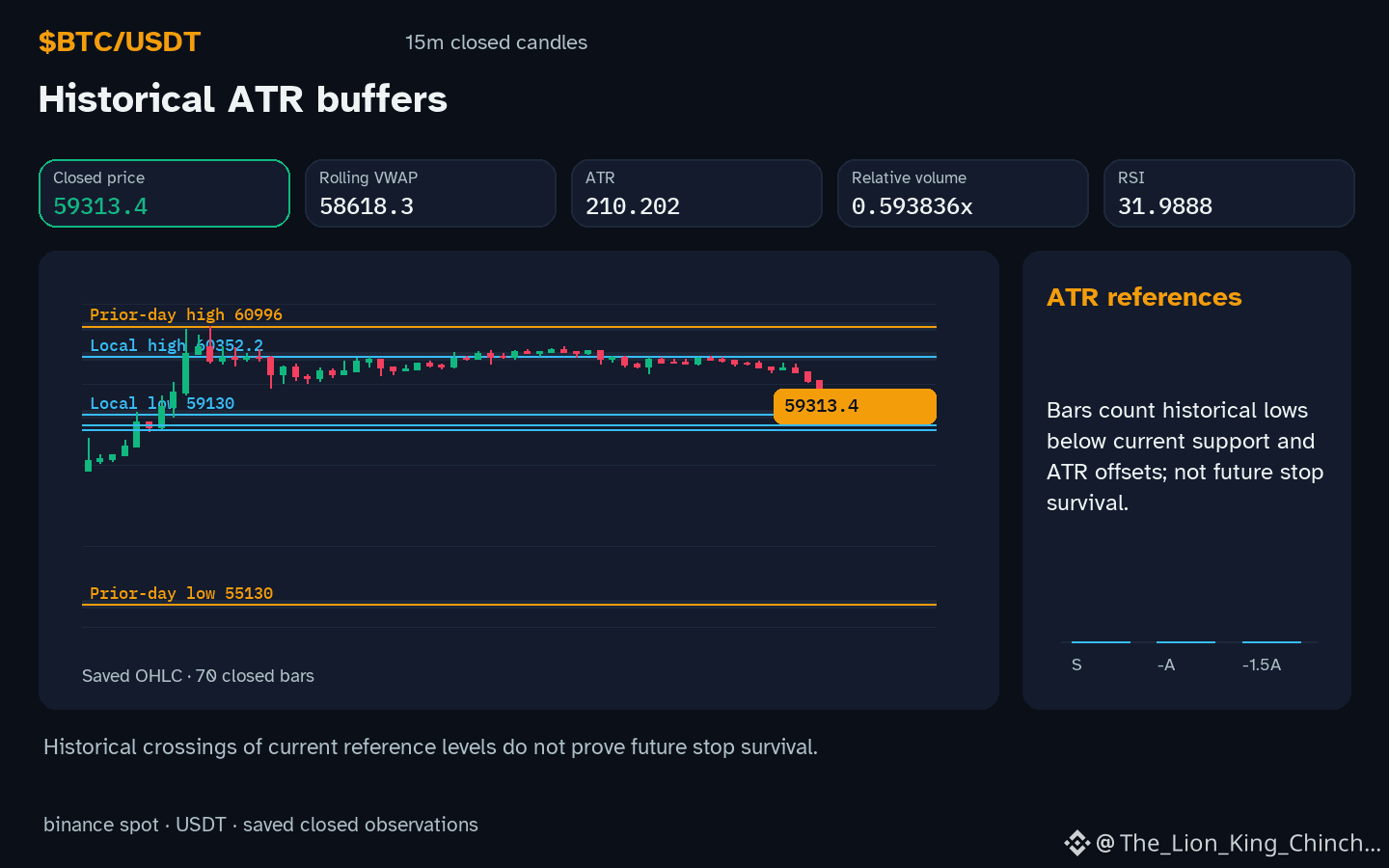
Does $BTC price activity within a recorded range require a static response or a dynamic update to your thesis? The asset is currently inside its local range while the hourly direction is down. This observation highlights a trade-off between waiting for a planned exit and acting early on new data.
### The Choice of Invalidation
When using a structured reassessment rule, a hypothetical participant chooses between protecting entry quality and accepting a wider invalidation distance. If the price moves against a thesis but stays within the support level of 59130, one might wait for a closed candle to confirm a trend change. This avoids chasing volatility but risks a larger loss if the level fails abruptly. Conversely, acting immediately upon a minor change in the RSI 32.0 might preserve capital but often results in exiting before a planned move matures.
### A Mental Self-Check
Consider a thought experiment where the local resistance at 60352.2 is the primary target. If the daily change is 5.35077% and the hourly direction remains down, the reassessment rule asks if the original reason for the trade still exists. A counterexample would be exiting simply because the price stalled, rather than waiting for a specific violation of the structure. A concrete way to reassess is to look for a closed candle beyond the prior range. If $BTC stays within these bounds on volume only 0.59x the baseline, the original range interpretation likely remains valid despite small fluctuations. 🛡️
Probabilistic market research, not a recommendation or guaranteed return.
#BTC #RiskManagement #CryptoLearning