

Disclosure: It is not financial advice
Friday's drop arrived after Hong Kong had gone home
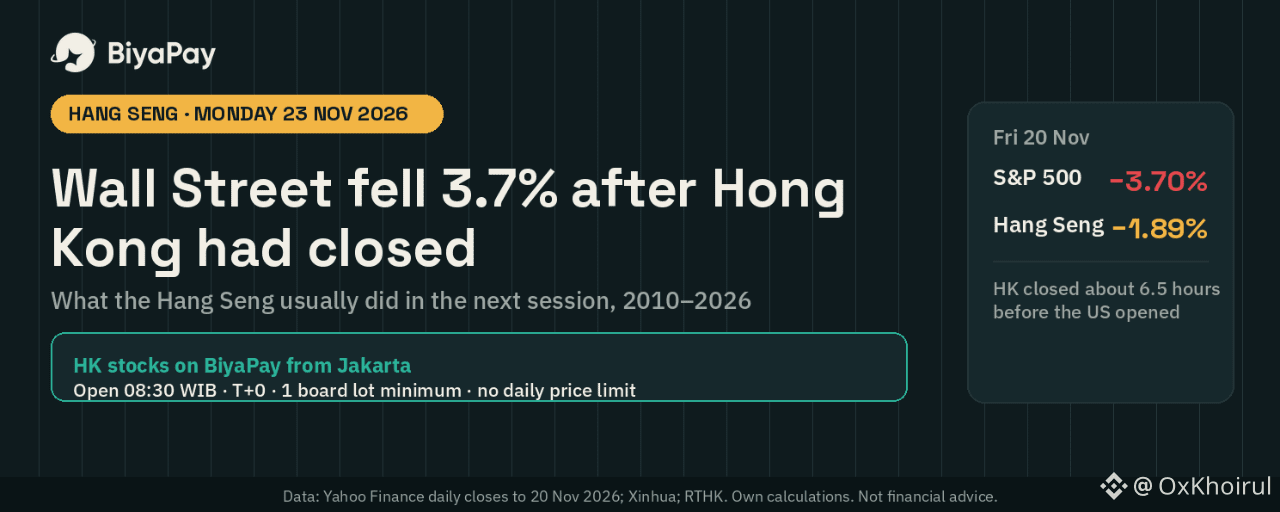
On Friday 20 November 2026 the S&P 500 fell 3.70% to 6,910.39 and the Nasdaq Composite fell 5.28% to 22,617.73, according to Xinhua's closing report. Technology was the worst sector, down 7.11%.
Hong Kong had already finished its week by then. The Hang Seng Index closed 1.89% lower at 22,410.80 on Friday afternoon, and the Hang Seng Tech Index fell 3.8% to 3,511, RTHK reported.
The Hang Seng closes at 16:00 Hong Kong time. That is 03:00 in New York, six and a half hours before the US market opens. So Friday's 1.89% fall in Hong Kong was a reaction to Thursday's US session, when the S&P 500 lost 2.02%. Friday's 3.70% drop has not been traded in Hong Kong at all yet. The first chance is Monday 23 November, at 09:30 Hong Kong time.
That raises a practical question for anyone holding Hong Kong stocks: what does the Hang Seng usually do in the session after a big US drop?
Why Hong Kong trades yesterday's Wall Street
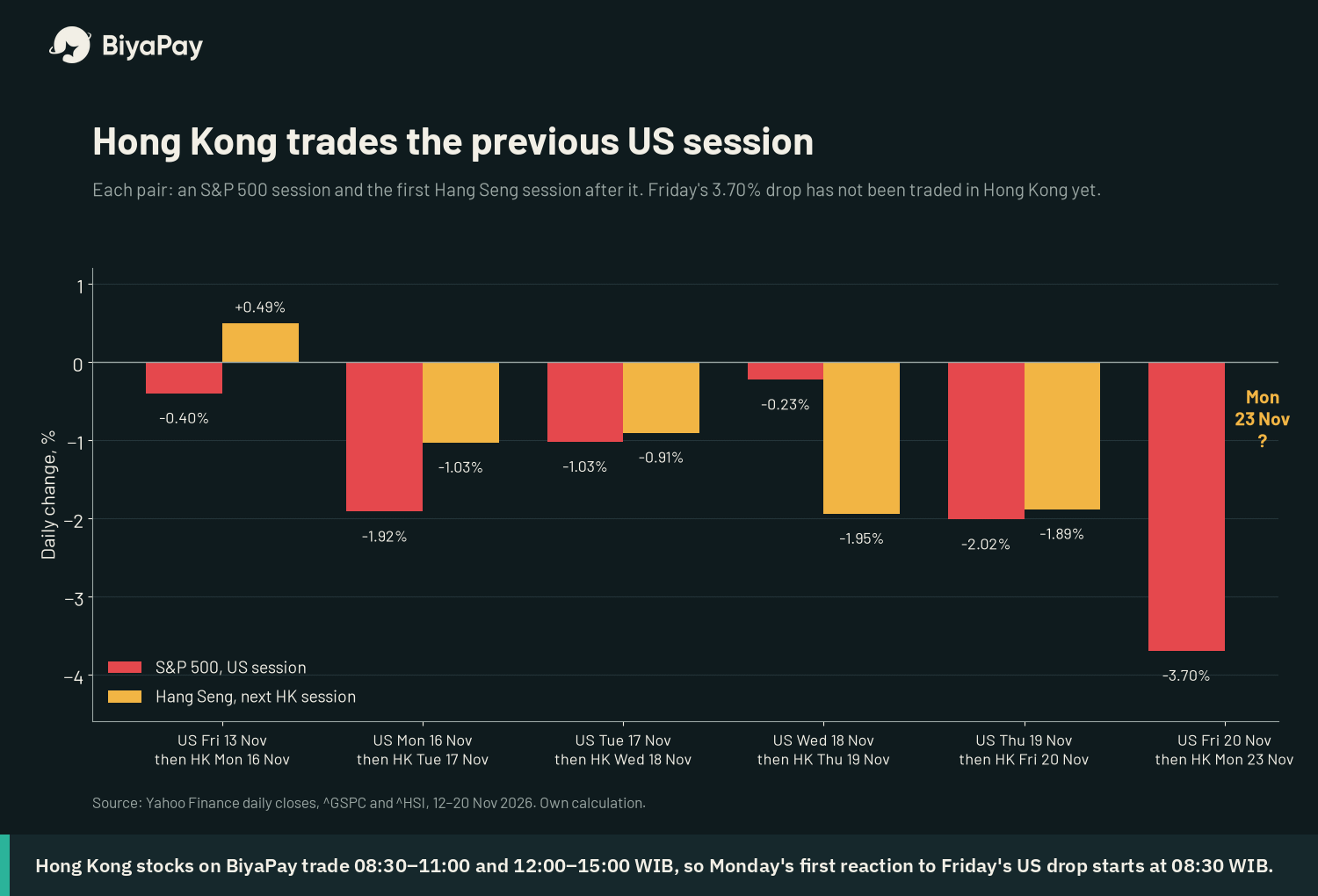
I matched every Hang Seng session with the US session that closed just before it. Over the past year, the correlation between the Hang Seng's daily move and the previous US session was 0.30. The correlation with the US session of the same calendar date, which happens after Hong Kong closes, was 0.03, close to zero.
On average over that year, the Hang Seng moved about 0.4% for every 1% the S&P 500 moved in the session before. Over ten years the pattern is weaker but the same: 0.25 against the previous US session, 0.17 against the same date.
This week shows both the link and its limits. Monday's 1.92% US fall was followed by a 1.03% Hong Kong fall. But on Thursday Hong Kong lost 1.95% after a US session that was down only 0.23%. Hong Kong has its own news too. RTHK said signs of tighter US tech curbs on China weighed on sentiment.
What happened after earlier 3% drops
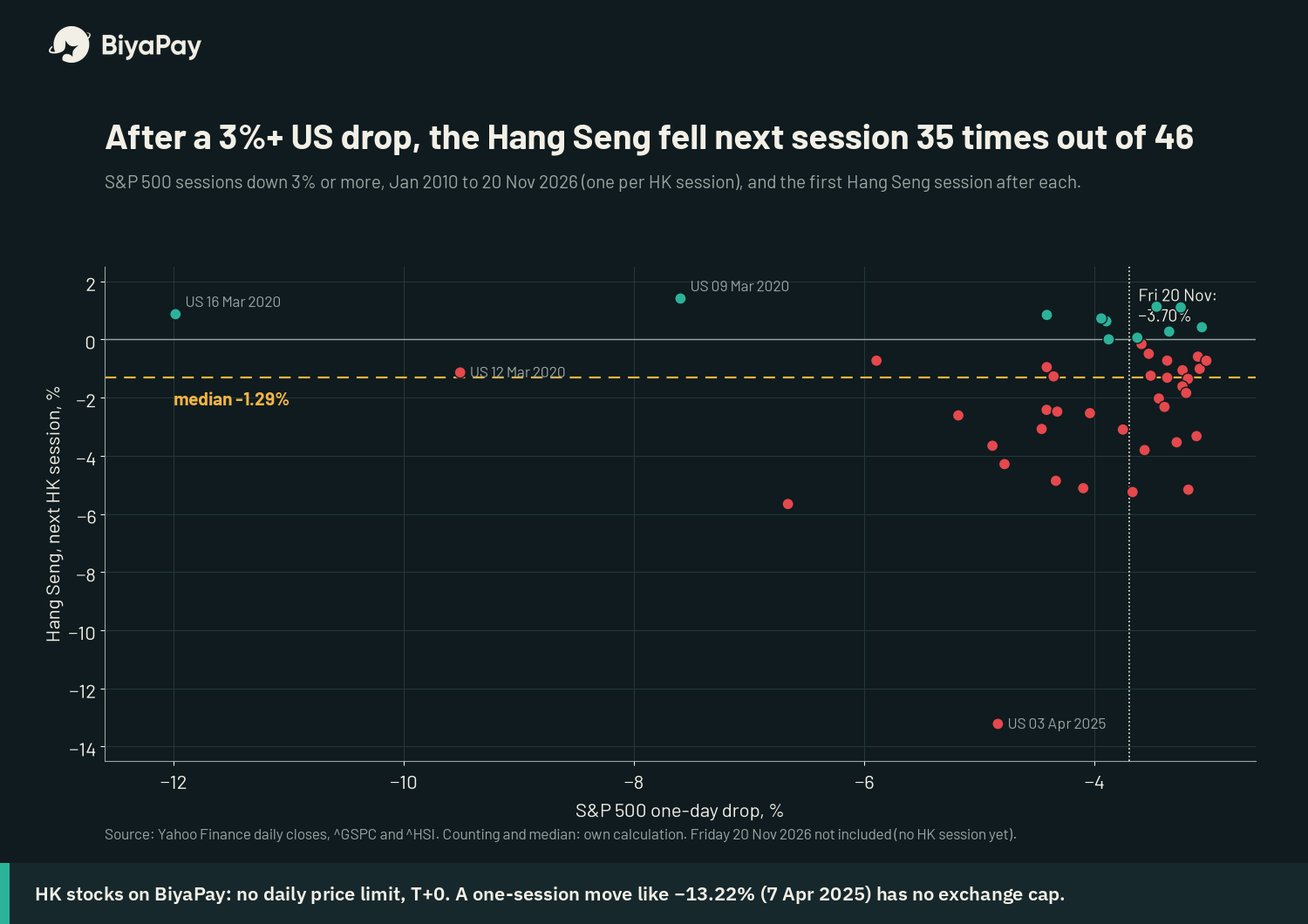
Since January 2010, the S&P 500 has fallen 3% or more in 46 sessions that were followed by a separate Hong Kong session. Here is what the Hang Seng did in the first session after each one:
It fell 35 times, rose 10 times and was flat once.
The median move was -1.29%.
It fell more than 2% in 19 of the 46 cases.
Over the first five Hong Kong sessions, the median was -1.55%, and the index was lower in 31 of 46 cases.
For comparison, since 2000 the Hang Seng has closed lower on 48.9% of all trading days. After a 3% US drop, that share rose to 76%.
The range was very wide. The worst case was 7 April 2025: after US falls of 4.84% and 5.97% on 3 and 4 April, Hong Kong reopened from a holiday and the Hang Seng fell 13.22%. The best was 10 March 2020, when the Hang Seng rose 1.41% the day after the S&P 500 fell 7.60%.
A median of -1.29% is a description of the past, not a forecast for Monday. It does show that Hong Kong has usually fallen less than the US move it was reacting to.
Not a hedge, not a copy
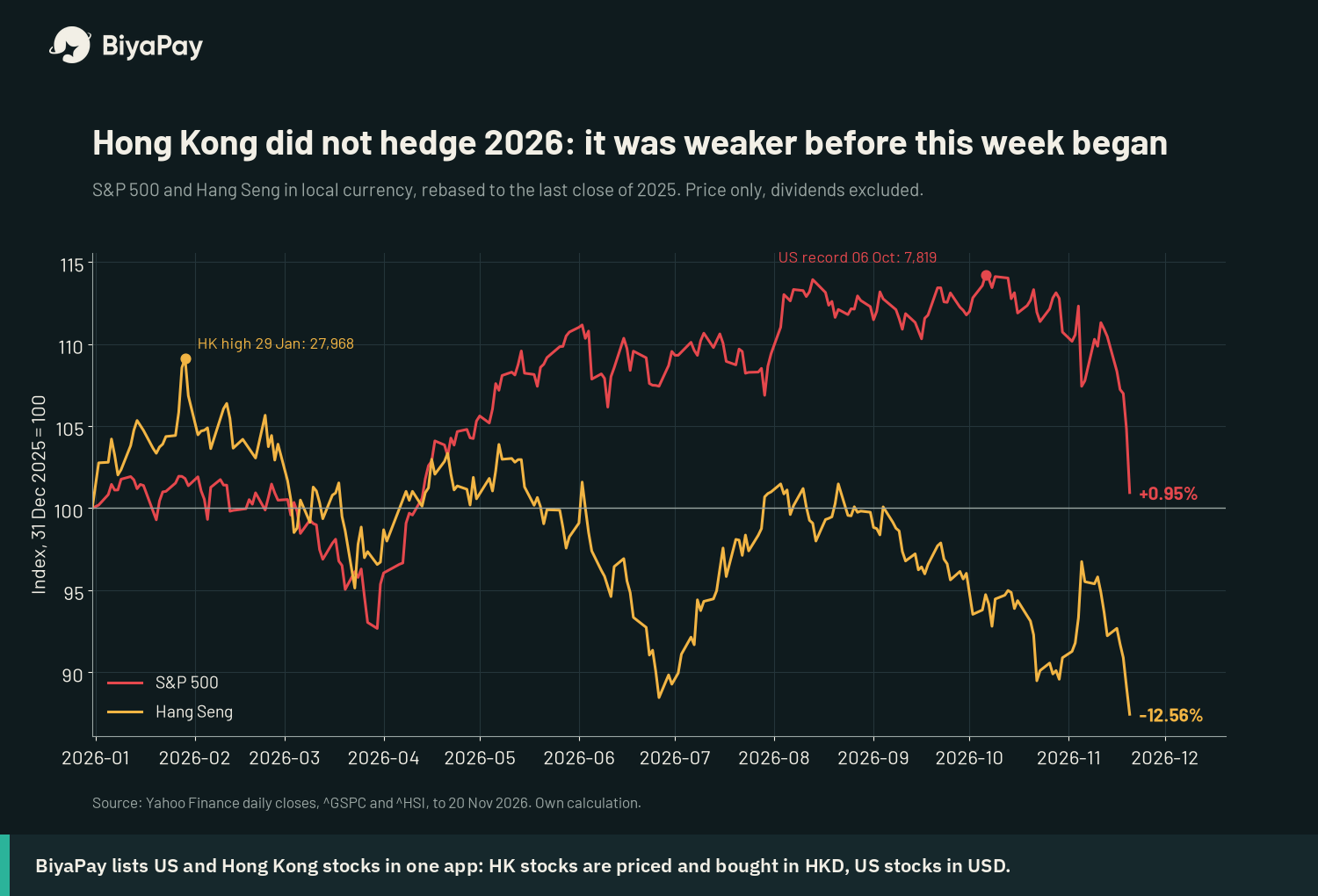
It is tempting to see Hong Kong as a diversifier for a US-heavy portfolio. This year the data does not support that idea in a simple way.
The Hang Seng peaked at 27,968 on 29 January 2026 and is now 19.9% below that level. In local currency it is down 12.56% for the year, while the S&P 500 is still up 0.95%, even after falling 11.6% from its 6 October record.
This week the Hang Seng fell 5.19% and the S&P 500 fell 8.61%. Hong Kong fell less, but it did not go the other way. My reading: Hong Kong lowers the size of a US shock, but it does not cancel it, and it carries its own China-related risks.
Trading Hong Kong hours from Jakarta
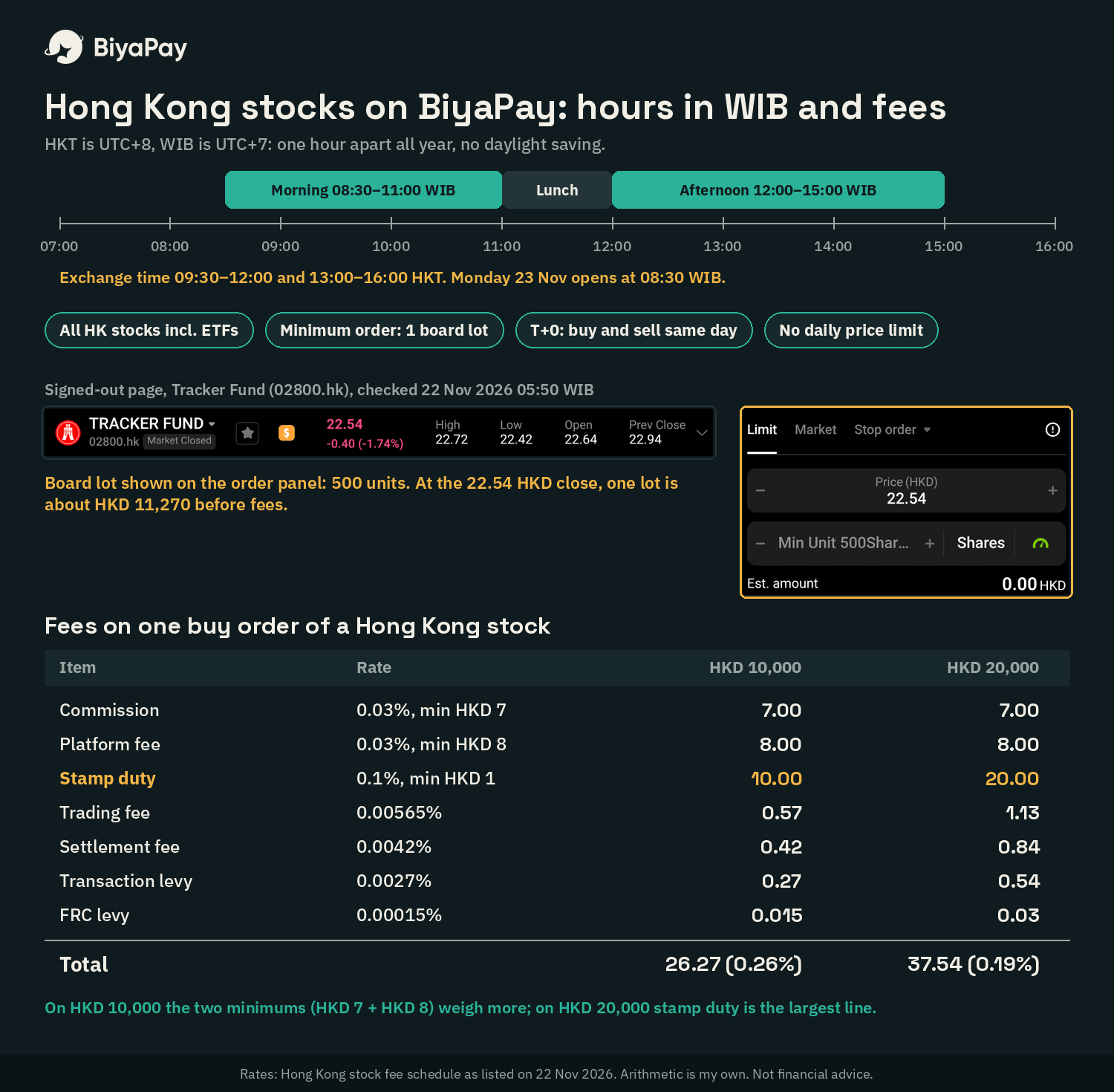
For an Indonesian investor, Hong Kong is the easier market on the clock. Hong Kong time is UTC+8 and WIB is UTC+7, with no daylight saving on either side, so the sessions are 08:30–11:00 and 12:00–15:00 WIB. Monday's reaction to Friday's US drop starts at 08:30 in Jakarta.
BiyaPay supports all Hong Kong stocks, including ETFs, in the same app as US stocks. The minimum order is one board lot, and lot sizes differ by stock. The Hong Kong market has no daily price limits, and trading is T+0, so shares bought on Monday morning can be sold the same day.
On BiyaPay, a HKD 20,000 purchase of a stock costs about HKD 37.54, or 0.19%: commission of 0.03% with a HKD 7 minimum, a platform fee of 0.03% with a HKD 8 minimum, and HKD 20 of stamp duty at 0.1%, plus small exchange and regulatory levies. Stamp duty is the largest line. On HKD 10,000 the total is about HKD 26.27, or 0.26%, because the two minimums carry more weight.
My take
Monday morning in Hong Kong is the first real-money vote on Friday's US sell-off, and it happens while New York is asleep. History says the Hang Seng usually falls after a 3% US drop, usually by less than the US move, and with a wide spread of outcomes.
What I would not do is treat Hong Kong as a safe place to hide from a US tech sell-off. In 2026 the Hang Seng has been weaker than the S&P 500 for most of the year, and the Tech Index fell twice as much as the main index on Friday.
What I find useful is the timing. A Jakarta-based investor sees the US close at 04:00 WIB and the Hong Kong open at 08:30 WIB. That gap is enough time to read the numbers, decide on a size, and avoid trading on the first headline.
Sources: Xinhua, "U.S. stocks close lower" (21 November 2026); CNBC, "S&P 500 correction: Five forces behind the market sell-off" (20 November 2026); RTHK, "HK, mainland slip as tech stocks take brunt of fears" (20 November 2026); Yahoo Finance daily closes for ^GSPC (from 1980) and ^HSI (from 1986) to 20 November 2026. Correlations, counts, medians and fee arithmetic are my own calculations, checked on 22 November 2026 (Asia/Jakarta).