

🚨
The market has just suffered a brutal shock. But the most dangerous part of a stock-market collapse may not be the losses investors see on their screens—it may be the loans sitting quietly on bank balance sheets, secured by assets whose value is suddenly disappearing.
A brutal market selloff can become something far more dangerous when the financial system is built on leverage.
The hidden mechanism: collateral is falling, but the debt remains
One of the most dangerous lending structures in a bull market is securities-backed lending.
Investors borrow money from banks and financial institutions using their stock portfolios as collateral. It works beautifully while markets rise. Investors can access liquidity without selling their shares, while lenders collect interest and believe they are protected by collateral.
But what happens when the collateral suddenly loses 20%, 30%, or even 40% of its value?
The debt doesn’t disappear.
Banks may demand additional collateral. Borrowers may be forced to sell assets. If they cannot meet margin calls, lenders may liquidate their portfolios—often at precisely the worst possible moment.
The chain reaction is frighteningly simple:
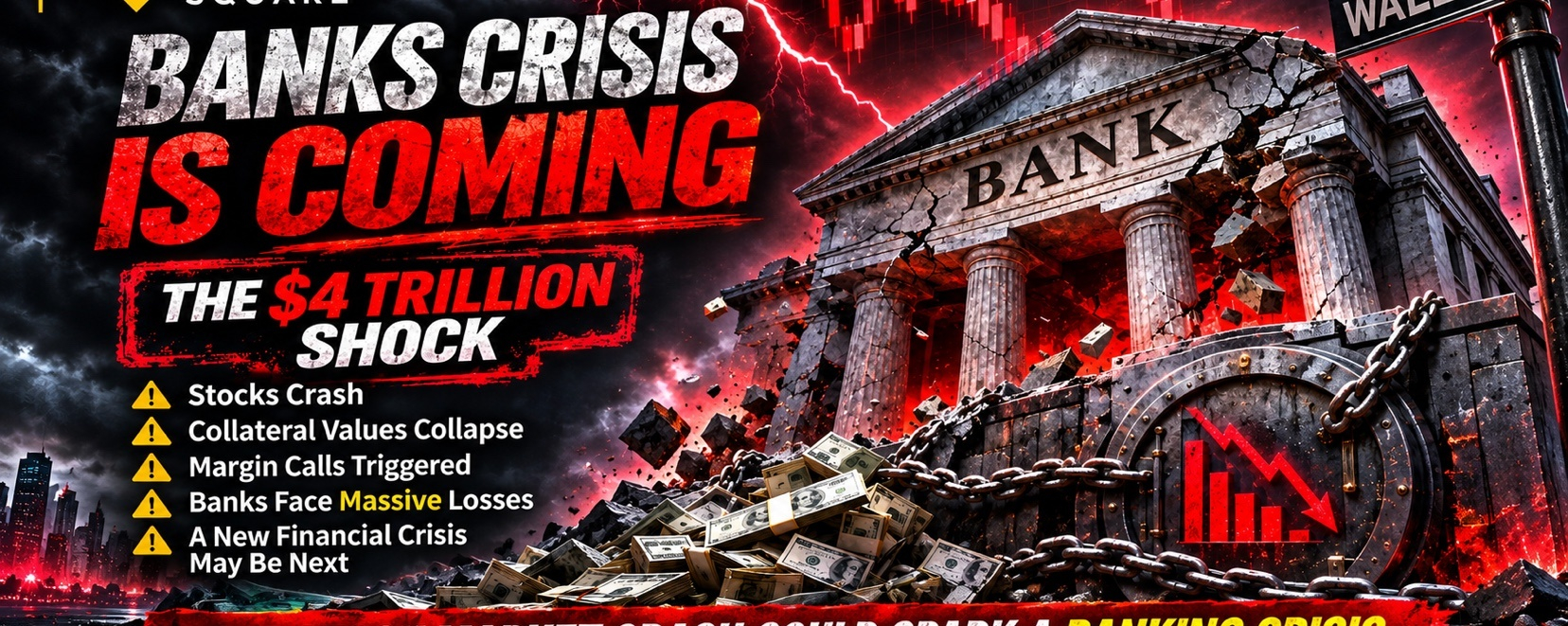
📉 Stock prices fall
➡️ Collateral values decline
➡️ Margin calls arrive
➡️ Borrowers sell assets
➡️ Selling pressure increases
➡️ Markets fall further
➡️ More margin calls follow
This is how a market correction can potentially turn into a financial feedback loop.
The banks are increasingly connected to this risk
This is not merely theoretical.
Recent Federal Reserve analysis has highlighted the growing importance of less-traditional lending, including securities-based lending and lending to nonbank financial institutions, among major U.S. banks.
These lending activities create additional channels through which financial stress can spread.
The danger is not that every loan will default.
The danger is that a rapidly falling market can transform loans that appeared safe yesterday into loans requiring urgent collateral protection today.
Banks don’t need to be holding worthless loans for a crisis to begin. They need exposure to borrowers, funds, and counterparties that suddenly require liquidity at the same time.
The warning signs were already documented
The Federal Reserve’s financial stability assessments have highlighted vulnerabilities including:
• Elevated asset valuations
• Financial-sector leverage
• Hedge-fund leverage
• Funding vulnerabilities
• Potential forced asset sales during periods of stress
Excessive leverage can force institutions to sell assets, reduce lending, or cut risk precisely when the broader economy needs liquidity.
The question is not whether these risks exist.
The question is what happens when several of them are activated simultaneously.
The $4 trillion shock may be the beginning—not the end
A market capitalization loss of trillions of dollars does not mean the same amount of physical cash vanished from the financial system.
But the collapse in valuations matters enormously when those assets are being used as collateral.
The bigger the decline, the smaller the collateral cushion.
The smaller the collateral cushion, the greater the chance of margin calls.
The greater the margin calls, the greater the forced selling.
And the greater the forced selling, the deeper the market decline can become.
This is how a stock-market crash can potentially become a credit crisis.
The question everyone should be asking
The question isn’t simply:
“How much did the stock market lose?”
The question is:
“How much debt was built on top of the assets that just lost their value—and who is holding that debt?”
If borrowers begin receiving margin calls at scale, if private funds are forced to liquidate assets, if banks begin tightening lending to protect their balance sheets, and if liquidity disappears from markets investors previously considered safe, the consequences could extend far beyond a technology-stock correction.
A stock-market crash can be absorbed.
A credit contraction is much harder to absorb.
And a credit contraction combined with falling collateral values, leverage, forced selling, and deteriorating confidence can become the type of financial event that spreads faster than regulators can respond.
The market has already delivered the shock. The question now is whether the financial system can absorb it.
We are not declaring that a banking crisis is guaranteed. But the vulnerabilities are real, and the interaction between leverage, collateral, liquidity, and falling asset prices deserves serious attention.
The danger may not be visible in today’s headlines.
It may be buried in collateral agreements, lending books, margin requirements, and balance sheets that appear perfectly healthy—until the collateral stops being worth what everyone thought it was.
The next financial crisis, if one develops, may not begin with a bank run. It may begin with a margin call.
#BankingCrisis #FinancialMarkets #StockMarket
Sources and evidence
Reuters — The snowballing selloff in global markets
Federal Reserve Bank of St. Louis — Major banks increase exposure to less-traditional lending
Federal Reserve — Estimating securities-based loans outstanding
Federal Reserve — November 2026 Financial Stability Report
Wall Street Journal — November 21 market selloff reporting