
#NvidiaLoses$2.7TrillionInMonthAndAHalf
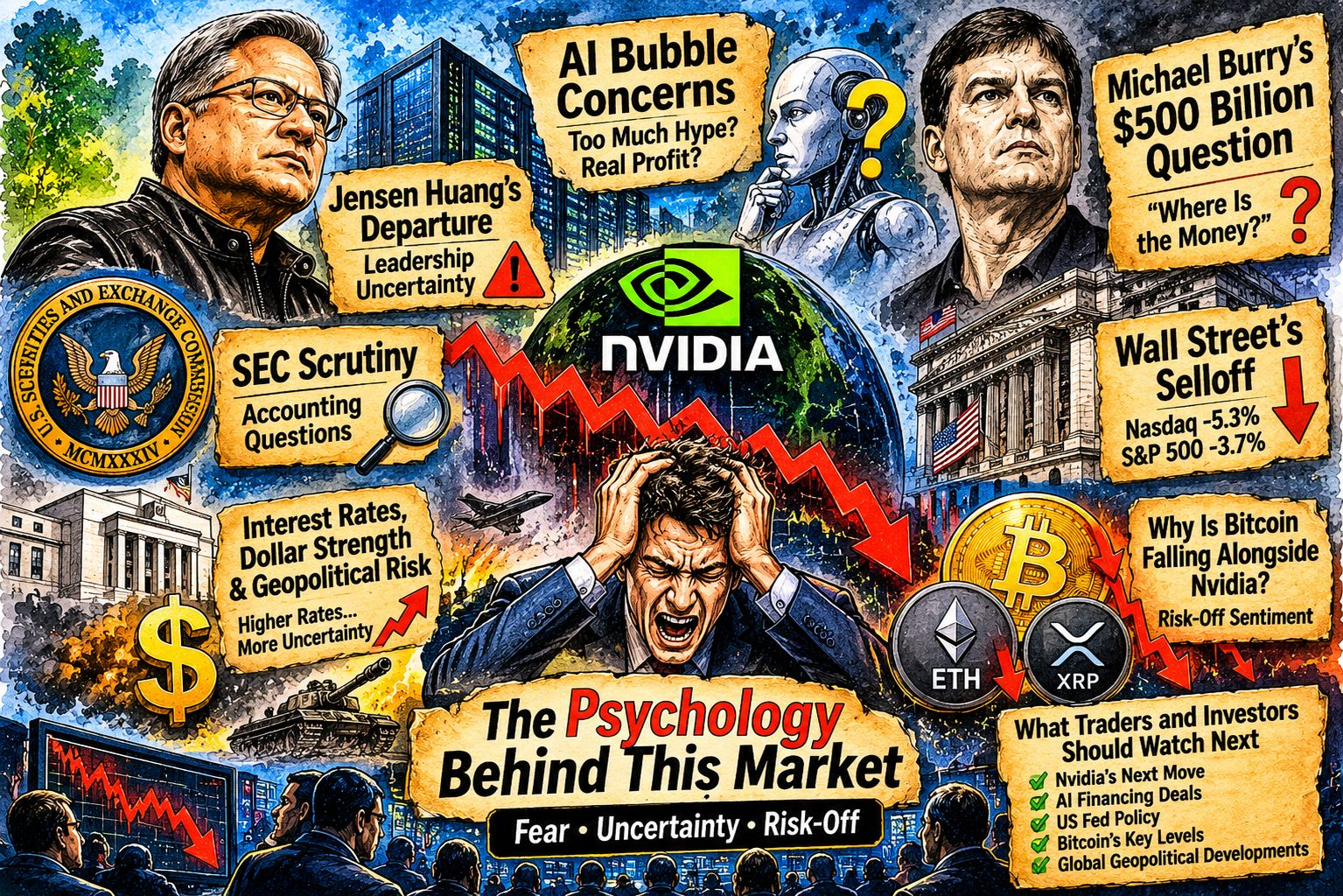
📉 Nvidia has lost approximately $2.6 trillion in market capitalization in seven weeks, with its shares falling around 46% from their record peak. On November 20, the stock plunged another 14%, marking its seventh consecutive weekly decline — its longest losing streak since 2008.
But this is no longer just an Nvidia stock correction. It is becoming a broader test of confidence in artificial intelligence, institutional capital, global liquidity and risk assets.
The bigger question is: Are investors losing confidence in Nvidia, or are they beginning to question the financial sustainability of the entire AI revolution?
Let's examine what is happening beneath the market.
👤 1. Jensen Huang's Departure: A Leadership Shock That Changed Investor Psychology
Jensen Huang's departure as Nvidia CEO on November 12 created an extraordinary confidence shock.
For years, Jensen was more than a corporate executive. He was the strategic architect and public face of Nvidia's AI expansion.
His departure following a governance controversy and reports concerning his personal conduct raised several uncomfortable questions:
Who will lead Nvidia's next phase of AI innovation?
Can the company maintain its strategic relationships with major AI customers?
Will its competitive advantage remain intact without Jensen's leadership?
How will the board restore institutional and investor confidence?
The market's reaction was significant. Nvidia's shares came under immediate pressure, and investors began reassessing the leadership premium previously attached to the company.
However, the correction had already started before his departure. Leadership uncertainty intensified an existing decline rather than creating the entire selloff.
🤖 2. AI Bubble Concerns: Demand Is Not the Same as Profitability
This is arguably the biggest structural concern.
Microsoft, Google, Amazon and other technology companies are investing enormous amounts in AI infrastructure.
But investors are increasingly asking:
Will the revenue generated by AI justify the enormous capital expenditure required to build it?
The concern is not that AI technology has no future. It is whether the economics of the current investment cycle are sustainable.
If AI companies cannot generate sufficient returns from their infrastructure, they may eventually:
Reduce future data-centre investments.
Delay GPU purchases.
Renegotiate computing contracts.
Become more dependent on external financing.
For Nvidia, this matters because today's demand expectations are closely connected to tomorrow's AI infrastructure spending.
🏦 3. Michael Burry's $500 Billion Question: Where Is Wall Street's Money?
One of the most important developments is the delayed $500 billion AI financing initiative.
In August, Nvidia announced partnerships with six major financial institutions:
Apollo, Blackstone, BlackRock, Brookfield, Goldman Sachs and KKR.
The objective was to mobilize more than $500 billion in third-party capital to finance AI infrastructure over time.
However, according to the November 19 Wall Street Journal report shared by Michael Burry, no capital had been deployed under the initiative.
The reported disagreement concerns financial risk:
Nvidia proposed guarantees covering up to 25% of certain project costs.
Lenders reportedly want stronger protection against customer defaults.
Banks are concerned that GPU collateral could lose value as technology advances.
The first financing transaction is reportedly unlikely before 2027.
Importantly, the original agreements were nonbinding MOUs, not guaranteed $500 billion cash commitments.
🧠 Why does Burry's warning matter?
Because AI demand can be genuine while the financing supporting that demand remains vulnerable.
If customers cannot borrow affordably or generate sufficient cash flow to repay their loans, future infrastructure expansion could slow.
This is a financing-risk warning, not proof that Nvidia's chip business has collapsed.
⚖️ 4. SEC Scrutiny: Another Layer of Uncertainty
Nvidia is also facing reported SEC scrutiny over potential accounting issues.
Reuters reported on November 20 that the investigation is examining potential accounting matters. The precise scope has not been publicly disclosed, and an investigation does not establish wrongdoing.
Nevertheless, this creates another source of uncertainty at a time when investors are already questioning leadership, financing arrangements and the quality of AI-related revenue.
Markets dislike uncertainty, especially when a company's valuation depends heavily on expectations of future growth.
📉 5. Wall Street's Selloff: The Crisis Is No Longer Limited to Nvidia
The broader US technology market has experienced substantial selling pressure.
November 20 market update:
Nasdaq Composite: -5.3%.
S&P 500: -3.7%.
Dow Jones: -1.93%.
Nvidia: -14%.
Nvidia's weekly decline: approximately 23%.
Both the S&P 500 and Dow entered correction territory, while the Nasdaq suffered its worst week since the early COVID-19 period in 2020.
Nearly $9 trillion has been erased from global equity market values since their August peak, according to Reuters.
This is important because Nvidia is deeply connected to the broader AI and semiconductor investment ecosystem.
When institutional investors reduce technology exposure, selling pressure can spread across semiconductor companies, cloud infrastructure providers, AI startups and index-linked portfolios.
🌍 6. Interest Rates, Dollar Strength and Geopolitical Risk
Another major pressure is the changing macroeconomic environment.
Investors are increasingly concerned about persistent inflation and the possibility of further US Federal Reserve tightening.
Higher borrowing costs can:
Make AI infrastructure financing more expensive.
Reduce the attractiveness of high-growth valuations.
Encourage capital allocation towards safer assets.
Put pressure on speculative investments.
The US dollar has also climbed to a 19-month high, creating additional pressure on emerging-market currencies and dollar-priced risk assets.
Geopolitical tensions and the possibility of further military escalation add another layer of uncertainty.
Higher oil prices can intensify inflation concerns, potentially complicating the Federal Reserve's policy decisions.
However, geopolitical risk should not be treated as the primary explanation for Nvidia's specific collapse. Current reporting identifies AI valuation concerns, monetary policy, technology-sector selling and Jensen's departure as more direct drivers.
₿ 7. Why Is Bitcoin Falling Alongside Nvidia?
This is where the story becomes particularly important for cryptocurrency traders.
Bitcoin fell below the psychologically important $60,000 level on November 20 and reached approximately $55,830, its lowest level since September 2024.
Other major cryptocurrencies also came under pressure.
Institutional ETF flows reveal the deterioration in sentiment:
US spot Bitcoin ETFs recorded approximately $582.2 million in net outflows on November 19.
BlackRock's IBIT accounted for approximately $541.1 million of those outflows.
November's cumulative Bitcoin ETF net outflows approached $3.47 billion.
US spot Ethereum ETFs recorded approximately $131.2 million in outflows on November 19.
The Crypto Fear and Greed Index also reached extreme-fear territory in contemporaneous market reporting.
Why is this happening?
Because institutional investors often manage exposure across multiple risk-sensitive asset classes.
When confidence deteriorates, investors may reduce exposure to technology stocks, cryptocurrencies and other speculative investments simultaneously.
This creates a common risk-off environment.
Important distinction: Nvidia's decline is not directly causing Bitcoin's decline. Both markets are responding to overlapping macroeconomic and liquidity pressures.
📊 8. Deep Chart Analysis: What Is the Market Actually Telling Us?
NVIDIA — Bearish Structure 📉
The seven-week decline and seven consecutive weekly losses indicate a substantial deterioration in price structure.
The important technical observations:
Approximately 46% below its record peak.
Consecutive lower-price sessions and persistent selling pressure.
A 14% single-session decline indicates aggressive repricing.
The stock is struggling to establish a convincing recovery structure.
👍Bullish confirmation: Nvidia needs to establish a higher low, recover important broken price levels and sustain buying pressure.
👎Bearish confirmation: Continued lower lows, failed rebounds and heavy selling volume would indicate that distribution remains dominant.
BITCOIN — Critical Support Breakdown 🐻
Bitcoin's fall below $60,000 is psychologically significant.
The immediate chart areas to monitor:
$55,000–$56,000: Immediate demand and recent low area.
$60,000: Important psychological level that bulls need to reclaim.
$62,000–$63,000: Potential recovery and resistance zone.
If Bitcoin cannot defend its recent low, downside price discovery remains possible.
If it reclaims $60,000 and subsequently establishes acceptance above $62,000–$63,000, the immediate bearish structure could begin to weaken.
ETHEREUM — Weak Risk Appetite
Ethereum's price around $1,600–$1,750 reflects the broader pressure on crypto risk appetite.
ETF outflows and weak market breadth are additional concerns. A sustained recovery requires improving spot demand rather than merely short-covering.
XRP — Leverage and ETF Sentiment
XRP also experienced significant weakness, with the token falling approximately 10% on November 21 reporting.
Long liquidations and declining ETF assets are important warning signs.
The market needs stronger spot buying and improved institutional flows before a durable recovery can be confirmed.
Technical note: These are market-monitoring zones, not guaranteed support or resistance levels. Confirmation requires actual price action, volume and closing data.
🧠 9. The Psychology Behind This Market: Fear Is Spreading Across Asset Classes
What we are witnessing is a change in investor behaviour.
Earlier, the dominant narrative was:
🚀 AI growth will continue.
🚀 Institutional capital will keep entering.
🚀 Bitcoin and technology stocks will benefit from expanding liquidity.
Now the questions are changing:
⚠️ Can AI infrastructure spending generate sustainable profits?
⚠️ Who will finance the next phase of expansion?
⚠️ Can Nvidia maintain its leadership without Jensen?
⚠️ Will higher interest rates continue to pressure valuations?
⚠️ Are institutions reducing risk across multiple asset classes?
This shift from aggressive optimism to capital preservation is one of the most important psychological developments in the current market.
🔍 10. What Traders and Investors Should Watch Next
Before assuming that the market has reached its bottom, monitor:
Nvidia's leadership transition and regulatory developments.
The first actual financing deal under the $500 billion initiative.
AI companies' cash flows and infrastructure spending.
US Treasury yields, dollar strength and Federal Reserve expectations.
Nasdaq and semiconductor-sector stabilization.
Bitcoin's ability to reclaim $60,000.
Spot ETF flows and derivatives liquidations.
Whether geopolitical developments create another inflationary shock.
🎯 FINAL VERDICT: Is This Just an Nvidia Correction or a Broader Financial Confidence Crisis?
The answer is that both developments are interconnected.
Nvidia's decline began with broader concerns about AI valuations and infrastructure spending. Jensen Huang's departure, reported SEC scrutiny and financing uncertainty intensified the pressure.
Meanwhile, rising borrowing-cost concerns and institutional risk reduction have spread weakness into technology stocks and cryptocurrencies.
But one distinction must remain clear:
A $2.6 trillion market-cap decline is not $2.6 trillion of cash leaving Nvidia, and a Bitcoin selloff does not automatically mean the AI industry is collapsing.
Nvidia's strong operating results and future revenue expectations still matter. The market is currently questioning how much of that growth is sustainable and how much risk is embedded in the financing structure supporting the AI boom.
🚨 The biggest lesson for traders: Do not confuse a falling price with a broken business, but never confuse strong business performance with an automatically attractive stock valuation either.
The next phase will be determined by actual earnings, sustainable financing, institutional capital flows and whether buyers regain conviction.
In this market, patience, liquidity management and confirmation matter more than blindly buying every dip.