
Wall Street finished its worst week since April 2025 with a Friday sell-off that left the S&P 500 and the Dow in correction territory. Doubts about how long the artificial intelligence boom can last had been building for weeks, and they boiled over.
Richard Saperstein, chief investment officer at Treasury Partners, called it an "AI repricing," driven by slowing data center buildouts, thinner funding for AI projects and a slower path for tech earnings growth.
Goldman Sachs' trading desk expects more: its panic gauge sat near the maximum, and it estimated that trend-following funds could dump another $65.8 billion of stocks even if the market goes flat.
The Fear Gauge Jumps, and Bonds Catch a Bid
The VIX, Wall Street's fear gauge, closed at 35.89 after touching 40 late in the session, its highest level since the April 2025 tariff meltdown. The tremor traveled. Gold slid 2.8%, Bitcoin fell about 5% to roughly $58,300, and Asian chip stocks took a beating, with Taiwan's benchmark down more than 6% and the Nikkei and Kospi each shedding roughly 5%.
Treasuries caught the flight to safety. The 10-year yield, the benchmark behind mortgages, loans and credit card rates, fell 12 basis points to 4.92%, and the 2-year dropped 13 basis points to 4.63%. The 30-year slipped about 9 basis points to roughly 5.31%. The moves came ahead of a speech by Fed Governor Christopher Waller, who told CNBC on Wednesday that a half-point rate hike is probably needed in December.
S&P 500 and Dow Cross Into Correction
The S&P 500 fell 3.7% to 6,910.39, its seventh straight loss, and ended the week down 8.6%. The Dow lost 949.73 points, or 1.93%, to 48,147.33, and both indexes closed more than 10% below their records. The Dow's 8% weekly loss was its worst since March 2020.
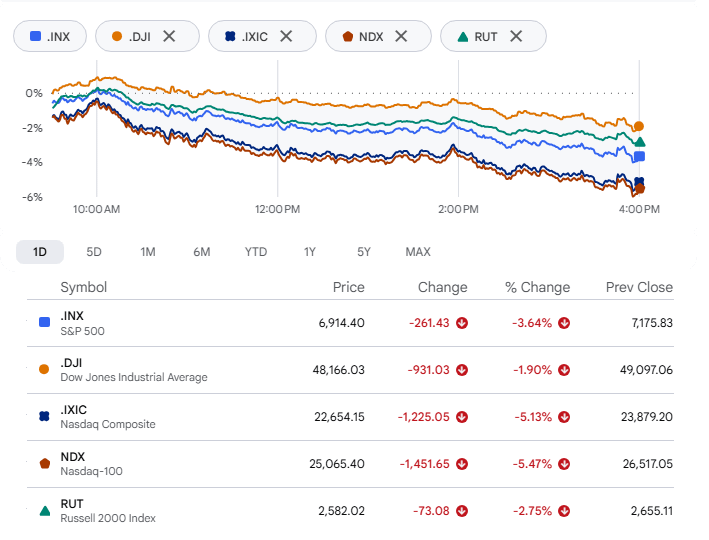
The Nasdaq Composite slid 5.3% to 22,617.73, wiping out its 2026 gain and finishing the week down about 10%, its worst since March 2020. The Nasdaq 100 dropped 5.6% and briefly entered a bear market during the session, falling 20% from its high before closing just short of it. The small-cap Russell 2000 lost 2.76% to 2,581.79.
Anthropic Gives Back Its Debut Pop
Anthropic surrendered a chunk of its first-day gains. Its shares fell 8.5% as investors booked profits after a frenzied debut, and the broader market, which had already sold off on IPO day, stayed under pressure. The stock closed just below $89, for a market value of $1.17 trillion.
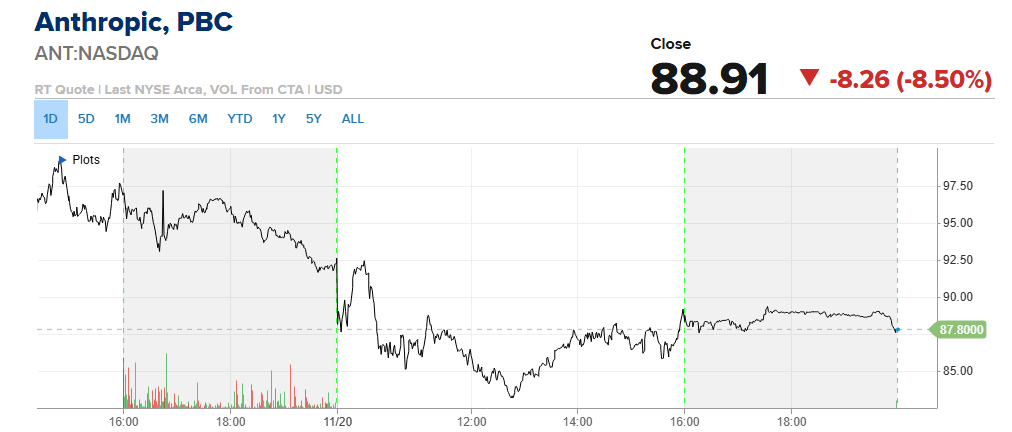
Thursday had been a monster debut for a company founded only five years ago. The shares opened at $111.50 a little before noon ET, a 34% premium to the $83 offer price, but could not hold the gains and closed at $97.17, up 17%. That close valued the company at about $1.28 trillion, or roughly $1.75 trillion fully diluted, in an IPO that raised $81.3 billion.
Nvidia's Worst Day in Almost Two Years
Nvidia fell 14%, its worst day since the DeepSeek sell-off in January 2025 and its seventh straight loss. Reuters reported that the SEC's probe is looking at possible accounting issues. The Wall Street Journal had said earlier in the week that the inquiry also covers whether Nvidia's disclosures misled investors.
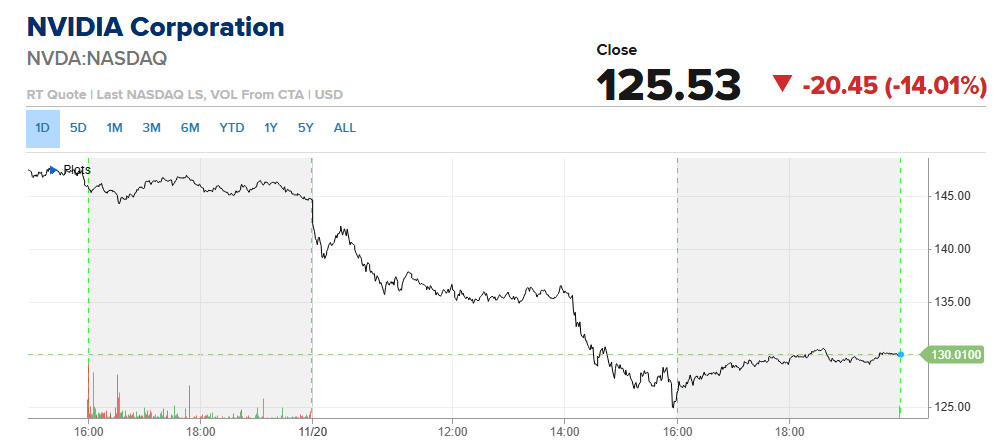
The damage was historic. Nvidia lost about $485 billion in market value on Friday and nearly $900 billion over the week, its worst week since October 2008. That topped the $573 billion it lost the week before, which had been the biggest one-week loss for any company on record, according to Dow Jones Market Data.
The Selling Spreads Across Big Tech and Chips
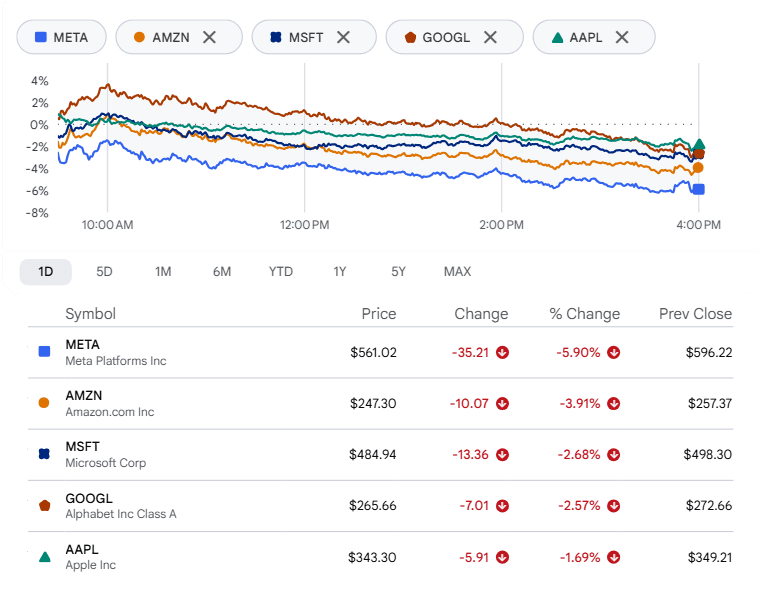
The selling hit almost every major AI name. Every member of the Magnificent Seven closed lower, with Meta down 5.9%, Amazon 4%, Microsoft 2.77%, Alphabet 2.7% and Apple, the sturdiest of the group, 1.90%.
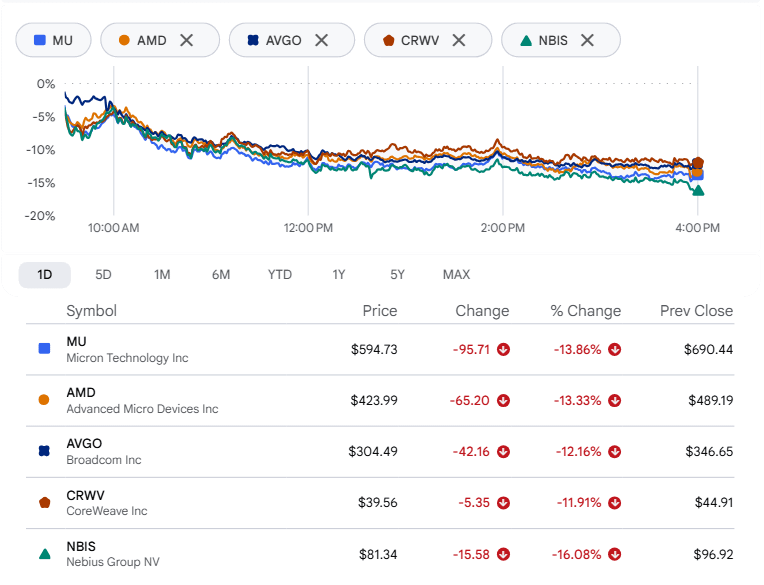
Chipmakers took the real beating: Micron lost 13.89%, AMD 13.25% and Broadcom 12.19%, while neoclouds CoreWeave and Nebius dropped 12.02% and 16.11%. Bloomberg tallied $2.1 trillion wiped from the Nasdaq 100 on Friday alone.
Ubisoft Gets Hit Too
The pain crossed the Atlantic. Ubisoft, the maker of Assassin's Creed, plunged by double digits in Paris after guiding to net bookings of about €250 million ($274 million) for October to December. That is well short of the roughly €361 million analysts expected and below the €338 million it booked a year earlier. The company blamed a lighter release slate and a particularly competitive holiday season, with the market's attention fixed on Take-Two's launch of Grand Theft Auto VI, which Take-Two says has already generated $3.79 billion in revenue through Thursday.
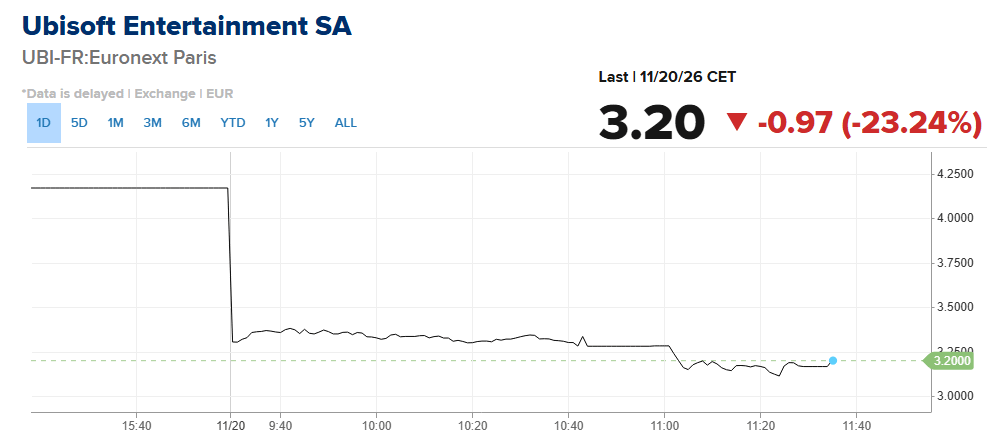
A day earlier, Ubisoft reported first-half net bookings down 16.5% from a year ago, though second-quarter bookings of €388.9 million beat its guidance of about €370 million.
Where the Money Hid
Investors ducked into defensive corners.
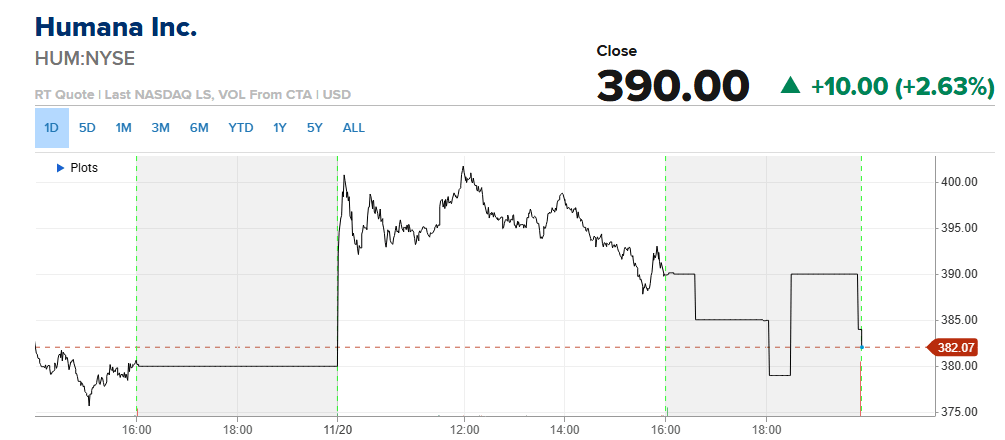
Humana climbed 2.6% after TD Cowen upgraded the Medicare Advantage insurer to buy from hold and raised its price target to $485 from $430, roughly 28% above the stock's $380 Thursday close. TD Cowen left its adjusted EPS estimates for 2026, 2027 and 2028 unchanged at $9.51, $18.41 and $40.42. The next checkpoint it flags is the 2028 Star ratings.
Sector Analysis:
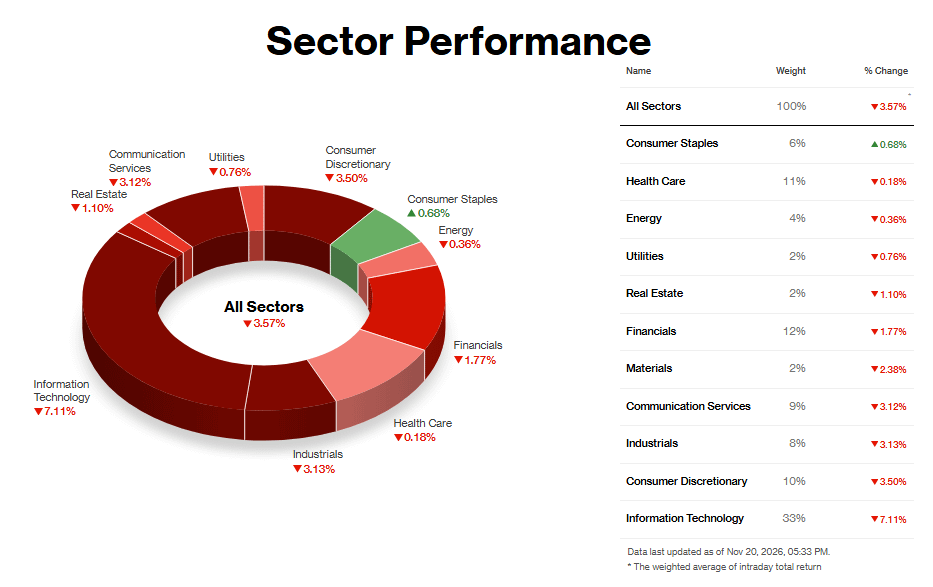
Consumer staples was the only S&P 500 sector to finish higher on Friday, gaining 0.67% while everything else was sold. Reuters described the move as a rotation into defensive sectors as the tech rout deepened, and Walmart rose more than 1%, with Costco and Procter & Gamble each up about 1%. Walmart also had a company-specific lift, since it raised its forecast the day before. A University of Michigan survey showed one-year inflation expectations falling to 3.7%, the lowest since March, an encouraging backdrop for consumer-facing defensives.
The move looks like shelter rather than a change of leadership. Duality Research notes the sector's gains this year owe almost everything to higher valuation multiples, and defensives tend to lag once growth stocks recover.
Worst-Performing Sectors
Technology, roughly a third of the index, fell 7.11%. By simple weight math, that accounted for about 2.3 points of the S&P 500's 3.7% slide. Nvidia lit the fuse: Reuters reported that SEC enforcement staff are reviewing potential accounting issues at the company, and the shares closed down 14% at a new 52-week low.
The contagion was swift. The Philadelphia Semiconductor Index lost 10.73% with all 30 members lower, and a triple-leveraged chip ETF shed nearly a third of its value, a sign that forced selling was compounding the damage. Reports that Google will source memory for its AI chips directly, cutting out fees paid to design partners, added to the pressure, and Anthropic gave back much of its IPO-day gain, falling 8.5%. This was a sector-wide rout rather than a single-stock problem.
Industrials, down 3.13%, got hit by the same trade through the back door. Caterpillar slid 5% to a fresh 52-week low, and Bloom Energy lost 15%. Both sell into data-center power demand, a corner already strained by doubts over how AI buildouts get financed.
Consumer discretionary lost 3.50% with no single dominant driver. Tesla dropped 7.6% alongside other megacaps, and Ross Stores slipped 2.9% on a soft forecast. Mostly, though, high-beta spending names were marked down in a market where futures put the odds of a December rate hike at 91.5%.