
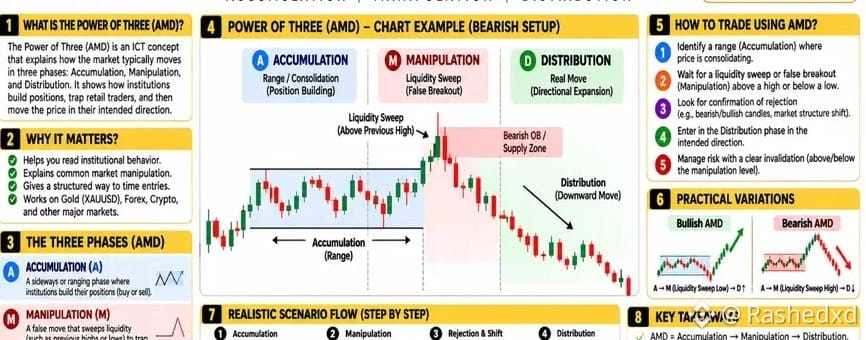

The ICT Power of Three (AMD) is one of the key concepts in Inner Circle Trader (ICT) methodology. It explains how price may move through three distinct phases: Accumulation, Manipulation, and Distribution. Understanding this concept can help traders read market behavior, identify potential liquidity traps, and recognize when a directional move may be developing.
1. Accumulation – The Building Phase
Accumulation is the phase where price moves sideways within a defined range. During this period, liquidity gradually builds above previous highs and below previous lows. Traders may begin taking positions while the market remains in consolidation.
Key characteristics:
Sideways price movement.
Formation of a clear trading range.
Liquidity building above and below the range.
No clear directional expansion yet.
2. Manipulation – The Liquidity Hunt
Manipulation is the phase where price temporarily moves beyond a significant high or low, potentially triggering stop-loss orders and trapping traders who enter on a false breakout. This movement is often associated with a liquidity sweep.
Key characteristics:
Sweep of previous highs or lows.
False breakout beyond the accumulation range.
Rejection from a liquidity zone.
Potential Market Structure Shift (MSS).
3. Distribution – The Directional Expansion
Distribution is the phase where price begins moving away from the accumulation range after the manipulation phase. This is where the market may establish its actual directional move, potentially supported by strong displacement and a change in market structure.
Key characteristics:
Strong directional price movement.
Break of short-term market structure.
Potential Fair Value Gap (FVG) formation.
Expansion toward the next liquidity target.
4. Bullish vs Bearish AMD
Bullish AMD:
Price consolidates, sweeps liquidity below the range (Sell-Side Liquidity), rejects the lower area, and potentially expands upward.
Bearish AMD:
Price consolidates, sweeps liquidity above the range (Buy-Side Liquidity), rejects the upper area, and potentially expands downward.
5. How to Apply Power of Three in Trading
Identify the accumulation range on the higher timeframe.
Mark the previous highs and lows.
Wait for a potential liquidity sweep during manipulation.
Look for rejection and Market Structure Shift (MSS).
Identify a valid Fair Value Gap (FVG) or Order Block (OB).
Use the 15-minute timeframe for additional confirmation.
Define your entry, stop-loss, and target before executing a trade.
6. Important Trading Conditions
Not every liquidity sweep leads to a reversal.
Accumulation does not always result in an immediate breakout.
Manipulation should be confirmed through price action.
Higher-timeframe market structure remains important.
Avoid entering trades without confirmation.
Always apply proper risk management.
KEY TAKEAWAY
The ICT Power of Three teaches traders to observe the market in three stages:
ACCUMULATION → MANIPULATION → DISTRIBUTION
Instead of chasing every breakout, traders can use AMD to understand where liquidity may be building, where stop-losses may be targeted, and when a potential directional expansion begins.
Remember: AMD is a market analysis framework, not a guaranteed trading pattern. Patience, confirmation, and risk management remain essential.
Educational content only. This is not a financial or investment recommendation