


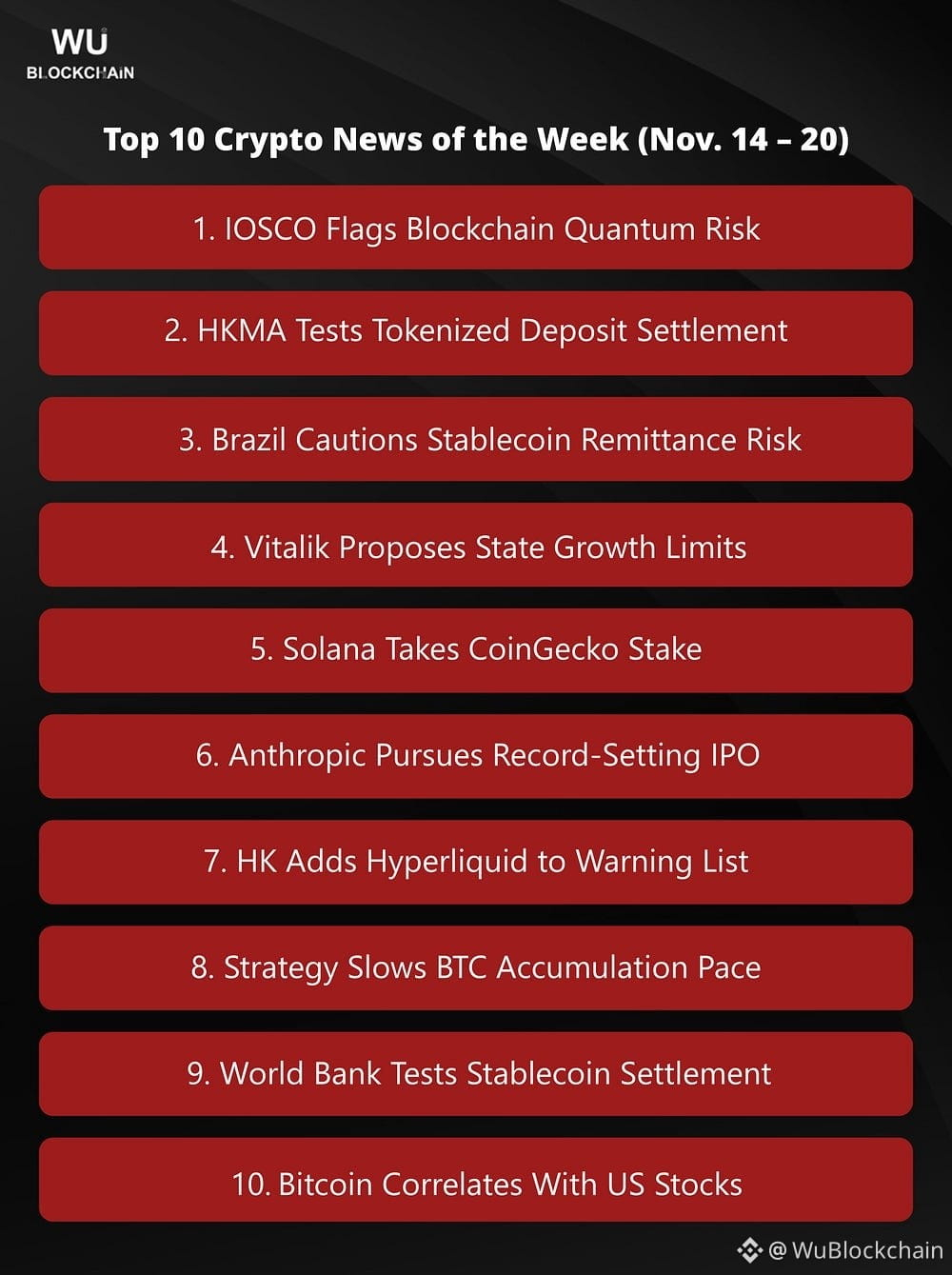
1. OSCO Report Warns of Quantum Risks; Blockchain Post-Quantum Migration Challenging link
The International Organization of Securities Commissions (IOSCO) has released a 63-page special report, calling on financial markets and the crypto industry to immediately address cybersecurity threats posed by quantum computing. It conservatively estimates that quantum computers capable of breaking existing public-key cryptography will emerge between 2030 and 2035, and some industry practitioners recommend forward planning on a five-year cycle. The report notes that since elliptic curve cryptography is deeply embedded in the core architecture of public blockchains including Ethereum, Solana and TRON, migrating blockchains to post-quantum cryptography will be particularly challenging. For one thing, the signature size of ML-DSA-44, the post-quantum standard from the National Institute of Standards and Technology (NIST), is approximately 2,420 bytes, 35 to 40 times larger than the current 64-byte signatures. For another, underlying upgrades require hard forks, and decentralized networks cannot be forced to migrate quickly.
2. HKMA Partners with Swift and HSBC to Explore Cross-Border Tokenized Deposit Settlement link
The Hong Kong Monetary Authority announced on November 16 that it will strengthen cooperation with SWIFT, the global financial messaging network for banks. Together with Bank of China (Hong Kong), Standard Chartered Bank (Hong Kong) and HSBC, it will explore interoperability between Swift Ledger and the settlement layer of Hong Kong’s Ensemble project to facilitate cross-border payments using multi-currency tokenized deposits. This cooperation aims to leverage SWIFT’s global financial network to connect local and international payment systems and enable instant, round-the-clock and programmable cross-border transactions. Howard Lee, Deputy Chief Executive of the HKMA, stated that this move will further link Hong Kong’s tokenized financial infrastructure with international financial institutions.
3. Brazil Central Bank: Fiat-to-Stablecoin Swaps May Qualify as Money Laundering link
Gerson Romantini, head of the foreign exchange department at the Central Bank of Brazil, said at a closed-door event that legitimate funds converted into stablecoins can acquire a “black money” tag and be deemed money laundering. The central bank is particularly concerned about the use of stablecoins in the remittance market. Reports indicate that the practice whereby fintech firms receive reais, convert them into stablecoins and transfer them to overseas entities for payments or family remittances has been prohibited under Resolution №561/2026, which took effect on October 1 this year.
4. Vitalik on EIP-8037: Curb State Growth for Scaling, Clarify Ethereum Protocol Roadmap link
Vitalik Buterin posted that EIP-8037 decouples execution scaling from state size growth limits by raising gas costs for newly added storage slots, code and accounts to balance scaling and security. He estimated that if the gas cap is increased tenfold and Glamsterdam-related proposals other than EIP-8037 are implemented, the annual state size growth would rise from approximately 110 GiB to 1100 GiB. He noted that most core developers currently prefer helping application developers fix compatibility issues before Glamsterdam goes live, and the upgrade has been postponed. He also suggested clarifying and fully communicating protocol features subject to potential future changes, including gas mechanisms, state trees, blob structures, the consensus layer and transaction formats, and stated that the consensus algorithm may undergo substantial adjustments over the next two years and legacy transaction types may eventually be retired.
In response to community questions, Vitalik said he has recommended a Merkle Tree scheme for use cases such as airdrops: issuers only need to submit the root hash, and users provide proof branches and pay gas to claim allocations on their own. In the long run, token balances can be stored using UTXOs and keyed nonces for privacy instead of occupying storage slots. He pointed out that since access rules for these states are more restrictive, most nodes can avoid storing the relevant data in full, resulting in significantly lower costs than the storage slot approach.
5. Anthropic Opens at $111.50 on Debut, Up 34.3% from IPO Price link
Anthropic (ANT) opened at $111.50 on its debut trading day, representing a roughly 34.3% increase from its IPO offering price of $83. As Anthropic started trading, the Nasdaq Composite Index fell to its intraday low, down 0.7%, after climbing as much as 2.1% shortly after the opening bell.
Sam Bankman-Fried (SBF), co-founder of FTX, invested $500 million in Anthropic in 2021 via the investment arm of Alameda Research, which acquired nearly 14% of the shares at that time. Following FTX’s bankruptcy, the stake was sold for approximately $1.3 billion in 2024, with proceeds going toward repaying FTX customers and other creditors. Anthropic was expected to go public the following week at a valuation of around $1.5 trillion. Based on this valuation, if Alameda Research had retained the shares it sold back then, the holding would be worth roughly $37 billion, equivalent to 74 times the initial investment.
6. SFC Adds Hyperliquid to Suspicious Virtual Asset Platform Alert List link
According to information on the official website of the Securities and Futures Commission of Hong Kong (SFC), the SFC added decentralized trading platforms Hyperliquid and Hyperliquid Hong Kong to its alert list of suspicious virtual asset trading platforms on November 18, 2026. The regulator stated that the entities are not licensed by the SFC and are suspected of operating virtual asset trading platforms in Hong Kong without a licence, claiming to operate such platforms, or actively promoting their digital asset trading services to the Hong Kong public.
7. Solana Foundation Acquires Controlling Stake in CoinGecko; Terms Undisclosed link
CoinGecko announced on November 17 that it is entering the next phase of development with support from the Solana Foundation. It will focus on three major areas in the future: first, strengthening data and API infrastructure and expanding coverage of on-chain assets, RWAs and derivatives; second, improving market intelligence analysis and asset discovery capabilities; third, exploring trading-related businesses. CoinGecko stated that it will continue to maintain cross-blockchain ecosystem data coverage and a transparent methodology. The announcement did not disclose the specific form of support, investment amount or equity arrangement from the Solana Foundation.
Vibhu, a member of the Solana Foundation, recently confirmed in a post that the Solana Foundation now holds a majority equity interest in CoinGecko, meaning it has obtained controlling equity. CoinGecko’s earlier announcement only mentioned receiving support from the Solana Foundation and did not explicitly disclose this equity relationship. The specific shareholding ratio and transaction amount have not yet been announced.
8. Strategy Spends $2.7B on STRC Buybacks; BTC Purchases Slow Sharply link
Since July this year, Strategy has spent a total of approximately 2.7 billion US dollars to repurchase its preferred shares STRC. Around 1.4 billion US dollars of these repurchases were executed at an average price above 99 US dollars, accounting for 52% of the total repurchase amount. This contrasts with the company’s previously stated strategy of reducing repurchase intensity as the share price approaches 100 US dollars. From November 9 to 15, Strategy repurchased 228.1 million US dollars worth of STRC at an average price of roughly 99.93 US dollars, marking its largest weekly repurchase volume. During the same period, it only spent 33.4 million US dollars to acquire 485 BTC. The company primarily funds the repurchases by selling MSTR common stock. Nearly 89% of its 3-billion-US-dollar preferred share repurchase quota has been utilized, leaving approximately 332 million US dollars remaining.
9. World Bank Teams with Citi and Circle on Stablecoin Payment Solutions link
The World Bank Group announced that the World Bank will collaborate with Citi and Circle Internet Group to explore how regulated U.S. dollar stablecoins and blockchain payment rails can work alongside or optimize existing correspondent banking fund disbursement frameworks, so as to improve the speed, transparency and cost efficiency of payments and settlements. The initiative will combine Citi’s traditional banking network covering more than 180 jurisdictions with Circle’s stablecoin payment infrastructure to enable USDC minting and round-the-clock real-time settlement of funds, and further expand the capabilities of the World Bank’s existing blockchain fund-tracking platform FundsChain, which currently covers 96 countries. The initial pilot will focus on borrowing countries that support and permit the use of digital assets, and cooperation with other banks will be sought in the future.
10. Study: Bitcoin Tracks US Equities, Not Digital Gold; Volatility Falls Below Chip Stocks link
DWF Labs released a latest research report showing that based on market data from 2016 to November 2026, Bitcoin’s correlation with the Nasdaq has risen to approximately 0.40 since 2020. When the Nasdaq falls more than 1% in a single day, Bitcoin has roughly a three-quarters chance of declining in tandem, and it still exhibits risk-asset characteristics overall. The report identifies three major structural shifts in 2026: first, Bitcoin’s annualized volatility has fallen to 44%, below the semiconductor sector’s 52% for the first time in a decade; second, following the sharp rally in AI chip stocks starting last September (chips up 85% while BTC fell 39%), after stripping out broad Nasdaq market effects, Bitcoin has maintained a positive correlation (+0.20) with software stocks and a negative correlation (−0.30) with chip stocks since March this year; third, Bitcoin’s 90-day correlation with gold hit a ten-year high of 0.59 in September and currently stands at around 0.49.
Fundraising
Tether makes a strategic investment in Swiss stablecoin platform SCRYPT to expand fiat currency and payment businesses. link
Securitize has completed the acquisition of River One to expand stablecoin financing and AI credit underwriting services. link
Stablecoin payment firm Codex has closed a $30 million Series A round led by Pantera at a valuation of $130 million. link
On-chain derivatives protocol Variational has raised $110 million at a $1.5 billion valuation. link
Tether, together with Further, has invested nearly $10 million in Singapore-based MetaComp, bringing its total fundraising to $45 million. link
Modular synthetic asset protocol Null has secured a $1.7 million Pre-Seed round led by cyber•Fund and Nethermind. link
Learn more, check out crypto-fundraising.info.
Follow us
Twitter: https://twitter.com/WuBlockchain
Telegram: https://t.me/wublockchainenglish