
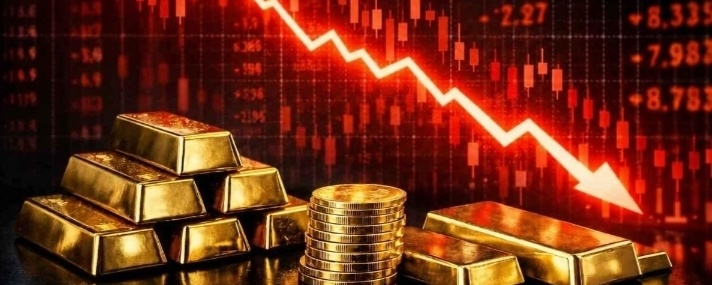


Gold is going through a serious correction, and the latest market data suggests that this is more than ordinary profit booking.
On November 20, gold touched an intraday low of $3,513.54 per ounce, while spot prices were reported at $3,576.09, down 1.3% in one Reuters market snapshot.
Gold is now heading towards its worst weekly performance in eight months, with an approximately 8% weekly decline.
But what is actually driving this selloff?
Let's break down the bigger picture.
1. The Federal Reserve has become the biggest problem for gold
One of the strongest reasons behind the current decline is changing expectations around US monetary policy.
Markets are increasingly expecting another interest-rate hike in December.
According to Reuters, traders were pricing in a 99.3% probability of a 25-basis-point rate increase.
This changes the investment equation.
Gold does not generate interest. When investors expect higher interest rates, bonds and other yield-generating assets become more attractive.
This creates additional selling pressure on gold.
2. The US Dollar is strengthening
The dollar has become another major headwind.
The US Dollar Index has been trading around its highest levels in approximately 19 months.
Since gold is priced internationally in dollars, a stronger dollar makes bullion more expensive for international buyers.
This can reduce demand and put additional pressure on prices.
The combination of a stronger dollar and hawkish Fed expectations is particularly negative for gold.
3. AI stock selloff is creating forced liquidation
There is another important factor that many traders might overlook.
The recent weakness in technology and AI-related stocks has increased volatility across global markets.
Some investors are selling profitable positions in other assets to cover losses and raise liquidity.
Gold is also getting caught in this selling pressure.
Normally, gold benefits from stock-market uncertainty. But during forced liquidation, even traditional safe-haven assets can decline.
This is one reason the current correction looks unusually aggressive.
4. Treasury yields remain an important factor
US Treasury yields have remained elevated around the 5% region.
Although the 10-year yield briefly slipped below 5% on Friday amid demand for government bonds, the broader interest-rate environment remains challenging for gold.
The important indicator here is real yields.
If real yields continue increasing, investors may prefer interest-bearing assets over gold.
5. Is institutional demand disappearing?
Not necessarily.
The current decline should not automatically be interpreted as the end of gold's long-term investment story.
Central-bank purchases, reserve diversification and investment demand remain important structural factors.
However, long-term demand cannot prevent short-term corrections when monetary policy expectations change rapidly.
The key distinction is between short-term market positioning and long-term fundamental demand.
6. Important price levels to watch
The recent intraday low around $3,513 is an important reference point.
Here are the areas I would monitor:
$3,500–$3,515: Recent low and psychological support zone.
$3,400: Potential downside observation area.
$3,300–$3,400: A deeper support region highlighted by market analysts.
$3,800: Important recovery area.
$3,900: A stronger bullish recovery would need to establish itself above this region.
These are observation zones, not guaranteed support or resistance levels.
A sustained breakdown below the recent low could extend the bearish structure.
On the other hand, a weaker dollar and declining real yields could create conditions for a recovery.
7. What happens next?
I see three possible scenarios.
Bearish scenario:
If the Federal Reserve maintains its hawkish position, the dollar remains strong and gold fails to recover broken levels, further downside remains possible.
Recovery scenario:
If inflation data starts cooling, rate-hike expectations decline and the dollar weakens, gold could experience a meaningful recovery.
Consolidation scenario:
If economic signals remain mixed, gold could consolidate while investors wait for fresh inflation data and Federal Reserve communication.
My Final View
I think the most important thing to understand is that gold is currently facing a monetary-policy problem.
The combination of higher-rate expectations, dollar strength and forced liquidation is outweighing safe-haven demand.
But I would not call this the complete breakdown of gold's long-term investment case.
For traders, the priority should be watching how price reacts around the recent lows rather than blindly buying because gold looks cheap.
A strong recovery in gold needs confirmation from both macroeconomic conditions and price action.
The real question is not simply how much further gold can fall. It is when the economic conditions that supported its previous rally will return.
What do you think: Is this the beginning of a deeper bearish trend, or is the market preparing for a major recovery?