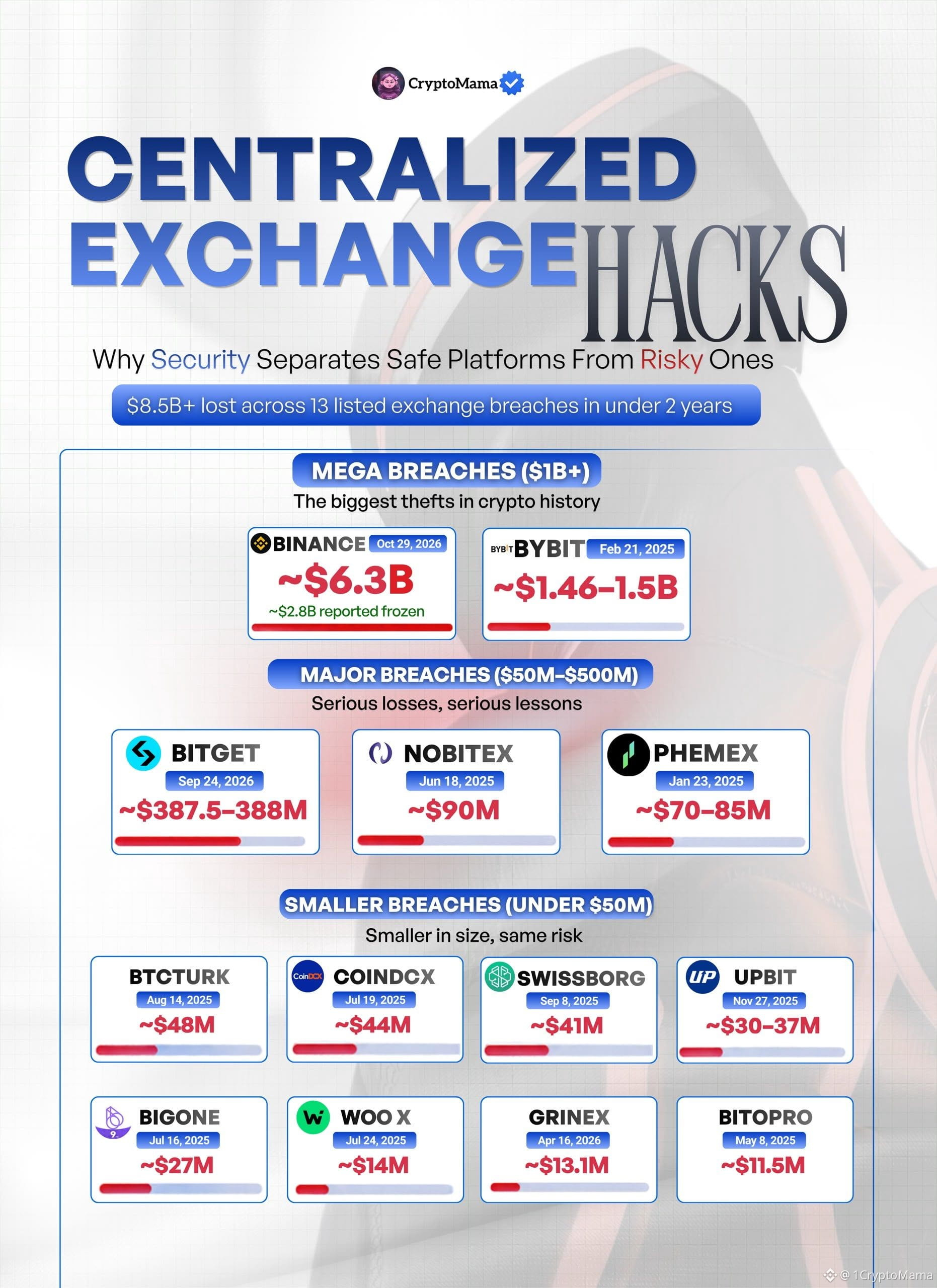
Are we building a financial revolution on infrastructure that is secure enough to protect it? Because crypto is getting bigger, But are we getting any safer? Take a look at what's happening to centralized exchanges.
2025 and 2026 have delivered some brutal security incidents.
Bybit reportedly lost approximately $1.5 billion, Binance $6.3 billion
Bitget $388 million
Nobitex $90 million
Femex up to $85 million
CoinDCX $44 million
SwissBorg $41 million
And that's not even the full list
This hack exposes an uncomfortable reality about crypto,we can build faster blockchains, launch sophisticated trading platforms, and bring billions in institutional capital into the ecosystem, but none of that matters if the infrastructure holding people's money remains vulnerable.
The danger goes beyond the exchanges themselves. It's users losing life changing savings, businesses losing operational capital, investors losing confidence, and the entire industry taking another hit to its credibility.
What worries me most is that, as crypto adoption grows, the incentives for attackers grow with it. More capital, more users, more infrastructure, and potentially more sophisticated attack surfaces.
Security cannot remain an afterthought because exchanges need stronger custody systems, rigorous audits, better access control, real-time threat monitoring, and transparent incident response.
Users need to stop treating exchange balance as risk free storage because Crypto's next big challenge isn't just getting more people on-chain; rather it's making sure their assets are safe when they get there, because adoption without security is a disaster waiting to happen.