
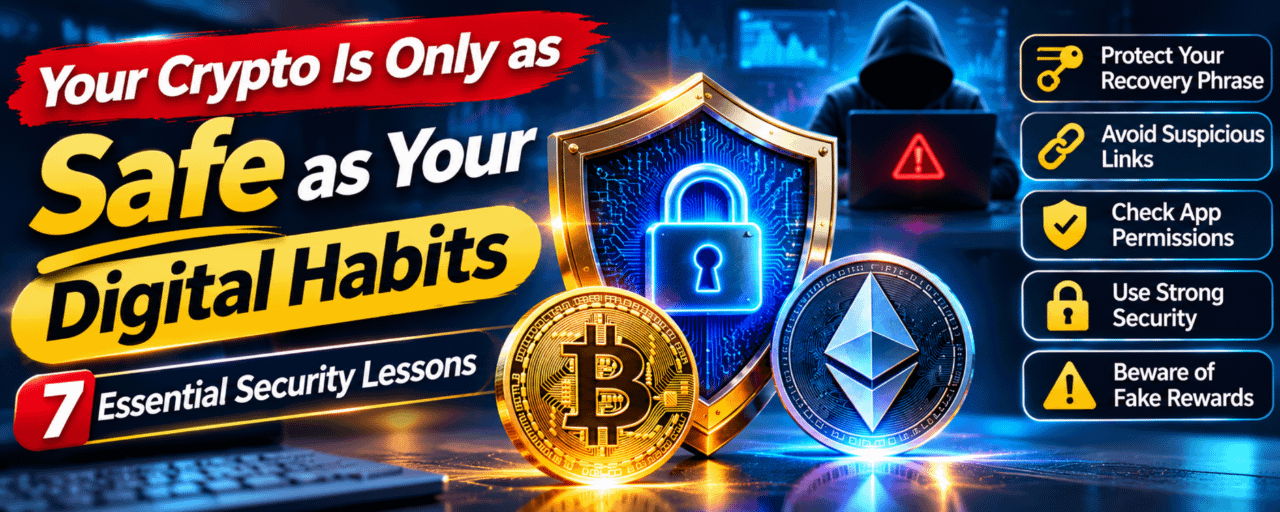

Imagine waking up one morning and discovering that your digital assets are gone—not because the market crashed, but because of a single careless click.
In the cryptocurrency ecosystem, digital security is not optional. It is an essential skill that everyone should understand.
Whether you are learning about Bitcoin, exploring Ethereum, or simply studying blockchain technology, these seven security lessons can help you navigate the digital world more safely.
1. Your Recovery Phrase Is Your Digital Master Key
A recovery phrase can provide access to the assets controlled by a self-custody wallet.
Anyone who obtains it may be able to access those assets.
Never share your recovery phrase through messages, emails, websites, or social media. Store it securely offline and avoid keeping screenshots of it.
2. Not Every Professional-Looking Website Is Safe
Fraudulent websites often use impressive graphics, convincing language, and attractive reward offers to gain trust.
Always verify website addresses independently instead of relying on links received through unexpected messages.
A beautiful website is not proof of legitimacy.
3. Understand What You Are Approving
Ethereum and other programmable blockchain networks allow users to interact with decentralized applications.
Some applications request permission to access or transfer certain digital assets.
Before approving any request, understand exactly what permissions you are granting.
If something is unclear, stop and investigate.
4. Strengthen Your Account Security
A strong password is an important starting point, but additional security measures can reduce certain risks.
Consider the following practices:
Use unique passwords for different accounts.
Enable two-factor authentication.
Keep your devices and software updated.
Review unfamiliar login activity.
Avoid accessing sensitive accounts on untrusted devices.
Small security habits can make a meaningful difference.
5. Understand Why Blockchain Transactions Are Difficult to Reverse
Traditional payment systems may offer ways to dispute certain transactions.
Confirmed Bitcoin transactions, however, generally cannot be reversed unilaterally.
Always double-check the receiving address, network, and transaction details before sending digital assets.
Accuracy is especially important when there is no simple undo button.
6. Be Suspicious of Guaranteed Rewards
Fraudulent schemes frequently use promises of extraordinary returns, exclusive opportunities, and urgent deadlines.
Be cautious of anyone offering guaranteed profits or requesting an advance payment to release a reward.
Genuine financial opportunities involve conditions and risks. No attractive advertisement can eliminate those risks.
7. Make Digital Education a Daily Habit
Online threats continue to evolve as technology advances.
Learning about wallet permissions, social engineering, phishing, and account protection can help you recognize suspicious activity.
You do not need to purchase cryptocurrency to start developing these skills.
Digital literacy is valuable even outside the cryptocurrency ecosystem.
Final Thoughts
Blockchain technology offers fascinating possibilities, but responsible participation begins with understanding personal security.
Bitcoin illustrates the importance of transaction accuracy. Ethereum highlights the importance of understanding digital permissions.
Technology can provide powerful tools, but informed habits remain an important part of protecting yourself.
Never allow excitement to become more powerful than caution.
Your knowledge is your first defense. Your awareness is your strongest daily habit.
Which digital security practice do you think more people should learn?
Disclaimer: This article is for educational and informational purposes only. It does not constitute financial or investment advice.
$BTC $ETH
#CryptoSecurity #Bitcoin #Ethereum #BlockchainEducation #ScamPrevention #DigitalSafety #FinancialLiteracy$BTC $ETH
