
Last month, Espresso said it could finalize up to one million transactions per second based on measured throughput. The team has now tested that number under sustained load, and it held.
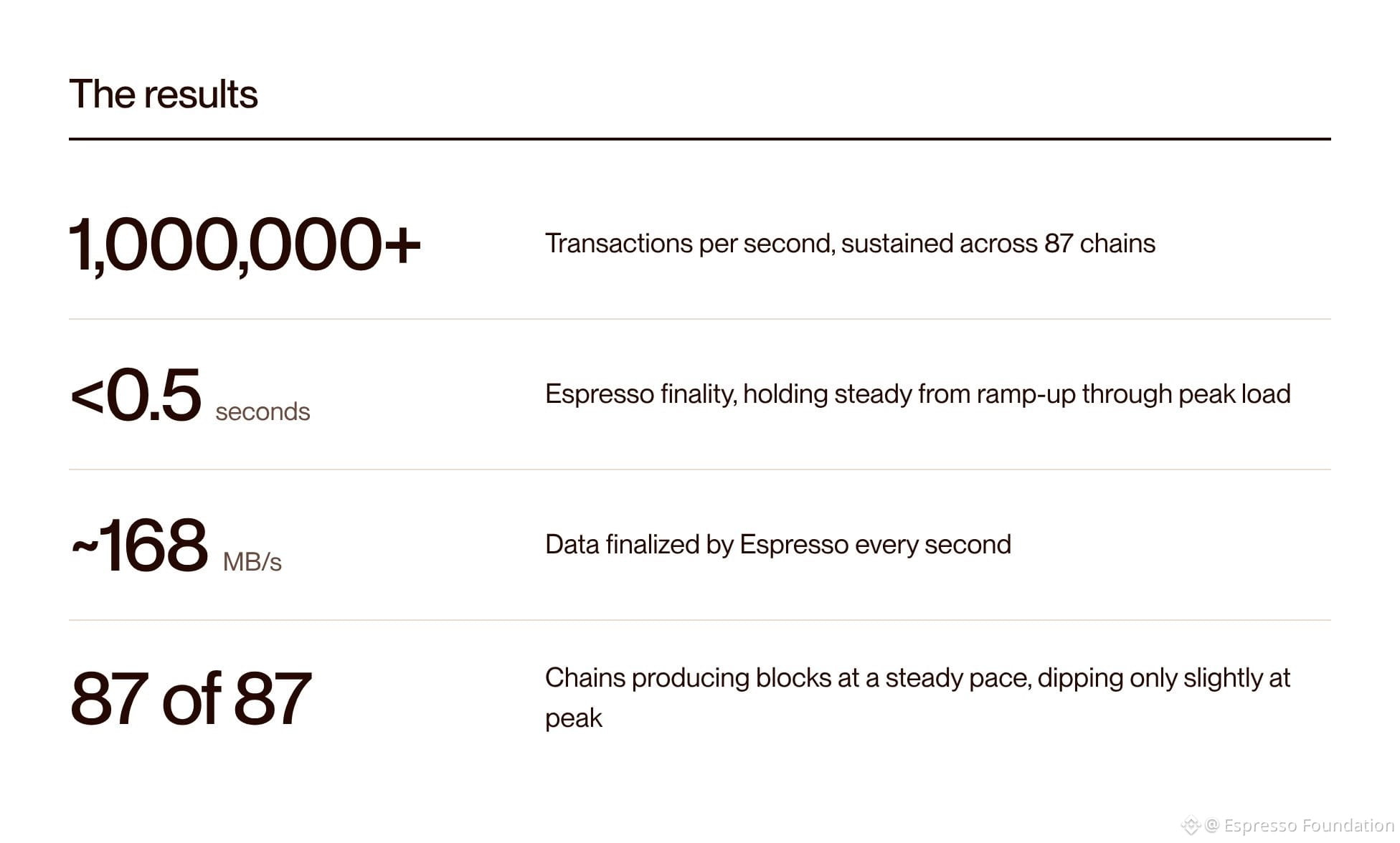
On a 100-node devnet built to mirror mainnet, with simulated global network delays, the team stood up 87 independent chains, each running its own sequencer and Besu execution client, and had them all send ERC-20 transfers to Espresso at the same time. Results from the run:
• 1M+ TPS sustained across all 87 chains
• Finality under 0.5 seconds, holding steady from ramp-up through peak load
• Roughly 168 MB/s of data finalized every second, below the 181 MB/s previously measured
• All 87 chains kept producing blocks at a steady pace
To confirm the data was usable and not just fast, a separate full node with no connection to its chain’s sequencer rebuilt that chain’s state entirely from Espresso-finalized data. It stayed within a few blocks for the entire run.
Why this matters: AI agents are expected to push transaction volume sharply higher, while compliance data and privacy proofs will make each transaction larger. Settlement infrastructure has to keep finality fast as that pressure builds, and this benchmark shows Espresso’s finality holding steady at more than a million transactions per second.
Full methodology, hardware and measurement details are in the article on the Espresso X account. Which use case do you expect to need this kind of capacity first: payments, tokenized assets or AI agents?
https://x.com/EspressoSys/status/2123471820825169946
$ESP
#Espresso #Blockchain #RealTimeSettlement