$XAUT: Intention vs. Impulse in Tight Ranges
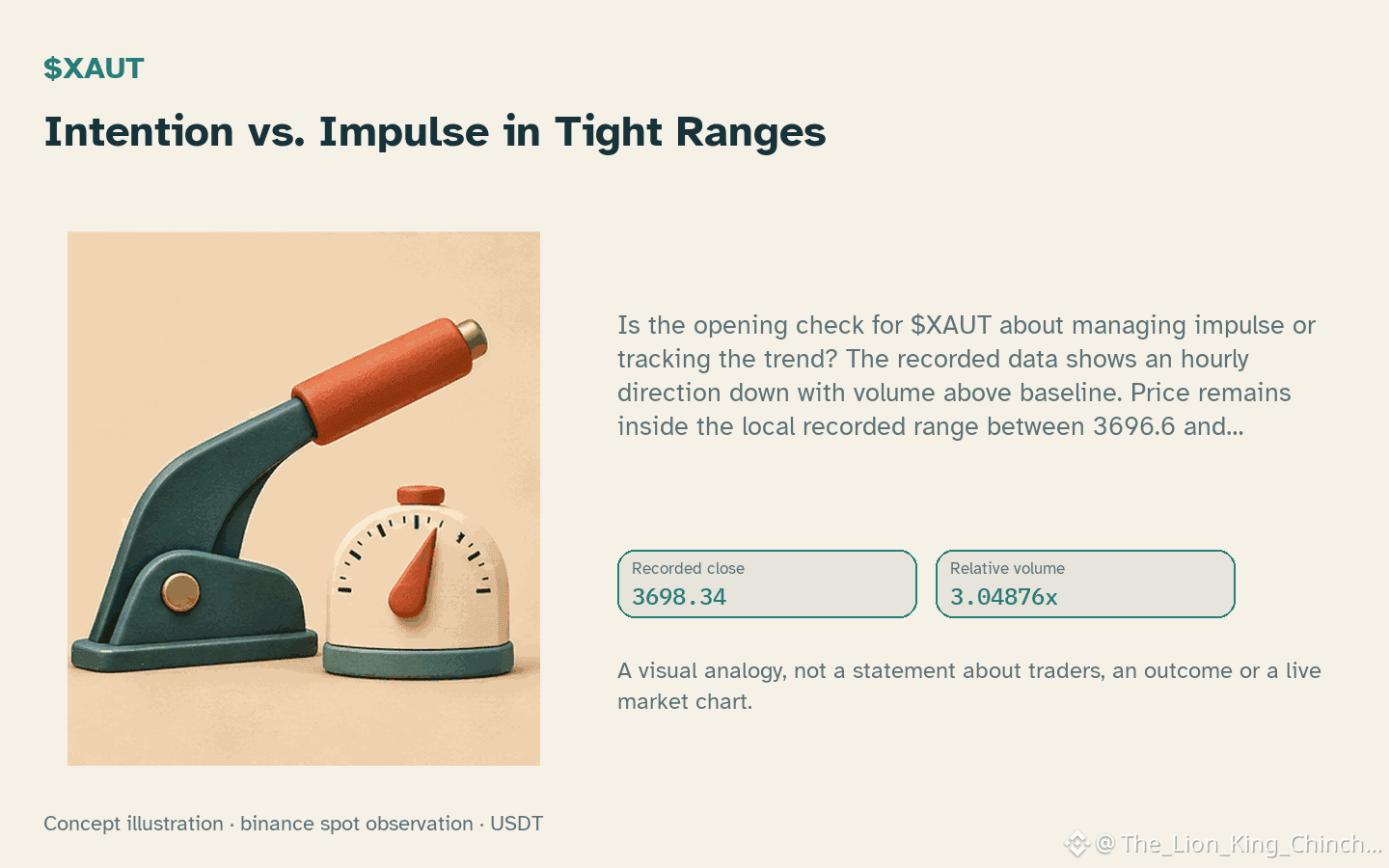
Is the opening check for $XAUT about managing impulse or tracking the trend? The recorded data shows an hourly direction down with volume above baseline. Price remains inside the local recorded range between 3696.6 and 3732.35. This creates a hypothesis of consolidation that needs validation, not immediate action.
Pre-session intention setting is a hypothetical mechanism. Imagine a trader deciding to watch for a confirmed break rather than reacting to the first candle. The trade-off here is entry quality versus chasing. If the price stays within the range, acting impulsively based on the hourly down move risks poor timing. Waiting for the close of a candle outside the range improves certainty. This approach acknowledges that current indicators are descriptive, not predictive. RSI sits at 33.5, which confirms momentum but does not signal a reversal on its own.
The analogy fails when traders treat the range as a guarantee. A counterexample is a breakout that fails immediately, trapping early entrants. The self-check is simple: did you define the invalidation point before entering? If the answer is no, the intention was unclear. Relative volume is 3.05x baseline, showing activity but not direction. The measured movement is an hourly change of -0.226345%. These facts describe the observed window, not future potential. To reassess this interpretation, look for the next closed hourly candle. If it closes inside the range, the consolidation hypothesis remains valid. If it closes outside, the initial intention to wait for confirmation was rewarded. If it closes on the opposite side of the entry, the invalidation level was breached. Use these conditions to distinguish observation from intent.
Probabilistic market research, not a recommendation or guaranteed return.
#XAUT