

When testing new Layer 1 networks, most users only care about whether a transaction can be sent or a faucet can be claimed. But as a QA tester, the real value lies in testing the infrastructure that developers will actually use.
In this report, I tested the BOT Chain Testnet (Bohr) using Foundry. The goal was simple: deploy a smart contract, send a write transaction, and read the state back via the public RPC. The network feels fast, and deployment works. However, I found critical desync issues between the public RPC endpoint and the block explorer that could severely impact automated scripts.
The Testing Process
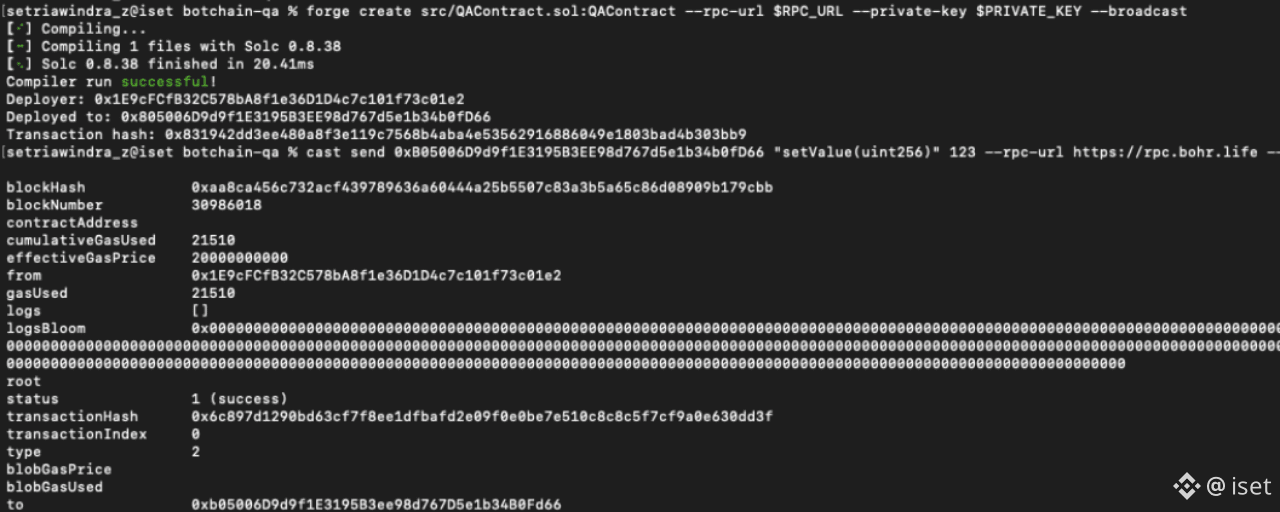
I configured the BOT Chain Testnet (Chain ID 968) using Foundry. I deployed a basic QAContract.sol via forge create. The deployment succeeded, using 211510 gas. I then used cast send to write data to the contract (setValue(123)). The terminal confirmed the transaction with status 1 (success).
So far, the network performed well.
Finding 1: Explorer UI Data Parsing Bug
After sending the transaction, I checked the block explorer at scan.bohr.life. The transaction status was marked as Finalized. But looking at the Blockchain Info tab, the "Gas Used" displayed 0. My terminal recorded 211510 gas. The explorer failed to parse the gas data for this specific contract interaction. While not a critical failure, it shows a flaw in the indexer UI, which could confuse users trying to track their gas usage.
Finding 2: Critical RPC State Desync
The bigger issue occurred when I tried to read the state. I ran cast call to check the value stored in the contract. The error was: "contract does not have any code".
I then tried to verify the transaction hash directly via cast tx. The error was: "tx not found".
This is a severe issue. The explorer, which acts as the user-facing indexer, showed the transaction as Finalized. But the public RPC node (rpc.bohr.life), which developers use to read data and build automated scripts, claimed that neither the transaction nor the contract existed.
This indicates a state lag or indexer desync. The RPC node is not synced with the block production or the explorer's database. In a testnet environment, this happens. But for developers testing dApps, this breaks everything. If a script relies on the public RPC to read the state after a transaction, it will fail silently.
Why This Matters
A blockchain is only as good as the tools that read it. If the public RPC endpoint lags behind the blocks, developers cannot verify if their logic is working. BOT Chain documentation specifies a minimum priority fee of 20 gwei, and the EVM compatibility is solid. But the public infrastructure layer needs immediate attention.
Recommendations for the BOT Chain Team
Check the Blockscout indexer configuration for gas calculation on contract interactions.
Investigate the RPC node sync status. Public RPC nodes must be in sync with block production. Running an archive node or improving the load balancer for the public RPC could fix this.
Provide a status page for RPC endpoint health.
Conclusion
BOT Chain has the potential to be a solid EVM-compatible environment. Deployment is smooth, and the gas fees are reasonable. But for QA testers and developers, infrastructure reliability is everything.
You can review the full smart contract and QA report in my GitHub repository here:
https://github.com/setriawindraz/botchain-qa