
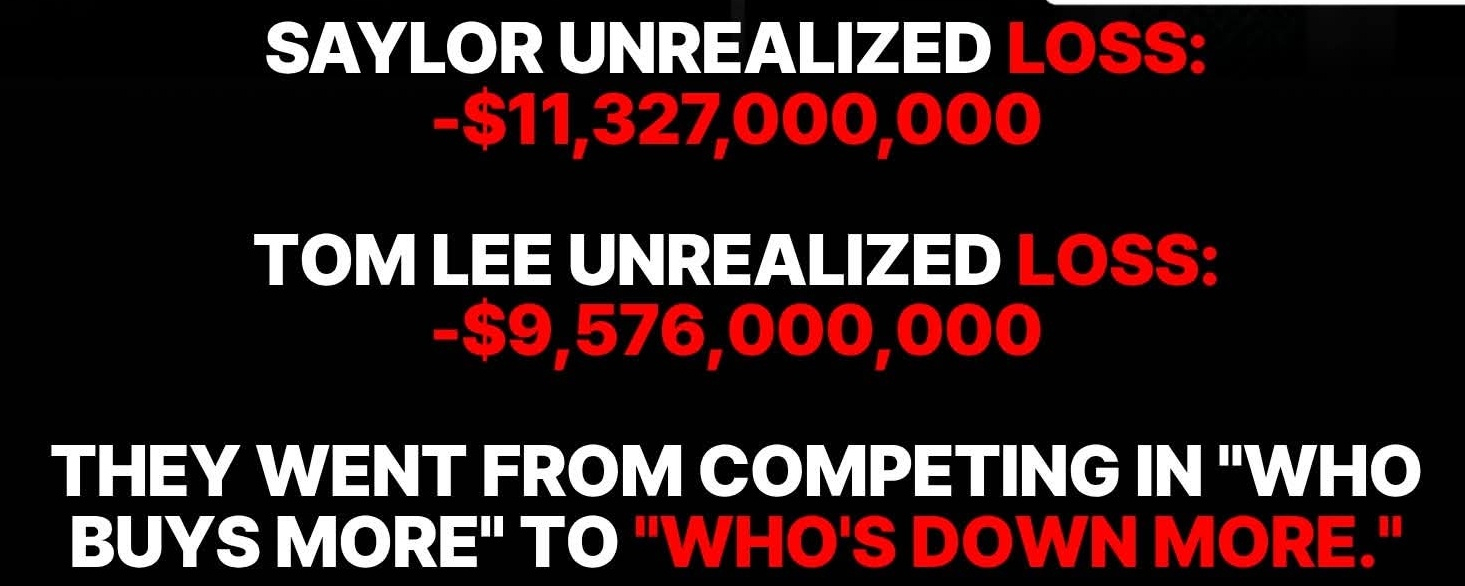

They Were Competing to Buy More Crypto. Now They're Competing With Billions in Paper Losses.
Michael Saylor and Tom Lee have become two of the most closely watched names in the corporate crypto investment world.
One is building an enormous Bitcoin treasury.
The other is accumulating Ethereum on a massive scale.
But the recent market decline has changed the conversation.
The numbers circulating online show:
Michael Saylor: -$11.327 billion in unrealized losses.
Tom Lee: -$9.576 billion in unrealized losses.
Those figures represent the reported paper-loss estimates in the circulating comparison, not confirmed realized losses.
And here's what makes this situation particularly interesting.
Neither investment strategy is simply disappearing because the market has turned against them.
Let's look at what these companies are actually doing.
1. Michael Saylor's Bitcoin Strategy
Saylor's company, Strategy, has accumulated hundreds of thousands of Bitcoin.
As of November 15, the company held 850,849 BTC, acquired at an average cost of approximately $75,452 per coin.
When Bitcoin trades below that average, the market value of the company's holdings falls below its acquisition cost.
But instead of abandoning its strategy, Strategy purchased another 485 BTC for approximately $33.4 million during the week of November 9–15.
That's a significant decision during a period of market weakness.
2. Tom Lee's Ethereum Strategy
Tom Lee is taking a similar long-term approach through BitMine.
The company held more than 6.07 million ETH as of November 16.
That's approximately 4.97% of Ethereum's total supply.
Even during the recent decline, BitMine added another 7,653 ETH.
Lee has argued that Ethereum's falling price does not necessarily reflect the developments taking place across its underlying network.
His investment thesis is built around the potential long-term growth of Ethereum infrastructure, institutional adoption, and tokenization.
3. Why Aren't They Simply Selling Everything?
This is where investment strategy becomes important.
Both companies are following treasury strategies built around their respective cryptocurrencies.
Their management teams appear to believe that the long-term potential of these assets justifies holding through substantial price volatility.
But there is a difference between believing in an asset and having the financial ability to hold it through a prolonged downturn.
A company must also manage liquidity, financing costs, debt obligations, shareholder expectations, and operating expenses.
A falling crypto price can create pressure even when no coins are sold.
4. The Real Meaning of a Billion-Dollar Paper Loss
Imagine buying an asset for $100 million.
Its market value later falls to $75 million.
You now have a $25 million decline in the value of your investment.
But if you haven't sold, you haven't locked in that $25 million loss through a sale.
That's the basic difference between an unrealized and realized loss.
However, paper losses are not meaningless.
They can reduce the value of corporate assets, affect investor confidence, make future fundraising more difficult, and increase financial pressure.
If prices recover, those unrealized losses can shrink.
If prices fall further, they can become even larger.
5. There's One More Thing Investors Should Watch.
Buying more during a decline lowers the average purchase cost only when the new purchases are made below the existing average.
But it also increases the amount of capital exposed to the same asset.
That's why continuing to buy during a downturn isn't automatically proof of financial strength or a guarantee of future success.
It is a strategy that depends on liquidity, funding access, time horizon, and the ability to withstand further declines.
My observation is that these two companies are demonstrating something important about the difference between short-term market prices and long-term investment conviction.
But conviction alone doesn't eliminate risk.
And billions of dollars in unrealized losses should never be dismissed simply because an investor refuses to sell.
The real test of a long-term strategy isn't how confidently someone buys during a bull market. It's whether the balance sheet can survive the bear market too.