
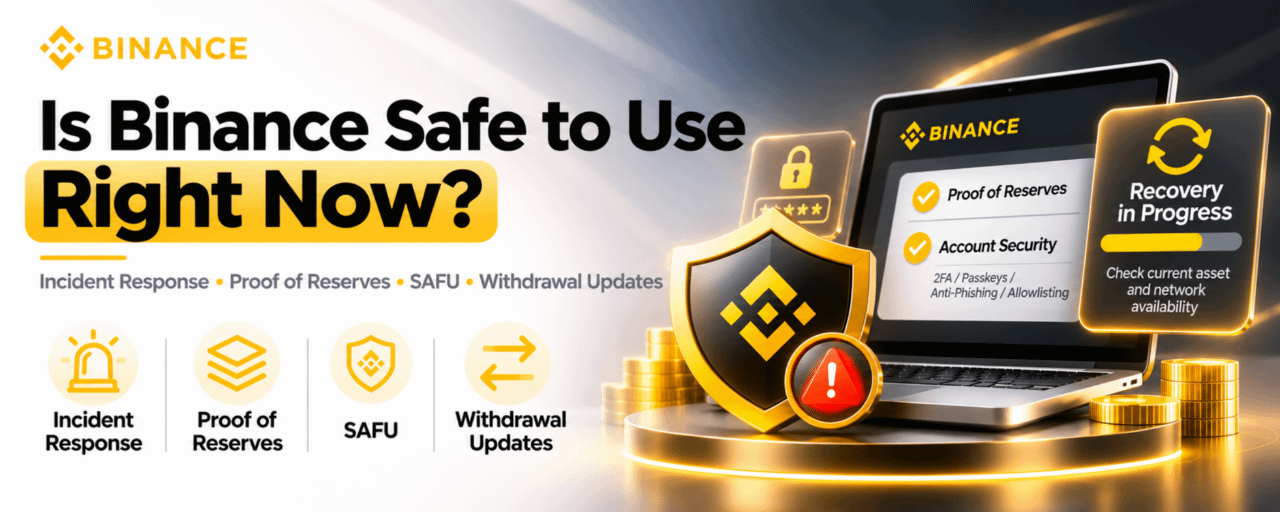

Is Binance safe to use right now? The answer requires looking beyond the exchange's reputation or its latest security announcement.
Following a major security incident on October 29, 2026, Binance has announced that it has covered the affected assets using company resources, published an updated Proof of Reserves snapshot, and continued restoring withdrawal services.
As of November 19, Binance has made significant progress in its recovery. However, users should not assume that every withdrawal route is already available or that the incident has eliminated all security risks. The practical approach is to review the exchange's latest operational updates, verify your own balance, and strengthen your account security.
Is Binance Safe to Use Right Now?
Binance remains operational, but the recent incident makes it important to evaluate its current security and withdrawal conditions carefully.
On October 29, 2026, Binance experienced a security breach involving unauthorized transactions from its hot wallet infrastructure. Approximately US$6.34 billion in digital assets were affected.
Binance subsequently announced that it would absorb the financial impact rather than pass the losses to users. On November 12, the exchange confirmed that it had completed coverage of the affected assets and published a new Proof of Reserves snapshot.
There is an important distinction, though: covering the affected assets does not automatically mean that every withdrawal service has returned to normal.
Binance has been restoring withdrawals in phases. A November 14 update reported that 87 networks had reopened, with the remaining networks and assets targeted for restoration the following week. Users should still check the availability of their specific asset and network before initiating a transfer.
In other words, Binance's recovery has made substantial progress, but users should continue monitoring operational updates rather than assuming every service is fully restored.
What Happened — and What Was Affected?
The October 29 incident involved unauthorized access to an internal wallet transaction signing service.
According to Binance's initial findings, attackers exploited access to the signing infrastructure to initiate transactions outside the normal withdrawal process. The incident affected approximately US$6.34 billion in digital assets across multiple networks.
Binance reported that the attack involved sophisticated techniques, including social engineering, compromised devices, internal tooling, and unauthorized transaction authorizations.
The exchange also stated that its investigation found no evidence that wallet private keys had been leaked at the time of its initial report.
Several operational measures followed:
Binance temporarily suspended withdrawals while investigating the incident and securing affected infrastructure.
The exchange worked with law enforcement, blockchain intelligence firms, asset issuers, and industry partners to trace and freeze affected assets.
Systems involved in the attack path were rebuilt or replaced.
Additional device controls, wallet-service risk controls, and AI-based behavioral anomaly detection were introduced.
The incident demonstrates why exchange security involves more than protecting private keys. Internal access controls, transaction authorization systems, employee devices, and operational procedures also matter.
Official update: https://www.binance.com/en/blog/community/3229153443759566763
How Swiftly Binance Took Action to Help Users / Keep Communications Transparent
After the incident, Binance announced that it would cover the financial impact of the stolen assets rather than pass those losses to customers.
On November 12, Binance confirmed that it had completed coverage of the affected assets, committing more than US$6.34 billion in company resources through a combination of its corporate treasury, a partial deployment of SAFU, and a portion of its Futures insurance fund.
The exchange also published a new Proof of Reserves snapshot taken on November 12, covering 198 tokens. Binance stated that users holding the affected assets would be able to independently verify that their balances were backed at a minimum of 1:1 once the full zero-knowledge proof was generated.
However, asset replacement and asset recovery are two different processes.
Replacing the affected assets addresses the backing of customer balances. Recovering stolen cryptocurrency involves tracing and attempting to retrieve assets that were transferred to attacker-controlled addresses.
Binance has continued working with relevant authorities and industry partners on the latter.
The exchange also announced that it would replenish SAFU to approximately US$1 billion after using part of the fund during the incident.
These announcements provide useful information about Binance's response. Still, users should distinguish between actions already completed, commitments made by the company, and recovery targets that remain in progress.
Official update: https://www.binance.com/en/support/announcement/detail/0729ad59cde74700b4eaa96c33441e71
How Are User Funds Protected on Binance?
Binance uses several mechanisms intended to support the protection and transparency of customer assets. Three areas are particularly relevant when evaluating the platform.
1. Proof of Reserves (PoR)
Proof of Reserves allows users to examine whether their account balances are included in a particular reserve snapshot.
Binance uses cryptographic verification methods, including Merkle Trees and zk-SNARKs, to support independent balance verification.
However, PoR should not be treated as a complete financial audit or a guarantee against every possible operational or security incident. It represents information associated with a specific snapshot.
2. Secure Asset Fund for Users (SAFU)
SAFU is Binance's emergency protection fund, established to help protect users in qualifying extreme situations.
Following the October incident, Binance confirmed that part of SAFU had been deployed alongside other company resources to cover affected assets. The exchange committed to replenishing the fund to approximately US$1 billion.
SAFU is an additional protection mechanism, not universal insurance covering every possible trading loss or account-related problem.
3. Account and platform security
Binance also provides account protection features such as two-factor authentication, passkeys, anti-phishing codes, and withdrawal address allowlisting.
These tools can help reduce the risk of unauthorized account access, but users still need to configure them properly and protect their own devices and login credentials.
What Is SAFU and When Does It Apply?
The Secure Asset Fund for Users is an emergency reserve established by Binance in 2018.
Its purpose is to provide an additional layer of protection for users in qualifying extreme situations. It should not be confused with Proof of Reserves.
The difference is straightforward:
Proof of Reserves provides information that helps users verify whether their balances are included in a reserve snapshot.
SAFU is an emergency fund intended to provide protection in qualifying circumstances.
Following the October 2026 incident, Binance announced that it had used part of SAFU alongside corporate resources and other funds to cover the affected assets. It also committed to replenishing SAFU to approximately US$1 billion.
Users should remember that SAFU is not a guarantee against every type of loss, including market volatility, unsuccessful trades, or every form of account compromise.
How Can I Verify My Own Balance Is Backed?
Rather than relying only on an exchange-wide reserve announcement, users can check whether their individual account balance appears in Binance's Proof of Reserves verification records.
Here is a practical way to do it:
Log in to your Binance account through the official website or application.
Navigate to Wallet → Verification.
Select an available Proof of Reserves snapshot.
Check the verification method, which may include Merkle Tree and zk-SNARKs.
Review your personal verification record, including the Record ID, covered assets, recorded balance, and snapshot date.
If you want to perform an independent check, download the available Merkle Tree data and follow Binance's official verification instructions.
One detail deserves attention: the snapshot date matters.
Your verification record reflects the balance captured at a particular point in time. A deposit made after that snapshot will not automatically appear in the earlier report.
A successful verification provides evidence that your recorded balance was included in that specific snapshot. It does not prove that withdrawals will always be available or that the exchange has no other financial or operational risks.
Useful resources:
Verify Your Account Balance: https://www.binance.com/en/support/faq/detail/815b25f0cb054bdd9d35eccc408fe981
Binance Proof of Reserves: https://www.binance.com/en/proof-of-reserves
What Should I Do to Secure My Own Account?
Exchange-level security measures are only part of the picture. Users also have a responsibility to protect their accounts.
Consider these practical steps:
Enable two-factor authentication or passkeys.
Set up an anti-phishing code to help identify genuine Binance communications.
Use withdrawal address allowlisting where appropriate.
Review your active devices and recent login activity.
Never share passwords, verification codes, or account credentials.
Access Binance through its official website or application.
Before withdrawing, confirm that the selected asset and network are supported and available.
Consider testing a withdrawal with a small amount before transferring a larger balance.
It is also worth reviewing how much cryptocurrency you actually need to keep on an exchange. Funds used for active trading and long-term holdings may require different custody approaches.
Self-custody can provide greater control over private keys, but it also introduces responsibilities. Losing access to a recovery phrase or signing a malicious transaction can result in irreversible losses.
Final Thoughts: Should You Continue Using Binance?
Binance has taken substantial steps following the October 29 security incident. It announced that the affected assets had been covered, published a new Proof of Reserves snapshot, and continued restoring withdrawal services.
These are meaningful recovery measures, but they should not be interpreted as proof that every risk has disappeared.
Before using Binance, check the current status of the asset and network you intend to withdraw, review your own Proof of Reserves verification record, and make sure your account security settings are properly configured.
Ultimately, the better question is not simply whether Binance is safe. It is whether you understand the protections available, the limitations that remain, and the steps you can take to manage your own exposure.
A transparent exchange should provide ways to verify its claims. A careful user should take the time to check them.
Disclaimer: This article is for educational and informational purposes only. Cryptocurrency trading and custody involve risks, including security incidents, operational disruptions, and market volatility. Always verify current service availability and conduct your own research before making financial decisions.