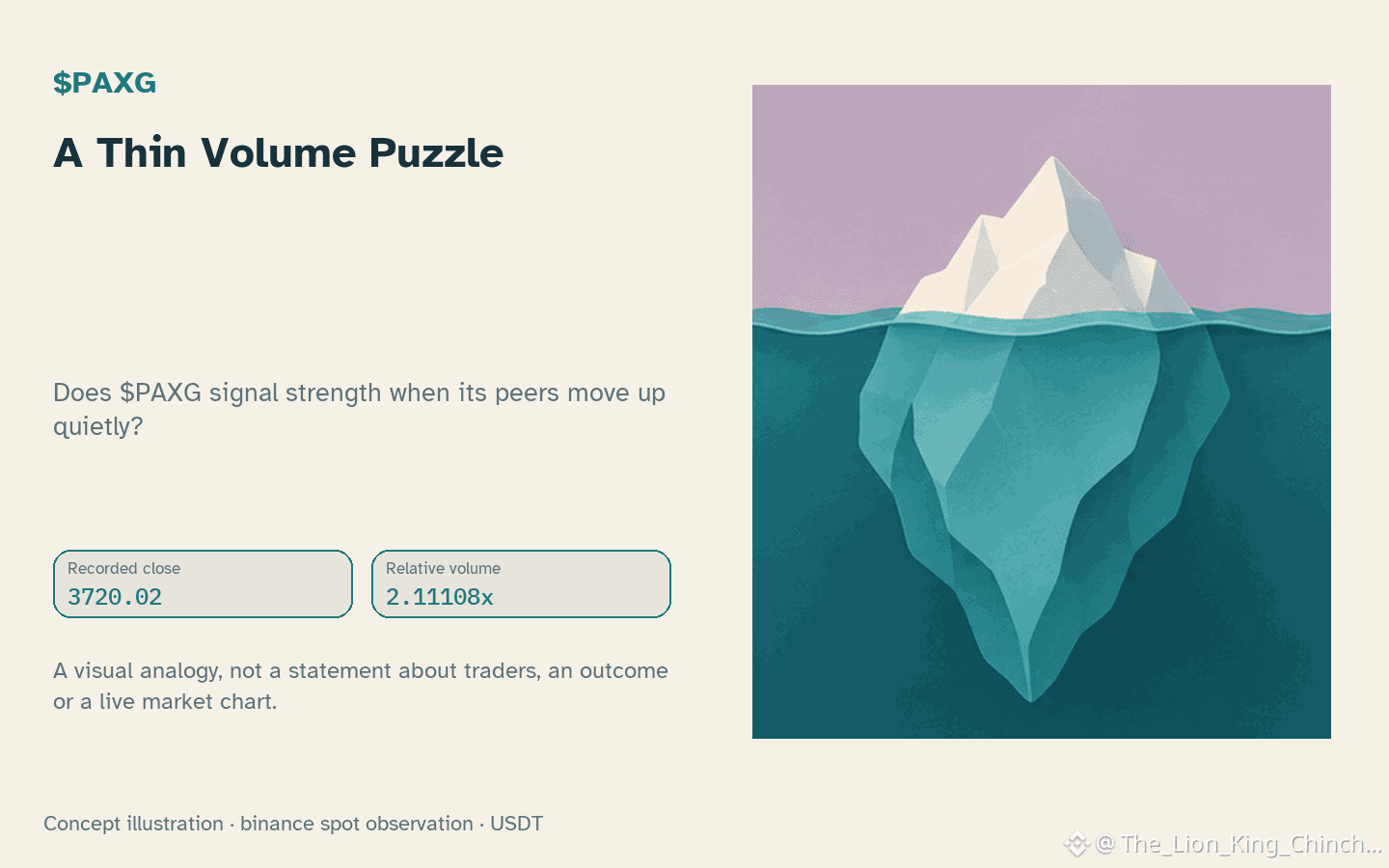
$PAXG: A Thin Volume Puzzle
Does $PAXG signal strength when its peers move up quietly?
A hypothetical trader sees $PAXG rising with relative volume 2.11x baseline. Meanwhile, $BTC and $LUNC also move up, but their volume is not above baseline. The trader asks if high volume confirms a trend.
This analogy helps isolate participation. If $PAXG shows sustained upward price action supported by higher volume, it suggests more market interest in that specific asset at that moment. The others show price movement without that extra participation data.
However, the analogy fails immediately. Shared direction is not measured correlation. It does not prove capital rotation or a common cause. $BTC and $LUNC move up, but without elevated volume, they lack the participation signal. A counterexample is a coin rising due to a brief liquidity pull rather than genuine demand. This shows volume context matters.
The RSI reading 45.8 provides a secondary check on momentum. If $PAXG remains above its EMA 3724.73 while volume persists, the hypothesis gains weight. But one candle does not prove a trend.
To reassess, wait for the next closed candle. If volume returns to baseline while price stalls, the participation divergence narrative weakens. Conversely, if price consolidates with steady volume, the initial expansion might be noise. This conditional check prevents mistaking temporary spikes for structural shifts.
Probabilistic market research, not a recommendation or guaranteed return.
The comparison to keep in mind: $BTC has hourly direction up and volume not above its baseline; $LUNC has hourly direction up and volume not above its baseline. This alone does not establish correlation.
#PAXG #BTC #LUNC